
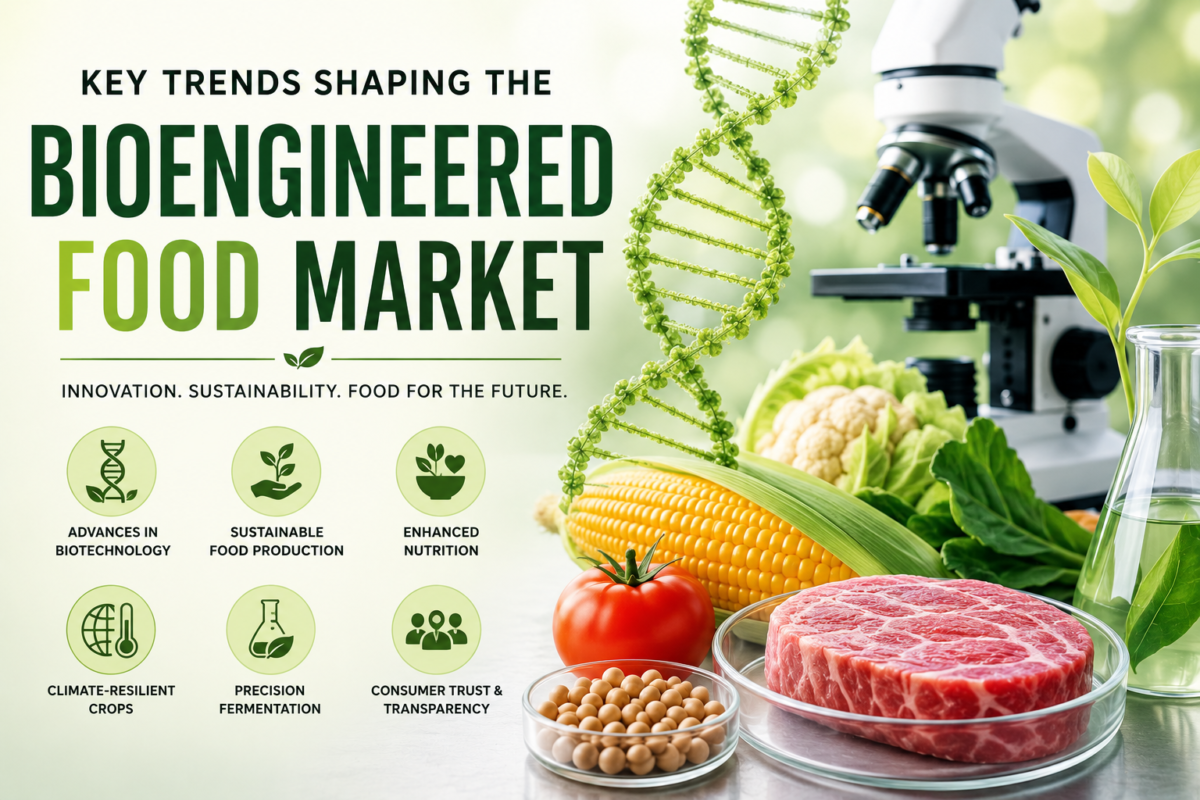
The bioengineered food market is experiencing significant growth as advances in biotechnology, food science, and sustainable agriculture transform the global food industry. Bioengineered foods are developed using modern genetic techniques to enhance nutrition, improve crop resilience, increase yields, and reduce environmental impact.
As food security and sustainability become global priorities, bioengineered foods are emerging as a key innovation area.
Here are the major trends shaping the bioengineered food market in 2026.
1. Growing Focus on Food Security
With the global population continuing to rise, food producers are seeking innovative ways to improve agricultural productivity.
Key Drivers:
- Increasing global food demand
- Climate-related crop challenges
- Limited agricultural land availability
- Need for higher crop yields
Bioengineered crops are helping improve food availability while reducing resource consumption.
2. Development of Climate-Resilient Crops
Climate change is accelerating demand for crops that can withstand extreme environmental conditions.
Emerging Innovations:
- Drought-resistant crops
- Heat-tolerant plant varieties
- Pest-resistant bioengineered crops
- Disease-resistant agricultural products
These innovations are helping farmers improve productivity in challenging environments.
3. Enhanced Nutritional Profiles
Food manufacturers are increasingly using biotechnology to improve nutritional value.
Examples Include:
- Vitamin-enriched crops
- Improved protein content
- Enhanced amino acid profiles
- Functional food ingredients
Bioengineering is enabling the development of foods with greater health benefits.
4. Expansion of Plant-Based & Alternative Proteins
Alternative protein production is becoming a major growth area.
High-Growth Segments:
- Bioengineered plant proteins
- Precision fermentation ingredients
- Alternative dairy proteins
- Sustainable protein sources
These technologies are helping meet rising demand for sustainable nutrition.
5. Advances in Precision Fermentation
Precision fermentation is transforming food manufacturing.
Applications:
- Animal-free dairy proteins
- Functional food ingredients
- Sustainable sweeteners
- Novel food compounds
This technology allows manufacturers to create ingredients with greater efficiency and consistency.
6. Increased Investment in Sustainable Food Production
Investors are actively supporting food biotechnology innovation.
Key Focus Areas:
- Sustainable agriculture
- Resource-efficient food systems
- Carbon footprint reduction
- Circular food economy solutions
Funding is accelerating commercialization across the sector.
7. Regulatory Evolution & Consumer Transparency
Governments worldwide are developing frameworks for bioengineered foods.
Key Trends:
- Clearer labeling requirements
- Enhanced food safety assessments
- Increased consumer education
- Greater transparency initiatives
Building consumer trust remains a priority for industry participants.
8. AI & Biotechnology Convergence
Artificial intelligence is helping accelerate food innovation.
Emerging Applications:
- Crop trait optimization
- Ingredient discovery
- Food formulation development
- Agricultural research acceleration
AI is becoming an important tool in bioengineered food development.
Market Outlook: Bioengineered Food Industry
The bioengineered food market is expected to grow steadily due to:
- Rising global food demand
- Sustainability initiatives
- Agricultural productivity needs
- Growth of alternative proteins
- Advances in biotechnology
The sector is positioned to play a major role in addressing future food system challenges.
The bioengineered food market is entering a period of rapid innovation driven by sustainability, nutrition, and food security priorities. Technologies such as genetic engineering, precision fermentation, and AI-assisted food development are reshaping how food is produced and consumed.
As global demand for efficient and sustainable food systems increases, bioengineered foods are expected to become an increasingly important part of the future food landscape.