
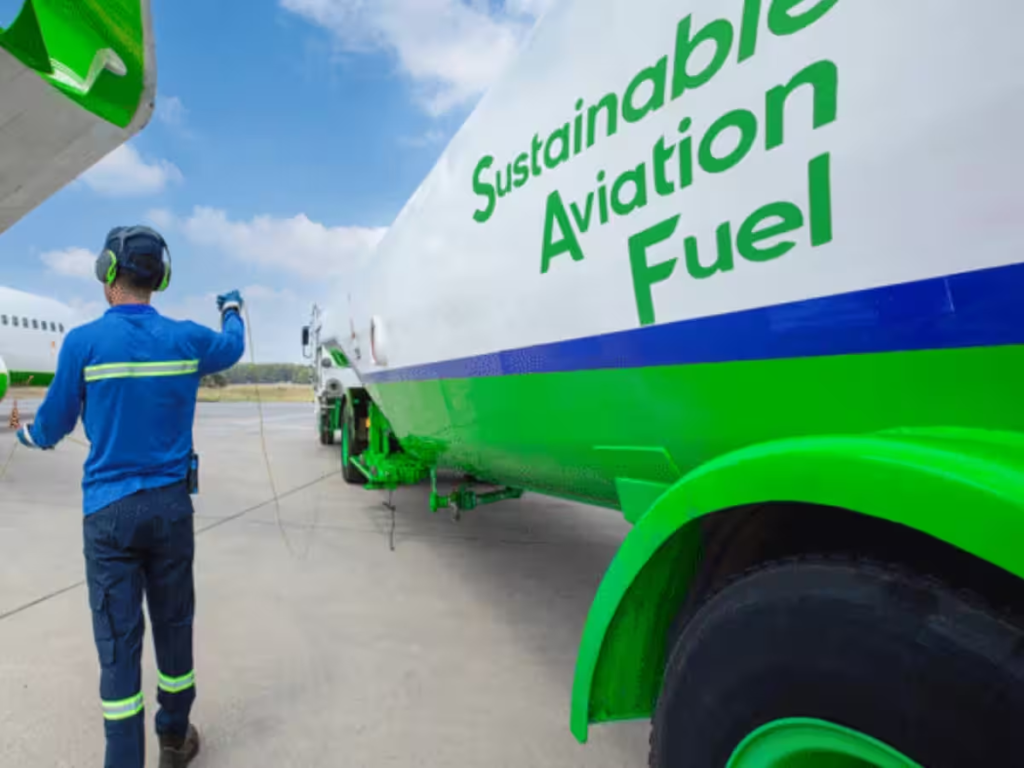
Aviation is one of the hardest sectors to decarbonize.
Electric aircraft may work for short-distance travel, while hydrogen could play a role in selected future aircraft. But for long-haul aviation, liquid fuel is likely to remain essential for decades.
That is why Sustainable Aviation Fuel (SAF) has become one of the most important technologies in aviation’s transition toward lower emissions.
According to Stratistics MRC, the Global Sustainable Aviation Fuel (SAF) Market is accounted for $3.5 billion in 2026 and is expected to reach $71.7 billion by 2034 growing at a CAGR of 45.4% during the forecast period.
SAF can be produced from waste oils, biomass, municipal waste, alcohols, and eventually renewable electricity combined with captured carbon. It can also be blended with conventional jet fuel and used in existing aircraft and airport infrastructure.
The challenge is scale.
According to IATA, global SAF production is expected to reach around 2.4 million tonnes in 2026, representing only about 0.8% of total aviation fuel consumption. IATA estimates that roughly 500 million tonnes could be required annually by 2050 for aviation to achieve its net-zero pathway. IATA
So the future of SAF will depend less on whether the technology works and more on whether the industry can produce it affordably, sustainably, and at enormous scale.
Why Sustainable Aviation Fuel Matters
Aircraft require fuels with extremely high energy density.
This makes aviation much harder to electrify than passenger cars.
SAF offers an important advantage because it can potentially reduce lifecycle emissions while remaining compatible with much of today’s aviation ecosystem.
Depending on the production pathway, SAF may be created from:
- Used cooking oil
- Agricultural residues
- Forestry waste
- Municipal waste
- Alcohol-based feedstocks
- Renewable hydrogen
- Captured carbon dioxide
ICAO defines SAF under CORSIA as renewable or waste-derived aviation fuel that meets specific sustainability criteria. ICAO
This creates an opportunity to reduce emissions without immediately replacing the global aircraft fleet.
SAF Production Is Growing, but Still Too Slowly
The SAF industry has expanded quickly from a very small base.
IATA estimates production increased from around 1 million tonnes in 2024 to 1.9 million tonnes in 2025, with approximately 2.4 million tonnes expected in 2026. IATA
However, growth is beginning to slow.
Even at 2.4 million tonnes, SAF would account for less than 1% of global aviation fuel demand in 2026. IATA
This highlights the enormous production gap between current supply and long-term requirements.
The industry therefore needs not just new SAF plants, but an entire ecosystem of:
- Feedstock suppliers
- Refining capacity
- Renewable electricity
- Hydrogen production
- Carbon capture
- Fuel certification
- Airport logistics
- Long-term airline purchasing agreements
HEFA Will Likely Lead in the Near Term
One of the most established SAF production routes is Hydroprocessed Esters and Fatty Acids, or HEFA.
HEFA typically uses waste oils, fats, and similar feedstocks.
Its advantage is commercial maturity.
The challenge is feedstock availability.
Waste oils and fats are also used in other industries, including renewable diesel production. As demand increases, competition for these raw materials could limit how much HEFA-based SAF can ultimately be produced.
This means HEFA may dominate early SAF growth, but other production technologies will be required for the industry to reach much larger volumes.
Alcohol-to-Jet Could Expand the Feedstock Base
Alcohol-to-Jet converts alcohols such as ethanol into aviation fuel.
This pathway could become important because ethanol production infrastructure already exists in many markets.
Potential feedstocks can include:
- Sugarcane
- Corn
- Agricultural residues
- Cellulosic biomass
Alcohol-to-Jet could therefore allow regions with established ethanol industries to participate more actively in SAF production.
However, lifecycle emissions and feedstock sustainability will remain important when evaluating different production routes.
E-SAF Could Become Critical After 2030
One of the most important future technologies is synthetic aviation fuel, often called e-SAF or Power-to-Liquid fuel.
Instead of relying primarily on biological feedstocks, e-SAF can be produced using:
- Renewable electricity
- Green hydrogen
- Captured carbon dioxide
- Synthetic fuel conversion
The major advantage is scalability without depending entirely on limited biomass resources.
The disadvantage is cost.
E-SAF requires large amounts of renewable electricity and green hydrogen, making production expensive today.
Even so, regulation is beginning to create demand.
The European Union’s ReFuelEU Aviation regulation requires SAF to represent 2% of aviation fuel supplied at EU airports from 2025, rising progressively to 70% by 2050. It also introduces a specific synthetic aviation fuel requirement beginning at 1.2% in 2030 and reaching 35% by 2050. Mobility and Transport
This could make Europe one of the most important early markets for e-SAF.
Cost Remains the Biggest Challenge
SAF remains significantly more expensive than conventional jet fuel.
IATA has reported that SAF prices can be roughly twice fossil jet fuel levels and substantially higher in some mandated markets. IATA
That cost difference matters because fuel is already one of the largest operating expenses for airlines.
Without incentives, mandates, tax credits, or long-term purchasing agreements, airlines may struggle to absorb the additional cost.
The future SAF market will therefore depend heavily on government policy.
Government Mandates Will Shape the Market
Unlike many emerging technologies, SAF demand may increasingly be policy-driven.
Governments are introducing:
- SAF blending mandates
- Production tax incentives
- Carbon pricing
- Airport fuel requirements
- Emissions reduction programs
- Public investment in new SAF plants
The European Union is already moving toward progressively higher SAF blending requirements.
ICAO’s CORSIA framework also allows eligible SAF to contribute toward reducing airlines’ offsetting obligations, provided fuels meet approved sustainability and certification requirements. ICAO
Policy stability will be critical because SAF facilities require large upfront investments and long development timelines.
Feedstock Competition Could Become a Major Constraint
SAF production depends heavily on sustainable feedstocks.
But many potential feedstocks are already used elsewhere.
Waste oils, biomass, renewable electricity, and hydrogen may also be required for:
- Road transport
- Chemicals
- Shipping
- Power generation
- Industrial decarbonization
This creates competition.
The aviation sector will therefore need to demonstrate that scarce low-carbon resources should be prioritized for aviation because alternatives such as direct electrification are more difficult.
Feedstock availability could become one of the defining issues shaping the future SAF market.
Asia Could Become a Major SAF Growth Region
Europe and North America are currently leading much of the SAF policy discussion, but Asia represents a major long-term opportunity.
Large aviation markets including:
- Japan
- Singapore
- South Korea
- China
- India
are increasingly exploring SAF production and adoption.
The region has significant airline traffic, refining infrastructure, biomass resources, and growing interest in aviation decarbonization.
As SAF mandates expand, Asia could become an important production and export hub.
What Could the SAF Market Look Like by 2035?
The SAF industry could look significantly different over the next decade.
Near-term supply is likely to remain dominated by bio-based SAF.
But the market may gradually diversify toward:
- Alcohol-to-Jet
- Fischer-Tropsch fuels
- Waste-derived fuels
- Synthetic e-SAF
- New feedstock pathways
At the same time, production may shift from isolated demonstration plants toward large commercial-scale facilities.
Successful companies will likely be those that secure:
- Low-cost feedstocks
- Renewable electricity
- Long-term airline contracts
- Government incentives
- Refining infrastructure
- Reliable certification
Key Opportunities in the SAF Value Chain
The future of SAF creates opportunities far beyond fuel producers.
Potential growth areas include:
- Sustainable feedstock development
- Green hydrogen
- Carbon capture
- SAF refining
- Renewable energy
- Airport infrastructure
- Fuel logistics
- Certification services
- Fuel testing
- Aviation carbon accounting
As SAF volumes increase, the supporting supply chain could become almost as important as the fuel itself.