
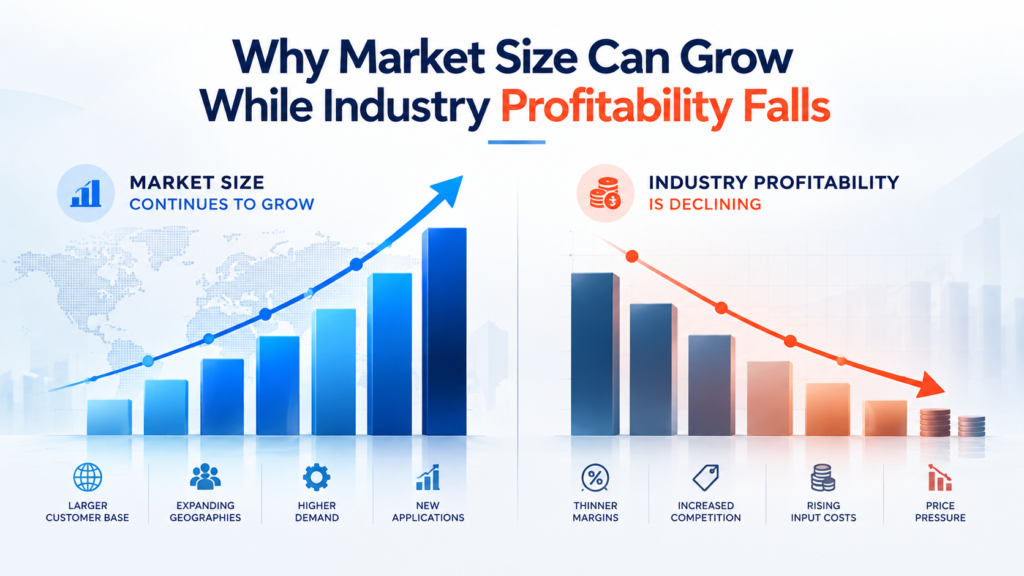
A growing market is usually seen as a positive sign.
If demand is increasing, revenues are rising, and more customers are entering the market, it seems logical to assume that companies operating in that industry should also become more profitable.
But that is not always what happens.
In many industries, market size can increase rapidly while profitability declines at the same time.
This can happen when competition intensifies, prices fall, input costs rise, capital requirements increase, or too many companies chase the same growth opportunity.
For investors, strategy teams, and market researchers, this distinction is important.
A large or fast-growing market does not automatically mean an attractive market.
Market Growth and Profitability Are Not the Same Thing
Market size usually measures the total value of products or services sold within a defined market.
Profitability measures how much value companies are actually able to retain after costs.
A market can grow because:
- More customers are buying
- Prices are increasing
- New applications are emerging
- Geographic adoption is expanding
- Technology penetration is rising
- Government incentives are supporting demand
But profitability depends on a different set of factors.
These include:
- Pricing power
- Production costs
- Competition
- Capital expenditure
- Distribution costs
- R&D spending
- Customer acquisition costs
- Regulatory expenses
This is why market growth alone does not tell the full story.
1. Competition Can Increase Faster Than Demand
One of the most common reasons profitability falls is increasing competition.
A fast-growing market attracts:
- New startups
- Established companies entering adjacent sectors
- International competitors
- Private equity investment
- Venture-funded challengers
If demand grows by 15%, but the number of serious competitors doubles, companies may be forced to reduce prices to protect market share.
Revenue may still increase across the industry, but profit margins can decline.
This is particularly common in technology-driven markets where companies prioritize growth over short-term profitability.
2. Price Competition Can Reduce Margins
A market can expand even while product prices fall.
Consider a technology product where adoption is increasing rapidly.
Unit sales may rise significantly, but competitors may continuously reduce prices.
This can happen because of:
- Manufacturing scale
- Cheaper components
- Aggressive market entry
- Product commoditization
- Discounting
- Lower-cost competitors
The total market may still grow because more units are being sold.
However, individual companies may earn less profit per unit.
This is why researchers should examine both market value growth and pricing trends.
3. Rising Costs Can Offset Revenue Growth
Companies may experience higher sales but also much higher operating costs.
Cost pressures can come from:
- Raw materials
- Energy
- Labor
- Logistics
- Components
- Financing
- Compliance
- Cybersecurity
- Insurance
If revenue grows by 10% but operating costs increase by 15%, profitability may decline.
This is especially important in manufacturing, energy, transportation, and capital-intensive industries.
Market growth therefore needs to be analyzed alongside cost structures.
4. High-Growth Markets Often Require Heavy Investment
Some of the fastest-growing industries require large amounts of capital.
Examples include:
- Semiconductor manufacturing
- Battery production
- Renewable energy
- Data centers
- Biotechnology
- Advanced manufacturing
Companies may need to invest heavily in:
- New factories
- Equipment
- R&D
- Talent
- Infrastructure
- Acquisitions
These investments may support future growth but reduce profitability in the short term.
A company can therefore increase revenue and market share while reporting lower operating margins.
This is why capital intensity matters when evaluating market attractiveness.
5. Growth Can Lead to Overcapacity
Strong demand forecasts often encourage companies to expand production.
But if too many companies expand at the same time, the industry can develop excess capacity.
This creates a cycle:
Strong demand → new investment → increased capacity → oversupply → lower prices → weaker profitability
The market itself may continue growing, but companies may struggle to generate strong returns.
This pattern is common in industries with large manufacturing investments.
6. Customer Acquisition Costs Can Rise
Growth markets often become more expensive to compete in.
As more companies target the same customers, businesses may spend more on:
- Advertising
- Sales teams
- Discounts
- Partnerships
- Incentives
- Distribution
This is particularly common in software, ecommerce, fintech, and consumer technology.
Revenue can continue to grow while customer acquisition becomes increasingly expensive.
The result is lower profitability even in a healthy market.
7. Buyers Can Gain More Negotiating Power
As markets mature, large customers may gain stronger bargaining power.
They may demand:
- Lower prices
- Longer payment terms
- Customization
- Free support
- Volume discounts
- Better service agreements
Suppliers may accept these conditions to protect contracts.
This can increase sales volume while reducing margins.
For B2B markets, customer concentration is therefore an important profitability indicator.
8. Technology Can Become Commoditized
Early in a technology cycle, only a few companies may offer a product.
This often allows higher prices and stronger margins.
As technology becomes widely available, differentiation declines.
Competitors begin offering similar products.
Customers then compare suppliers mainly on:
- Price
- Delivery
- Service
- Availability
The market may continue expanding rapidly, but profitability can fall as the product becomes commoditized.
9. Regulation Can Increase Market Size and Costs at the Same Time
Regulation can sometimes create new demand.
For example, new cybersecurity, environmental, safety, or compliance requirements may force companies to purchase new products and services.
This can expand the market.
However, companies supplying these products may also face higher costs from:
- Certification
- Reporting
- Testing
- Legal compliance
- Data protection
- Environmental standards
The overall market grows, but supplier profitability may not grow at the same pace.
Why This Matters in Market Research
When evaluating an industry, market size and CAGR are only part of the analysis.
Researchers should also examine:
- Operating margins
- Pricing trends
- Cost structures
- Competitive intensity
- Capital requirements
- Capacity expansion
- Customer concentration
- Supplier power
- Barriers to entry
This provides a more realistic view of whether market growth is translating into economic value.
A market growing at 20% annually may appear more attractive than one growing at 6%.
But if the faster-growing market has intense competition, falling prices, and heavy capital requirements, companies may generate weaker returns.
The slower-growing market may actually be more profitable.
Market Growth vs Market Attractiveness
This is an important distinction.
Market growth asks:
How quickly is demand increasing?
Market attractiveness asks:
How attractive is the market for companies operating in it?
Attractiveness depends on more than growth.
It also depends on:
- Profit margins
- Competitive pressure
- Customer power
- Supplier power
- Entry barriers
- Investment requirements
- Long-term pricing power
This is why frameworks such as competitive landscape analysis and Porter’s Five Forces remain useful when evaluating markets.