
Industrial automation has traditionally been built around precision, repetition, and predictability.
Robots are programmed to perform specific tasks, production lines are carefully engineered, and even small changes in products or layouts can require reprogramming.
According to Stratistics MRC, the Global Physical AI Market is accounted for $1.30 billion in 2026 and is expected to reach $27.15 billion by 2034 growing at a CAGR of 46.2% during the forecast period.
Physical AI could change that model.
Instead of machines simply following fixed instructions, physical AI combines artificial intelligence with robotics, sensors, control systems, and real-world decision-making. The goal is to create machines that can perceive their environment, understand changes, and respond more autonomously.
For manufacturers, this could shift automation from programmed systems to adaptable systems.
What Is Physical AI?
Physical AI refers to AI systems that can sense, reason, and act in the physical world.
In industrial environments, this can include:
- Robotic arms
- Autonomous mobile robots
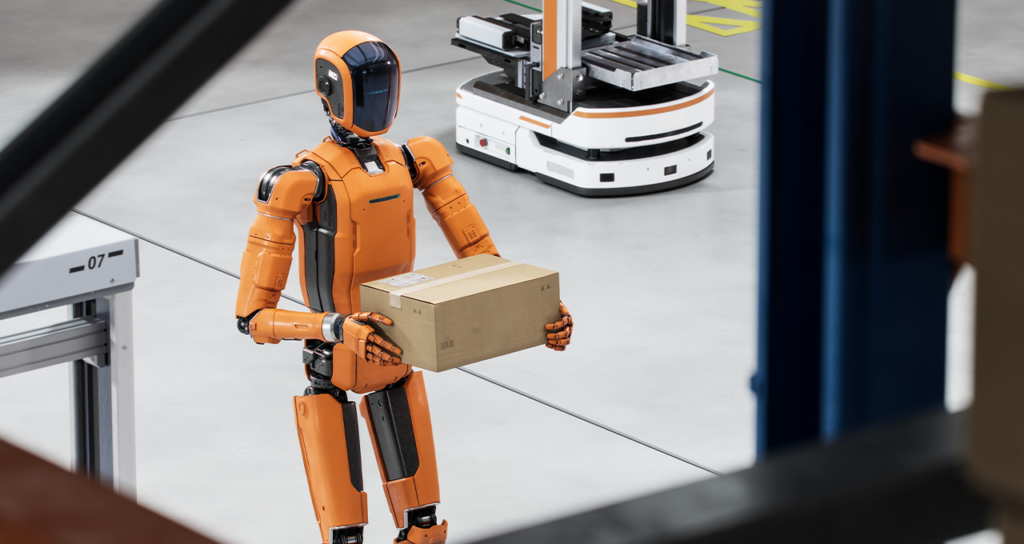
- Humanoid robots
- Machine vision systems
- Smart production equipment
- Warehouse automation
- Autonomous material handling
ABB describes industrial physical AI as AI reasoning combined with the sensors, controls, and mechanics required for robots to operate reliably in real manufacturing environments. Unlike traditional robots, these systems can be trained to respond to changing conditions rather than having every movement programmed manually.
That difference is important.
A traditional industrial robot performs a predefined task.
A physical AI system aims to understand what is happening around it and decide how to respond.
From Programming Robots to Training Them
One of the biggest changes could be how industrial robots are deployed.
Traditional automation often requires engineers to program:
- Robot movements
- Object positions
- Production sequences
- Safety boundaries
- Task-specific logic
Physical AI introduces a different approach.
AI models can be trained using:
- Real factory data
- Camera images
- Synthetic data
- Simulation
- Digital twins
- Operator demonstrations
ABB and NVIDIA are developing a physical AI workflow in which robots can be trained through simulated and real-world data rather than relying entirely on fixed programming. Their approach creates a continuous loop between digital simulation and physical operations.
This could make automation significantly easier to adapt when products or production requirements change.
Digital Twins Could Become a Training Environment
One of the most important technologies supporting physical AI is the digital twin.
A digital twin creates a virtual representation of:
- A robot
- A production cell
- A machine
- A warehouse
- An entire factory
Manufacturers can then test AI systems inside the virtual environment before deploying them on the factory floor.
This matters because training robots directly in real factories can be expensive and risky.
Simulation allows companies to test:
- Different product variations
- Unusual operating conditions
- Robot collisions
- Production layouts
- Machine failures
- Safety scenarios
Major robotics companies including ABB, FANUC, YASKAWA, and KUKA are integrating NVIDIA simulation technologies into their virtual commissioning environments. NVIDIA says these manufacturers collectively represent an installed base of more than two million robots.
The result could be faster deployment and lower engineering costs.
Robots Could Handle More Variation
Traditional factory automation works extremely well when conditions remain consistent.
The challenge comes when:
- Product designs change
- Parts arrive in different orientations
- Production volumes shift
- New products enter the line
- Objects move unexpectedly
Physical AI could allow robots to handle more of this variation.
Machine vision combined with AI can help a robot identify an object even when its position changes.
AI models can also allow machines to adjust their movements based on what they see.
This could expand automation into tasks that were previously too unpredictable for conventional industrial robots.
Examples may include:
- Flexible assembly
- Bin picking
- Sorting
- Quality inspection
- Packaging
- Warehouse operations
Industrial Automation Could Become More Flexible
One of the biggest potential advantages is flexibility.
Traditional automation is often economically attractive when manufacturers produce large volumes of the same product.
Physical AI could make automation more practical for:
- High-mix manufacturing
- Smaller production batches
- Frequently changing products
- Customized products
Instead of rebuilding or heavily reprogramming an automation cell whenever production changes, companies may be able to retrain the AI model.
This could shorten the time required to introduce new products.
ABB says its RobotStudio HyperReality platform, developed with NVIDIA technologies, is designed to reduce deployment costs by as much as 40% and accelerate time to market by up to 50% in supported robotic applications.
Edge AI Will Be Important
Industrial physical AI cannot always depend on cloud computing.
Factories often require decisions within milliseconds.
That means AI inference increasingly needs to happen close to the machine.
Edge AI hardware can process sensor and camera data directly on:
- Robot controllers
- Industrial PCs
- Machines
- Autonomous vehicles
This reduces latency and allows equipment to continue operating even when cloud connectivity is unavailable.
NVIDIA says industrial robotics companies are integrating Jetson computing modules into robot controllers to support real-time AI inference at the edge.
This could create opportunities across industrial semiconductors, edge computing, sensors, and embedded AI systems.
Physical AI Could Improve Quality Inspection
Quality control is another area with strong potential.
Traditional machine vision systems often rely on predefined rules.
AI-based vision systems can potentially identify more complex defects.
They may detect:
- Surface damage
- Incorrect assembly
- Component defects
- Packaging errors
- Product variation
These systems can also improve as additional examples become available.
Robotic vision is already being positioned as one of the most practical entry points for physical AI in precision manufacturing.
This makes inspection one of the areas where manufacturers may adopt physical AI before fully autonomous robots become common.
Humanoid Robots Could Enter Selected Factory Tasks
Humanoid robots are attracting significant investment because they could potentially work in environments originally designed for humans.
Instead of redesigning factories around specialized automation, humanoid robots could theoretically use:
- Existing tools
- Workstations
- Storage systems
- Production environments
In April 2026, Siemens announced that a humanoid robot had been tested at its electronics factory in Erlangen, Germany, performing autonomous logistics tasks using NVIDIA physical AI technologies.
Humanoids are still an emerging technology, but they could become useful for tasks where conventional automation is difficult to justify.
Potential applications include:
- Material handling
- Machine tending
- Internal logistics
- Inspection
- Repetitive manual work
Physical AI Could Help Address Labor Shortages
Manufacturing companies in many countries are struggling to recruit skilled industrial workers.
Automation has traditionally replaced repetitive tasks, but many remaining jobs involve too much variation for conventional robots.
Physical AI could expand the number of tasks that machines are capable of handling.
This may be particularly important in:
- Japan
- South Korea
- Europe
- Other aging industrial economies
Rather than replacing entire workforces, physical AI is more likely to automate specific tasks while changing the roles of human operators.
Workers may increasingly focus on:
- Supervision
- Engineering
- Exception handling
- Maintenance
- AI training
- Process optimization
Safety Will Become More Important
As robots become more autonomous, safety becomes more complex.
Traditional automation often relies on fixed safety zones.
Physical AI systems may operate in less predictable environments and work closer to humans.
This creates new requirements around:
- AI validation
- Sensor reliability
- Fail-safe controls
- Cybersecurity
- Certification
- Human-machine interaction
In 2026, NVIDIA introduced a full-stack safety architecture designed specifically for robotics and physical AI systems.
Safety could become one of the most important factors determining how quickly physical AI reaches large-scale industrial deployment.
New Opportunities Across the Automation Supply Chain
Physical AI could affect far more than robot manufacturers.
Potential growth opportunities include:
- Industrial cameras
- Machine vision
- AI processors
- Edge computing
- Sensors
- Digital twin software
- Simulation platforms
- Industrial networking
- Robot controllers
- Autonomous mobile robots
- AI safety systems
The industrial automation market may therefore shift from a hardware-centric industry toward a combination of:
hardware + software + AI models + simulation + data
That could change where value is captured across the industry.
Challenges to Adoption
Physical AI still faces significant barriers.
Industrial customers require extremely high levels of reliability.
A system that works correctly 95% of the time may be impressive in a laboratory but unacceptable on a production line.
Key challenges include:
- Safety
- Reliability
- Training data
- Integration with legacy equipment
- Cybersecurity
- Computing costs
- Lack of skilled workers
- Return on investment
Manufacturers are likely to introduce physical AI gradually rather than replacing existing automation overnight.
What the Future Could Look Like
The next generation of factories may combine traditional automation with more intelligent systems.
Highly repetitive production processes will continue to use conventional industrial robots.
But more variable tasks could increasingly use physical AI.
Factories may eventually contain a mix of:
- Traditional robotic arms
- AI-enabled robots
- Autonomous mobile robots
- Machine vision
- Humanoid systems
- Digital twins
- Edge AI
The most significant change may be that automation becomes easier to reconfigure.
Instead of designing machines around one fixed task, manufacturers could increasingly deploy systems that learn new tasks as production requirements evolve.
Physical AI could represent one of the biggest changes in industrial automation since programmable robotics.
Traditional automation made factories faster and more precise.
Physical AI could make them more adaptive.
By combining AI models, machine vision, simulation, edge computing, and robotics, manufacturers may be able to automate tasks that were previously too complex or variable.
The shift will not happen immediately.
Industrial systems still require reliability, safety, and predictable performance.
But as simulation improves and AI moves closer to machines, the difference between a robot that follows instructions and one that can understand its environment may become increasingly important.
The future of industrial automation may therefore be less about programming every movement — and more about teaching machines how to operate.