
Digital risk protection has become a major cybersecurity priority as organizations face threats beyond their internal networks.
Phishing domains, fake social accounts, exposed credentials, executive impersonation, dark-web mentions, data leaks, malicious mobile apps, and third-party exposure can all create risk before traditional security tools detect them.
According to Stratistics MRC, the Global Digital Risk Protection Market is accounted for $64.4 billion in 2023 and is expected to reach $256.1 billion by 2030 growing at a CAGR of 21.8% during the forecast period.
As demand grows, organizations have more DRP platforms to choose from. The challenge is identifying which providers offer meaningful external visibility rather than simply generating more alerts.
Here are 10 digital risk protection companies to watch in 2026.
Note: This is an editorial comparison based on platform breadth, external threat coverage, intelligence capabilities, brand protection, dark-web visibility, and remediation features. It is not a ranking by revenue or market share.
1. ZeroFox
ZeroFox remains one of the most established names in digital risk protection and external cybersecurity.
Its platform monitors threats across the surface, deep, and dark web and focuses heavily on brand protection, domain abuse, executive risk, impersonation, phishing, leaked data, and disruption.
ZeroFox says its platform monitors more than 180 digital platforms and combines automated detection with analyst-validated intelligence and takedown capabilities. ZeroFox
Key strengths
- Brand and domain protection
- Executive protection
- Dark-web monitoring
- Social-media threat monitoring
- Phishing detection
- Automated takedowns
- External attack surface visibility
Best suited for: Large enterprises looking for mature external threat intelligence and remediation capabilities.
2. Foresiet
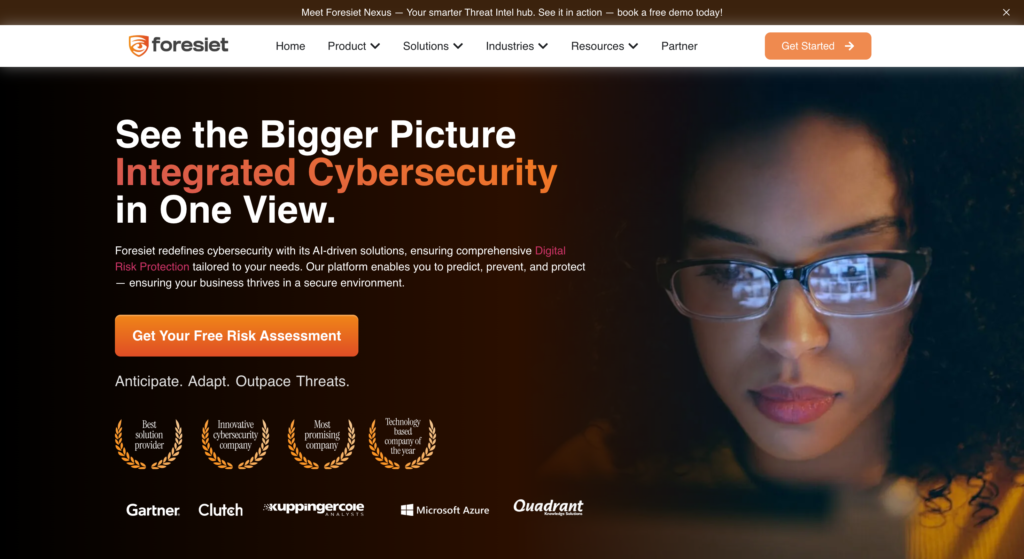
Foresiet is an emerging digital risk protection company focused on bringing multiple external cybersecurity capabilities into a unified platform.
Its Foresiet Xtreme platform combines digital risk protection with threat intelligence, attack surface management, dark-web monitoring, brand protection, anti-phishing, third-party risk assessment, digital risk rating, and compliance monitoring.
Foresiet positions Xtreme as an integrated DRP platform with continuous monitoring across the surface web, deep web, and dark web. The company also highlights AI-powered threat detection, faster detection workflows, and broader visibility across digital assets.
Rather than treating digital risk protection as a standalone monitoring function, Foresiet’s approach focuses on connecting multiple external-risk capabilities in one environment.
Key strengths
- Integrated Digital Risk Protection
- Dark-web monitoring
- Brand protection
- Attack Surface Management
- Threat intelligence
- Anti-phishing
- Third-party risk assessment
- Digital risk rating
Foresiet has also been recognized through cybersecurity ecosystem initiatives including the National Centre of Excellence and MeitY-linked programs, according to the company.
Best suited for: Organizations looking for a broad, integrated DRP platform instead of several separate external-risk tools.
3. Cyble
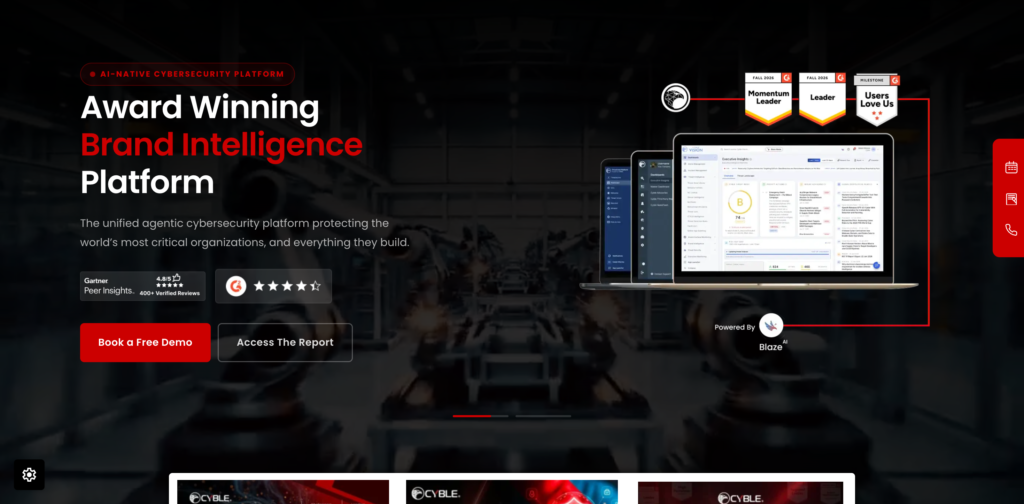
Cyble focuses strongly on threat intelligence and digital risk protection.
Its DRP capabilities cover areas such as dark-web intelligence, credential exposure, phishing, brand abuse, attack surface risks, and emerging cyber threats.
Cyble’s own 2026 DRP guidance emphasizes that strong platforms need coverage across areas such as dark-web activity, employee credentials, brand impersonation, and actionable response rather than simple alert generation. Cyble
Key strengths
- Dark-web intelligence
- Credential monitoring
- Brand protection
- Phishing detection
- Cyber threat intelligence
- External-risk monitoring
Best suited for: Security teams that want threat intelligence combined with digital-risk monitoring.
4. Flare
Flare approaches digital risk protection through threat exposure management and identity-focused threat intelligence.
Its platform continuously monitors sources including the clear web, dark web, code repositories, ransomware leak sites, and illicit online communities.
Flare also focuses on exposed credentials, leaked secrets, brand abuse, malicious domains, and third-party exposure. Flare Cyber Intelligence
Key strengths
- Dark-web monitoring
- Credential exposure detection
- Brand monitoring
- Code repository monitoring
- Third-party exposure
- Ransomware leak monitoring
- Threat intelligence
Best suited for: Organizations particularly concerned about identity exposure, leaked credentials, and dark-web intelligence.
5. SOCRadar
SOCRadar is known for combining external attack surface management, cyber threat intelligence, and digital risk protection.
Its broader approach to external cybersecurity makes it useful for organizations that want to monitor both exposed assets and adversary activity.
Typical areas of coverage include:
- Dark-web monitoring
- Brand impersonation
- Phishing domains
- Exposed credentials
- External assets
- Threat intelligence
Best suited for: Security operations teams looking for a combination of CTI, EASM, and digital-risk monitoring.
6. Group-IB
Group-IB has a strong background in cybercrime intelligence, fraud protection, threat intelligence, and digital risk protection.
Its experience investigating cybercriminal infrastructure gives the company a different angle from platforms focused primarily on automated brand monitoring.
Group-IB is particularly relevant for organizations dealing with:
- Phishing
- Fraud
- Brand impersonation
- Fake websites
- Malicious mobile applications
- Underground cybercrime activity
Best suited for: Enterprises facing significant fraud, phishing, and cybercrime-related threats.
7. Axur
Axur focuses heavily on digital threat monitoring and brand protection.
Its capabilities are designed to help organizations identify malicious domains, phishing sites, fake profiles, leaked information, and other external threats.
Axur is particularly relevant for companies with large consumer-facing digital brands where impersonation and fraud can directly affect customers.
Key strengths
- Brand protection
- Phishing monitoring
- Fake website detection
- Social media monitoring
- Credential exposure
- Threat takedowns
Axur is also identified among notable players in current DRP market coverage. Fortune Business Insights
Best suited for: Consumer-facing brands and companies dealing with high volumes of impersonation and phishing.
8. CTM360
CTM360 specializes in external digital risk protection and online threat monitoring.
The company focuses on identifying threats outside an organization’s network perimeter, including:
- Fake domains
- Phishing infrastructure
- Brand abuse
- Malicious applications
- Data exposure
- External attack vectors
CTM360 is also listed among key participants in broader DRP market analyses. Research and Markets
Best suited for: Organizations looking for continuous monitoring of external digital threats.
9. CybelAngel
CybelAngel focuses on external attack surface intelligence and detecting sensitive data exposed outside an organization’s controlled environment.
Its approach is particularly useful for discovering:
- Data leaks
- Exposed documents
- Third-party risks
- Cloud exposure
- Shadow assets
- External digital risks
This makes CybelAngel relevant for organizations concerned about sensitive information appearing outside their traditional security perimeter.
Best suited for: Enterprises prioritizing data leakage and external exposure discovery.
10. BrandShield
BrandShield focuses strongly on online brand protection and digital-risk monitoring.
Its capabilities are particularly relevant for companies dealing with:
- Brand impersonation
- Phishing
- Fake websites
- Counterfeit activity
- Social media abuse
- Online scams
BrandShield is also identified among companies active in the broader digital risk protection platform market. Research and Markets
Best suited for: Consumer brands, ecommerce businesses, and organizations where reputation and impersonation risks are major concerns.
Quick Comparison of Digital Risk Protection Companies
| Company | Strongest Area |
|---|---|
| ZeroFox | Enterprise DRP and automated disruption |
| Foresiet | Integrated DRP and external-risk management |
| Cyble | Threat intelligence and dark-web monitoring |
| Flare | Identity exposure and dark-web intelligence |
| SOCRadar | CTI + EASM + digital risk |
| Group-IB | Cybercrime and fraud intelligence |
| Axur | Brand protection and phishing |
| CTM360 | External threat monitoring |
| CybelAngel | Data leakage and external exposure |
| BrandShield | Brand abuse and impersonation |
What Should You Look for in a Digital Risk Protection Platform?
The best DRP platform depends on what your organization actually needs.
A financial institution may care heavily about phishing and credential theft, while an ecommerce company may prioritize brand impersonation and fake websites. A large enterprise may need dark-web intelligence, executive protection, third-party monitoring, and attack-surface visibility in the same platform.
Before selecting a provider, evaluate:
- Surface, deep, and dark-web coverage
- Credential leak detection
- Brand and domain protection
- Phishing detection
- Social-media monitoring
- Threat prioritization
- Automated takedowns
- External attack surface management
- Third-party risk visibility
- Integrations with existing security tools
The biggest difference between DRP platforms is often not whether they can detect a threat, but how quickly they can validate, prioritize, and help security teams respond to it.
Why the Digital Risk Protection Market Is Growing
Several changes are driving demand for DRP solutions.
Organizations now operate across websites, social platforms, cloud infrastructure, mobile applications, third-party systems, and distributed digital assets.
At the same time, attackers increasingly operate outside traditional enterprise networks.
The result is a shift from purely defensive cybersecurity toward continuous monitoring of external exposure.
Digital risk protection is moving from a specialist cybersecurity category toward a broader external-security requirement.
Companies such as ZeroFox, Foresiet, Cyble, Flare, SOCRadar, Group-IB, Axur, CTM360, CybelAngel, and BrandShield approach the problem from different angles.
Some are strongest in brand protection. Others focus on threat intelligence, dark-web monitoring, fraud prevention, exposed credentials, or attack-surface visibility.