
South Korea has spent decades at the center of the global display industry. But the nature of that leadership is changing.
The country once dominated LCD manufacturing through companies such as Samsung Display and LG Display. Today, the strategic focus has shifted toward OLED, advanced manufacturing and higher-value applications including smartphones, laptops, automotive displays, XR devices and wearables.
The challenge is that China is rapidly closing the gap.
In 2025, South Korea accounted for an estimated 68.7% of the global OLED market, down from 87.3% in 2020, while China’s share increased to 31.2%. The technology gap between Korean and Chinese manufacturers in IT OLED has also narrowed significantly.
This makes the next few years critical for South Korea’s display strategy.
From LCD Leadership to OLED Specialization
South Korea’s display industry has increasingly moved away from competing with China on LCD volume.
Instead, companies are concentrating investment on technologies where higher performance and technical complexity can create greater value.
OLED is at the center of this strategy because it enables:
- Thinner and lighter displays
- Higher contrast
- Faster response times
- Flexible and foldable designs
- Lower-power applications
- New form factors
South Korea’s government expects OLED’s share of the broader display market to increase from 36.1% in 2023 to 41.3% by 2028, reinforcing the industry’s shift toward higher-value display technologies.
Samsung Display and LG Display Are Increasing Investment
The two major Korean display manufacturers are responding with significant investments.
LG Display announced a new KRW 1.106 trillion investment in OLED technology infrastructure in April 2026, primarily targeting small- and medium-sized OLED production for smartphones, laptops and tablets. The company plans more than KRW 2 trillion in total capital expenditure during 2026.
In July, LG Display announced a broader KRW 3 trillion OLED investment program, supported partly by Korea’s National Growth Fund. The investment is aimed at maintaining technological leadership in premium OLED displays.
Samsung Display is also expanding.
The company has resumed construction of its A7 OLED facility in Asan, with completion targeted for early 2028. The facility is intended to support growing OLED demand from IT devices such as laptops, tablets and foldable products.
The Next Opportunity Is Bigger Than Smartphones
Smartphones remain an important OLED market, but Korean display companies are looking beyond mobile devices.
Major growth opportunities include:
IT displays: OLED laptops, tablets and monitors are becoming increasingly important as manufacturers move premium computing products away from LCD.
Automotive: Larger, curved and high-resolution displays are becoming increasingly common in modern vehicles.
XR and wearables: Head-mounted devices require extremely high pixel densities and compact display technologies.
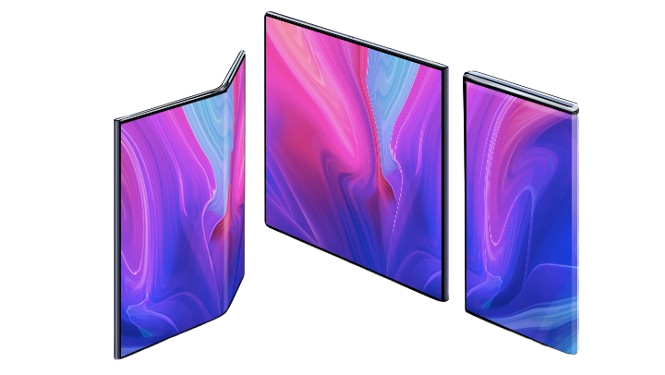
Foldables: Flexible OLED remains one of South Korea’s strongest areas of technological expertise.
Humanoid robotics: Samsung Display has identified humanoid applications alongside XR, automotive and wearable displays as future areas for its advanced display cluster.
This diversification could reduce the industry’s dependence on the smartphone replacement cycle.
China Is the Biggest Competitive Threat
South Korea’s biggest challenge is no longer simply maintaining technological leadership.
It is maintaining that lead while Chinese manufacturers rapidly increase their capabilities.
Chinese companies have expanded OLED production capacity and improved their position in smartphones, tablets and IT displays.
The shift is visible in market share. China’s OLED share increased from just 12.1% in 2020 to 31.2% in 2025, while South Korea’s share fell by nearly 19 percentage points over the same period.
The competition is therefore moving from:
LCD volume → OLED volume → advanced OLED technology.
South Korea’s advantage will increasingly depend on how quickly it can commercialize new generations of OLED rather than simply producing more panels.
Technology Is Becoming the Main Battleground
The next phase of competition is likely to focus on technologies such as:
- Tandem OLED
- High-efficiency OLED
- Flexible OLED
- QD-OLED
- Advanced IT OLED
- Automotive OLED
- MicroLED
- XR displays
Manufacturing efficiency will be just as important as the underlying technology.
Higher-generation production lines can improve the economics of manufacturing larger panels and make OLED more competitive in laptops, monitors and other IT products.
That is one reason Samsung and LG are investing in new production infrastructure rather than simply expanding existing capacity.
Investment Trends Point Toward Premium Displays
South Korea’s investment strategy suggests that the industry is prioritizing technology differentiation over manufacturing volume.
Government-backed financing is increasingly being used to support large-scale OLED equipment investment, while companies are directing their own capital toward next-generation production.
This approach is designed to protect South Korea’s position as China’s manufacturers move closer technologically.
The Korean government has also identified displays as a strategic export industry, with the sector generating roughly $17–18 billion in annual exports during 2023–2025.
What Comes Next for South Korea?
South Korea’s display industry is entering a more competitive phase.
The country still has major advantages in:
- OLED expertise
- Advanced materials
- Manufacturing technology
- Global customer relationships
- R&D capabilities
- Premium display production
However, China’s rapid progress means those advantages cannot be taken for granted.
The next opportunity is to expand OLED into IT, automotive, XR, wearables and other emerging applications, while developing more efficient and higher-performance display architectures.
The industry is effectively moving from a race for market share to a race for technology leadership.
South Korea remains one of the world’s most important display manufacturing centers, but its position is changing.
OLED has become the industry’s strategic core, with Samsung Display and LG Display committing billions of dollars to next-generation production and technology. At the same time, China’s growing OLED presence is putting pressure on Korea’s historical dominance.
The winners of the next display cycle will likely be companies that can combine advanced OLED technology, efficient manufacturing and new applications.
For South Korea, the objective is clear: stay ahead not by producing the most displays, but by producing the displays that competitors find hardest to replicate.