
Brain Implants Market
Brain Implants Market Forecasts to 2032 - Global Analysis By Product (Deep Brain Stimulator, Vagus Nerve Stimulation and Responsive Neurostimulation), Application (Chronic Pain, Epilepsy, Parkinson's Disease, Depression, Alzheimer's Disease, Essential Tremor and Other Applications), End User and By Geography

|
Years Coveredc |
2024-2032 |
|
Estimated Year Value (2025) |
US $7.40 BN |
|
Projected Year Value (2032) |
US $16.26 BN |
|
CAGR (2025 - 2032) |
11.9% |
|
Regions Covered |
North America, Europe, Asia Pacific, South America, and Middle East & Africa |
|
Countries Covered |
US, Canada, Mexico, Germany, UK, Italy, France, Spain, Japan, China, India, Australia, New Zealand, South Korea, Rest of Asia Pacific, South America, Argentina, Brazil, Chile, Middle East & Africa, Saudi Arabia, UAE, Qatar, and South Africa |
|
Largest Market |
North America |
|
Highest Growing Market |
Asia Pacific |
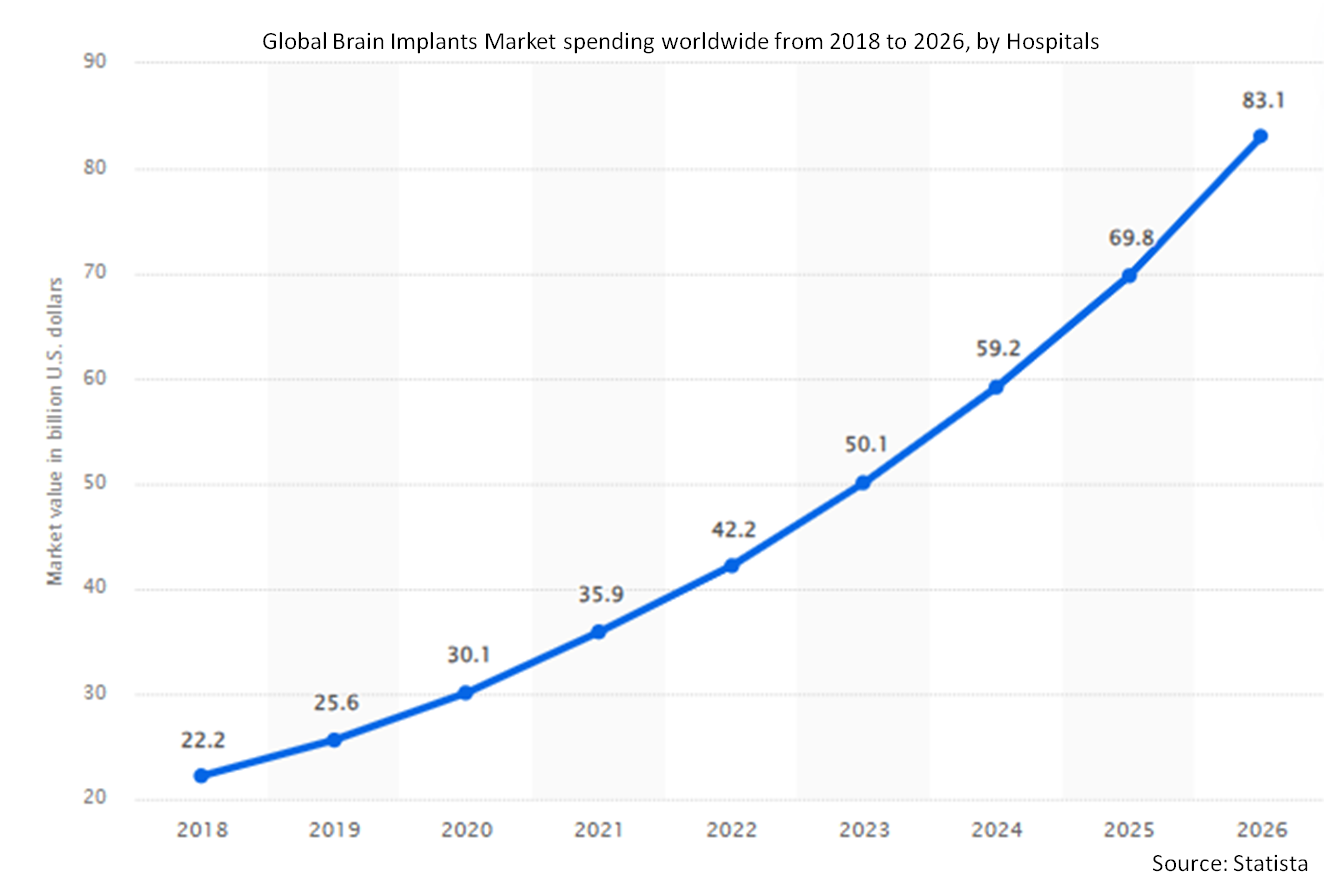
According to Stratistics MRC, the Global Brain Implants Market is accounted for $7.40 billion in 2025 and is expected to reach $16.26 billion by 2032 growing at a CAGR of 11.9% during the forecast period. Advanced medical devices known as brain implants, when inserted directly into the brain, facilitate communication with neural tissue. Numerous therapeutic, diagnostic, and enhancement applications exist for these implants. They work by capturing or triggering brain activity, frequently by sending and receiving electrical signals via electrodes. The safety, functionality, and possible uses of brain implants have been greatly enhanced by recent developments in materials science, wireless technology, and machine learning.
According to the American Association of Neurological Surgeons (AANS), approximately 250,000 individuals in the U.S. are affected by dystonia, a neurological movement disorder characterized by involuntary muscle contractions.
Market Dynamics:
Driver:
Increasing neurological disorder prevalence
The prevalence of neurological disorders is rising at a startling rate worldwide. Millions of people worldwide suffer from conditions like epilepsy, Parkinson's disease, Alzheimer's, chronic pain, and depression that don’t go away. For example, according to estimates from the World Health Organization (WHO), more than 50 million people worldwide have epilepsy. By controlling aberrant neural activity and enhancing patients' quality of life, brain implants provide an efficient intervention. Moreover, the need for implantable neurostimulation devices is growing since traditional treatments frequently fail, particularly in cases where the patient is drug-resistant.
Restraint:
Expensive procedures and equipment
Deep brain stimulation (DBS) systems and other brain implants are costly; without accounting for surgical and postoperative costs, they can cost anywhere from $35,000 to $50,000 per patient. An important obstacle to access is the high initial and ongoing costs, especially in low- and middle-income nations. Insurance coverage may be restricted, even in developed areas, which deters patients from choosing such treatments. Additionally, the cost burden also affects healthcare systems, particularly when long-term monitoring, device upkeep, and possible issues necessitating adjustments are taken into account.
Opportunity:
Growth of BCIs (brain-computer interfaces)
Brain-computer interfaces (BCIs) are integrating brain implants with external computing systems, opening up revolutionary possibilities in healthcare and other fields. Through the use of brain-computer interfaces (BCIs), people who have lost limbs or are paralyzed can use neural signals to operate computers, wheelchairs, and prosthetic limbs. Initiatives like Synchron's endovascular BCIs and Elon Musk's Neuralink are garnering interest and funding for use in both therapeutic and non-medical fields. Furthermore, the market for brain implants may be greatly expanded outside of traditional medical settings as these technologies develop and find commercial use in communication, gaming, smart devices, and augmented cognition.
Threat:
Ethical backlash and public skepticism
The public is still skeptical of brain implants despite their technological potential because of ethical and philosophical issues. Advocacy groups and patients may find it difficult to accept someone who has mind control, loses autonomy, or changes their personality. In societies where the sanctity of the human brain is highly valued for religious or cultural reasons, invasive procedures are frequently resisted. Moreover, as brain implants start to conflate enhancement and treatment, there is growing discussion about ethical boundaries and possible abuse, which may result in restrictions or prohibitions in some markets.
Covid-19 Impact:
The COVID-19 pandemic affected the market for brain implants in a variety of ways. Initial market disruptions included a temporary drop in implant procedures and clinical trials as a result of supply chain disruptions, hospital capacity reductions, and the postponement of elective neurosurgeries. However, as healthcare systems looked into cutting-edge solutions for remote patient monitoring and chronic disease management, the pandemic also accelerated investments in neuro-technology and digital health. Additionally, long-term market growth is also anticipated due to the increased prevalence of neurological complications linked to prolonged COVID, such as brain fog, stroke, and cognitive dysfunction.
The deep brain stimulator (DBS) segment is expected to be the largest during the forecast period
The deep brain stimulator (DBS) segment is expected to account for the largest market share during the forecast period. DBS is the most widely used neuromodulation therapy, driven by its clinical success and widespread use in treating neurological disorders like Parkinson's disease, essential tremor, dystonia, and obsessive-compulsive disorder. It involves the implantation of electrodes in specific brain regions to deliver controlled electrical impulses, effectively modulating abnormal neural activity. Furthermore, it is FDA-approved, well-established, and supported by a wealth of clinical data, and its adoption is further enhanced by ongoing innovation in device miniaturization, battery life, and MRI compatibility.
The depression segment is expected to have the highest CAGR during the forecast period
Over the forecast period, the depression segment is predicted to witness the highest growth rate, driven by the growing acceptance of neuromodulation therapies and the rising incidence of treatment-resistant depression (TRD). Deep brain stimulation (DBS) and vagus nerve stimulation (VNS) are becoming viable substitutes for traditional antidepressants, which frequently fail to relieve a considerable percentage of patients. Interest in implantable solutions is being fueled by ongoing clinical trials and developments in closed-loop systems designed for mood regulation. Additionally, the COVID-19 pandemic's worsening of the mental health crisis has highlighted the need for novel treatments, spurring investment and research in this rapidly expanding field.
Region with largest share:
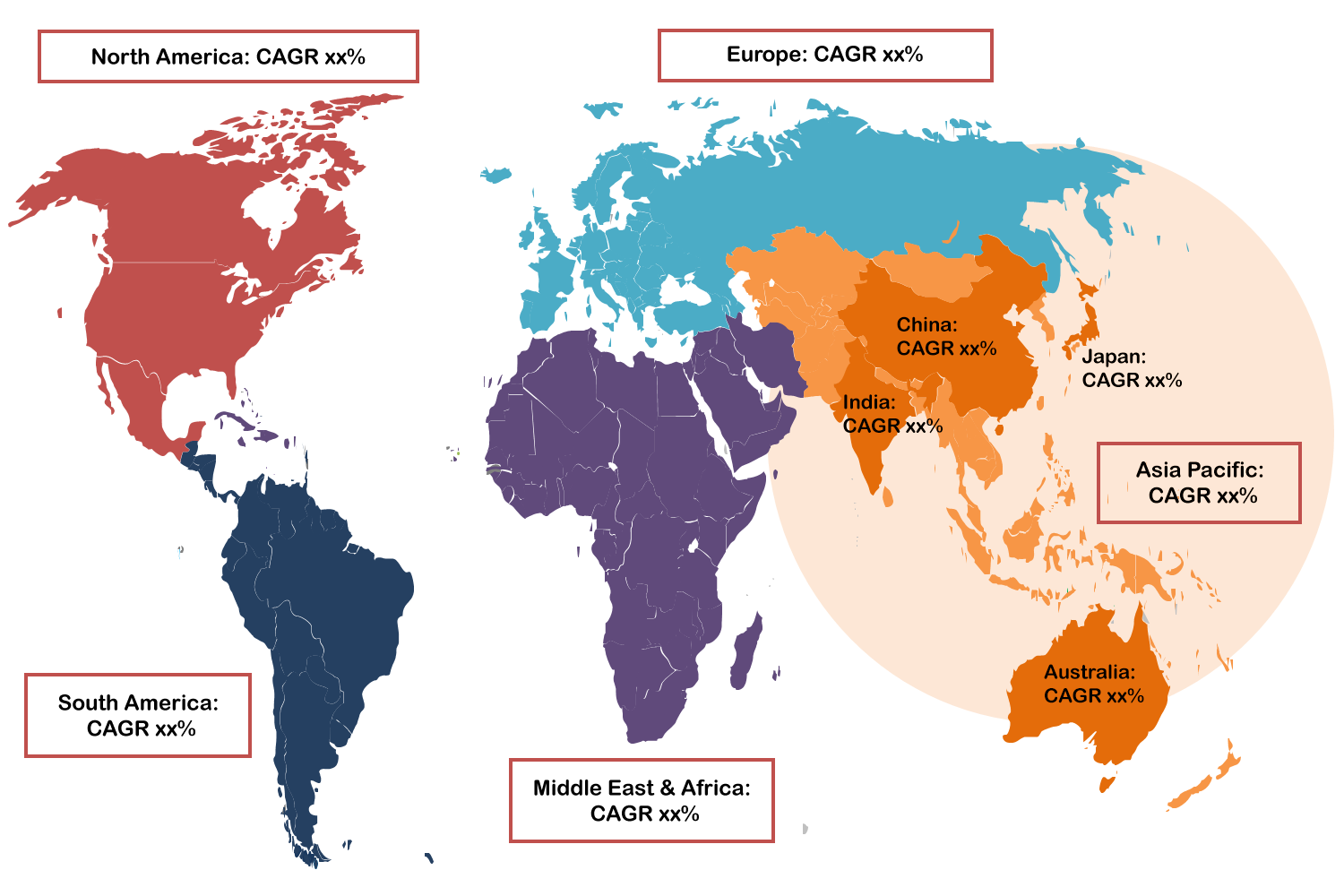
During the forecast period, the North America region is expected to hold the largest market share, mostly driven by the United States, which contributes significantly to global market revenue. High healthcare spending, a sophisticated healthcare infrastructure, and an increasing incidence of neurological conditions like depression, epilepsy, and Parkinson's disease all benefit the area. The dominance of North America is also attributed to the existence of top businesses, advantageous reimbursement practices, and ongoing R&D initiatives. Furthermore, driving market expansion in this area and establishing it as a major player globally is growing awareness of brain implants and their effectiveness in treating long-term neurological disorders.
Region with highest CAGR:
Over the forecast period, the Asia Pacific region is anticipated to exhibit the highest CAGR, driven by the rising incidence of neurological disorders, growing investments, and quick improvements in healthcare infrastructure. The need for cutting-edge medical technologies is rising in nations like China, India, and Japan as a result of aging populations, growing awareness of brain health, and easier access to healthcare. Government programs and investments meant to improve healthcare systems also encourage market expansion. Moreover, the region is a very promising market for future growth because of its large patient population and growing disposable incomes, which are also influencing the adoption of brain implant technologies.
Key players in the market
Some of the key players in Brain Implants Market include Boston Scientific Corporation, Medtronic plc, Synchron Inc., Abbott Laboratories, NeuroPace, Inc., LivaNova Plc, Precision Neuroscience Inc, NDI Medical LLC, Renishaw PLC, Aleva Neurotherapeutics SA, Beijing PINS Medical Co., Ltd, Functional Neuromodulation, Ltd., SceneRay Co., Ltd, Cyberonics, Inc. and NeuroSigma Inc.
Key Developments:
In April 2025, Medtronic plc announced a strategic agreement to distribute the advanced Dragonfly™* pancreaticobiliary system from Dragonfly Endoscopy, Inc. in the United States. This innovative platform introduces significant enhancements in pancreaticobiliary endoscopy — a field where procedural standards have remained largely unchanged for decades. Financial terms of the agreement were not disclosed.
In March 2025, Boston Scientific Corporation announced it has entered into a definitive agreement to acquire SoniVie Ltd., a privately held medical device company that has developed the TIVUS™ Intravascular Ultrasound System. An investigational technology, the TIVUS system is designed to denervate nerves surrounding blood vessels to treat a variety of hypertensive disorders, including renal artery denervation (RDN) for hypertension.
In December 2024, Abbott Laboratories and DexCom said that they have reached an agreement to settle all patent disputes between them related to continuous glucose monitoring devices. The agreement will dismiss all pending cases in courts and patent offices worldwide, along with a provision preventing legal action between the companies for patent and appearance disputes for the next 10 years.
Products Covered:
• Deep Brain Stimulator
• Vagus Nerve Stimulation
• Responsive Neurostimulation
Applications Covered:
• Chronic Pain
• Epilepsy
• Parkinson's Disease
• Depression
• Alzheimer's Disease
• Essential Tremor
• Other Applications
End Users Covered:
• Hospitals
• Neurology Clinics
• Other End Users
Regions Covered:
• North America
o US
o Canada
o Mexico
• Europe
o Germany
o UK
o Italy
o France
o Spain
o Rest of Europe
• Asia Pacific
o Japan
o China
o India
o Australia
o New Zealand
o South Korea
o Rest of Asia Pacific
• South America
o Argentina
o Brazil
o Chile
o Rest of South America
• Middle East & Africa
o Saudi Arabia
o UAE
o Qatar
o South Africa
o Rest of Middle East & Africa
What our report offers:
- Market share assessments for the regional and country-level segments
- Strategic recommendations for the new entrants
- Covers Market data for the years 2024, 2025, 2026, 2028, and 2032
- Market Trends (Drivers, Constraints, Opportunities, Threats, Challenges, Investment Opportunities, and recommendations)
- Strategic recommendations in key business segments based on the market estimations
- Competitive landscaping mapping the key common trends
- Company profiling with detailed strategies, financials, and recent developments
- Supply chain trends mapping the latest technological advancements
Free Customization Offerings:
All the customers of this report will be entitled to receive one of the following free customization options:
• Company Profiling
o Comprehensive profiling of additional market players (up to 3)
o SWOT Analysis of key players (up to 3)
• Regional Segmentation
o Market estimations, Forecasts and CAGR of any prominent country as per the client's interest (Note: Depends on feasibility check)
• Competitive Benchmarking
o Benchmarking of key players based on product portfolio, geographical presence, and strategic alliances
Table of Contents
1 Executive Summary
2 Preface
2.1 Abstract
2.2 Stake Holders
2.3 Research Scope
2.4 Research Methodology
2.4.1 Data Mining
2.4.2 Data Analysis
2.4.3 Data Validation
2.4.4 Research Approach
2.5 Research Sources
2.5.1 Primary Research Sources
2.5.2 Secondary Research Sources
2.5.3 Assumptions
3 Market Trend Analysis
3.1 Introduction
3.2 Drivers
3.3 Restraints
3.4 Opportunities
3.5 Threats
3.6 Product Analysis
3.7 Application Analysis
3.8 End User Analysis
3.9 Emerging Markets
3.10 Impact of Covid-19
4 Porters Five Force Analysis
4.1 Bargaining power of suppliers
4.2 Bargaining power of buyers
4.3 Threat of substitutes
4.4 Threat of new entrants
4.5 Competitive rivalry
5 Global Brain Implants Market, By Product
5.1 Introduction
5.2 Deep Brain Stimulator
5.3 Vagus Nerve Stimulation
5.4 Responsive Neurostimulation
6 Global Brain Implants Market, By Application
6.1 Introduction
6.2 Chronic Pain
6.3 Epilepsy
6.4 Parkinson's Disease
6.5 Depression
6.6 Alzheimer's Disease
6.7 Essential Tremor
6.8 Other Applications
7 Global Brain Implants Market, By End User
7.1 Introduction
7.2 Hospitals
7.3 Neurology Clinics
7.4 Other End Users
8 Global Brain Implants Market, By Geography
8.1 Introduction
8.2 North America
8.2.1 US
8.2.2 Canada
8.2.3 Mexico
8.3 Europe
8.3.1 Germany
8.3.2 UK
8.3.3 Italy
8.3.4 France
8.3.5 Spain
8.3.6 Rest of Europe
8.4 Asia Pacific
8.4.1 Japan
8.4.2 China
8.4.3 India
8.4.4 Australia
8.4.5 New Zealand
8.4.6 South Korea
8.4.7 Rest of Asia Pacific
8.5 South America
8.5.1 Argentina
8.5.2 Brazil
8.5.3 Chile
8.5.4 Rest of South America
8.6 Middle East & Africa
8.6.1 Saudi Arabia
8.6.2 UAE
8.6.3 Qatar
8.6.4 South Africa
8.6.5 Rest of Middle East & Africa
9 Key Developments
9.1 Agreements, Partnerships, Collaborations and Joint Ventures
9.2 Acquisitions & Mergers
9.3 New Product Launch
9.4 Expansions
9.5 Other Key Strategies
10 Company Profiling
10.1 Boston Scientific Corporation
10.2 Medtronic plc
10.3 Synchron Inc.
10.4 Abbott Laboratories
10.5 NeuroPace, Inc.
10.6 LivaNova Plc
10.7 Precision Neuroscience Inc
10.8 NDI Medical LLC
10.9 Renishaw PLC
10.10 Aleva Neurotherapeutics SA
10.11 Beijing PINS Medical Co., Ltd
10.12 Functional Neuromodulation, Ltd.
10.13 SceneRay Co., Ltd
10.14 Cyberonics, Inc.
10.15 NeuroSigma Inc
List of Tables
1 Global Brain Implants Market Outlook, By Region (2024-2032) ($MN)
2 Global Brain Implants Market Outlook, By Product (2024-2032) ($MN)
3 Global Brain Implants Market Outlook, By Deep Brain Stimulator (2024-2032) ($MN)
4 Global Brain Implants Market Outlook, By Vagus Nerve Stimulation (2024-2032) ($MN)
5 Global Brain Implants Market Outlook, By Responsive Neurostimulation (2024-2032) ($MN)
6 Global Brain Implants Market Outlook, By Application (2024-2032) ($MN)
7 Global Brain Implants Market Outlook, By Chronic Pain (2024-2032) ($MN)
8 Global Brain Implants Market Outlook, By Epilepsy (2024-2032) ($MN)
9 Global Brain Implants Market Outlook, By Parkinson's Disease (2024-2032) ($MN)
10 Global Brain Implants Market Outlook, By Depression (2024-2032) ($MN)
11 Global Brain Implants Market Outlook, By Alzheimer's Disease (2024-2032) ($MN)
12 Global Brain Implants Market Outlook, By Essential Tremor (2024-2032) ($MN)
13 Global Brain Implants Market Outlook, By Other Applications (2024-2032) ($MN)
14 Global Brain Implants Market Outlook, By End User (2024-2032) ($MN)
15 Global Brain Implants Market Outlook, By Hospitals (2024-2032) ($MN)
16 Global Brain Implants Market Outlook, By Neurology Clinics (2024-2032) ($MN)
17 Global Brain Implants Market Outlook, By Other End Users (2024-2032) ($MN)
18 North America Brain Implants Market Outlook, By Country (2024-2032) ($MN)
19 North America Brain Implants Market Outlook, By Product (2024-2032) ($MN)
20 North America Brain Implants Market Outlook, By Deep Brain Stimulator (2024-2032) ($MN)
21 North America Brain Implants Market Outlook, By Vagus Nerve Stimulation (2024-2032) ($MN)
22 North America Brain Implants Market Outlook, By Responsive Neurostimulation (2024-2032) ($MN)
23 North America Brain Implants Market Outlook, By Application (2024-2032) ($MN)
24 North America Brain Implants Market Outlook, By Chronic Pain (2024-2032) ($MN)
25 North America Brain Implants Market Outlook, By Epilepsy (2024-2032) ($MN)
26 North America Brain Implants Market Outlook, By Parkinson's Disease (2024-2032) ($MN)
27 North America Brain Implants Market Outlook, By Depression (2024-2032) ($MN)
28 North America Brain Implants Market Outlook, By Alzheimer's Disease (2024-2032) ($MN)
29 North America Brain Implants Market Outlook, By Essential Tremor (2024-2032) ($MN)
30 North America Brain Implants Market Outlook, By Other Applications (2024-2032) ($MN)
31 North America Brain Implants Market Outlook, By End User (2024-2032) ($MN)
32 North America Brain Implants Market Outlook, By Hospitals (2024-2032) ($MN)
33 North America Brain Implants Market Outlook, By Neurology Clinics (2024-2032) ($MN)
34 North America Brain Implants Market Outlook, By Other End Users (2024-2032) ($MN)
35 Europe Brain Implants Market Outlook, By Country (2024-2032) ($MN)
36 Europe Brain Implants Market Outlook, By Product (2024-2032) ($MN)
37 Europe Brain Implants Market Outlook, By Deep Brain Stimulator (2024-2032) ($MN)
38 Europe Brain Implants Market Outlook, By Vagus Nerve Stimulation (2024-2032) ($MN)
39 Europe Brain Implants Market Outlook, By Responsive Neurostimulation (2024-2032) ($MN)
40 Europe Brain Implants Market Outlook, By Application (2024-2032) ($MN)
41 Europe Brain Implants Market Outlook, By Chronic Pain (2024-2032) ($MN)
42 Europe Brain Implants Market Outlook, By Epilepsy (2024-2032) ($MN)
43 Europe Brain Implants Market Outlook, By Parkinson's Disease (2024-2032) ($MN)
44 Europe Brain Implants Market Outlook, By Depression (2024-2032) ($MN)
45 Europe Brain Implants Market Outlook, By Alzheimer's Disease (2024-2032) ($MN)
46 Europe Brain Implants Market Outlook, By Essential Tremor (2024-2032) ($MN)
47 Europe Brain Implants Market Outlook, By Other Applications (2024-2032) ($MN)
48 Europe Brain Implants Market Outlook, By End User (2024-2032) ($MN)
49 Europe Brain Implants Market Outlook, By Hospitals (2024-2032) ($MN)
50 Europe Brain Implants Market Outlook, By Neurology Clinics (2024-2032) ($MN)
51 Europe Brain Implants Market Outlook, By Other End Users (2024-2032) ($MN)
52 Asia Pacific Brain Implants Market Outlook, By Country (2024-2032) ($MN)
53 Asia Pacific Brain Implants Market Outlook, By Product (2024-2032) ($MN)
54 Asia Pacific Brain Implants Market Outlook, By Deep Brain Stimulator (2024-2032) ($MN)
55 Asia Pacific Brain Implants Market Outlook, By Vagus Nerve Stimulation (2024-2032) ($MN)
56 Asia Pacific Brain Implants Market Outlook, By Responsive Neurostimulation (2024-2032) ($MN)
57 Asia Pacific Brain Implants Market Outlook, By Application (2024-2032) ($MN)
58 Asia Pacific Brain Implants Market Outlook, By Chronic Pain (2024-2032) ($MN)
59 Asia Pacific Brain Implants Market Outlook, By Epilepsy (2024-2032) ($MN)
60 Asia Pacific Brain Implants Market Outlook, By Parkinson's Disease (2024-2032) ($MN)
61 Asia Pacific Brain Implants Market Outlook, By Depression (2024-2032) ($MN)
62 Asia Pacific Brain Implants Market Outlook, By Alzheimer's Disease (2024-2032) ($MN)
63 Asia Pacific Brain Implants Market Outlook, By Essential Tremor (2024-2032) ($MN)
64 Asia Pacific Brain Implants Market Outlook, By Other Applications (2024-2032) ($MN)
65 Asia Pacific Brain Implants Market Outlook, By End User (2024-2032) ($MN)
66 Asia Pacific Brain Implants Market Outlook, By Hospitals (2024-2032) ($MN)
67 Asia Pacific Brain Implants Market Outlook, By Neurology Clinics (2024-2032) ($MN)
68 Asia Pacific Brain Implants Market Outlook, By Other End Users (2024-2032) ($MN)
69 South America Brain Implants Market Outlook, By Country (2024-2032) ($MN)
70 South America Brain Implants Market Outlook, By Product (2024-2032) ($MN)
71 South America Brain Implants Market Outlook, By Deep Brain Stimulator (2024-2032) ($MN)
72 South America Brain Implants Market Outlook, By Vagus Nerve Stimulation (2024-2032) ($MN)
73 South America Brain Implants Market Outlook, By Responsive Neurostimulation (2024-2032) ($MN)
74 South America Brain Implants Market Outlook, By Application (2024-2032) ($MN)
75 South America Brain Implants Market Outlook, By Chronic Pain (2024-2032) ($MN)
76 South America Brain Implants Market Outlook, By Epilepsy (2024-2032) ($MN)
77 South America Brain Implants Market Outlook, By Parkinson's Disease (2024-2032) ($MN)
78 South America Brain Implants Market Outlook, By Depression (2024-2032) ($MN)
79 South America Brain Implants Market Outlook, By Alzheimer's Disease (2024-2032) ($MN)
80 South America Brain Implants Market Outlook, By Essential Tremor (2024-2032) ($MN)
81 South America Brain Implants Market Outlook, By Other Applications (2024-2032) ($MN)
82 South America Brain Implants Market Outlook, By End User (2024-2032) ($MN)
83 South America Brain Implants Market Outlook, By Hospitals (2024-2032) ($MN)
84 South America Brain Implants Market Outlook, By Neurology Clinics (2024-2032) ($MN)
85 South America Brain Implants Market Outlook, By Other End Users (2024-2032) ($MN)
86 Middle East & Africa Brain Implants Market Outlook, By Country (2024-2032) ($MN)
87 Middle East & Africa Brain Implants Market Outlook, By Product (2024-2032) ($MN)
88 Middle East & Africa Brain Implants Market Outlook, By Deep Brain Stimulator (2024-2032) ($MN)
89 Middle East & Africa Brain Implants Market Outlook, By Vagus Nerve Stimulation (2024-2032) ($MN)
90 Middle East & Africa Brain Implants Market Outlook, By Responsive Neurostimulation (2024-2032) ($MN)
91 Middle East & Africa Brain Implants Market Outlook, By Application (2024-2032) ($MN)
92 Middle East & Africa Brain Implants Market Outlook, By Chronic Pain (2024-2032) ($MN)
93 Middle East & Africa Brain Implants Market Outlook, By Epilepsy (2024-2032) ($MN)
94 Middle East & Africa Brain Implants Market Outlook, By Parkinson's Disease (2024-2032) ($MN)
95 Middle East & Africa Brain Implants Market Outlook, By Depression (2024-2032) ($MN)
96 Middle East & Africa Brain Implants Market Outlook, By Alzheimer's Disease (2024-2032) ($MN)
97 Middle East & Africa Brain Implants Market Outlook, By Essential Tremor (2024-2032) ($MN)
98 Middle East & Africa Brain Implants Market Outlook, By Other Applications (2024-2032) ($MN)
99 Middle East & Africa Brain Implants Market Outlook, By End User (2024-2032) ($MN)
100 Middle East & Africa Brain Implants Market Outlook, By Hospitals (2024-2032) ($MN)
101 Middle East & Africa Brain Implants Market Outlook, By Neurology Clinics (2024-2032) ($MN)
102 Middle East & Africa Brain Implants Market Outlook, By Other End Users (2024-2032) ($MN)
List of Figures
RESEARCH METHODOLOGY

We at ‘Stratistics’ opt for an extensive research approach which involves data mining, data validation, and data analysis. The various research sources include in-house repository, secondary research, competitor’s sources, social media research, client internal data, and primary research.
Our team of analysts prefers the most reliable and authenticated data sources in order to perform the comprehensive literature search. With access to most of the authenticated data bases our team highly considers the best mix of information through various sources to obtain extensive and accurate analysis.
Each report takes an average time of a month and a team of 4 industry analysts. The time may vary depending on the scope and data availability of the desired market report. The various parameters used in the market assessment are standardized in order to enhance the data accuracy.
Data Mining
The data is collected from several authenticated, reliable, paid and unpaid sources and is filtered depending on the scope & objective of the research. Our reports repository acts as an added advantage in this procedure. Data gathering from the raw material suppliers, distributors and the manufacturers is performed on a regular basis, this helps in the comprehensive understanding of the products value chain. Apart from the above mentioned sources the data is also collected from the industry consultants to ensure the objective of the study is in the right direction.
Market trends such as technological advancements, regulatory affairs, market dynamics (Drivers, Restraints, Opportunities and Challenges) are obtained from scientific journals, market related national & international associations and organizations.
Data Analysis
From the data that is collected depending on the scope & objective of the research the data is subjected for the analysis. The critical steps that we follow for the data analysis include:
- Product Lifecycle Analysis
- Competitor analysis
- Risk analysis
- Porters Analysis
- PESTEL Analysis
- SWOT Analysis
The data engineering is performed by the core industry experts considering both the Marketing Mix Modeling and the Demand Forecasting. The marketing mix modeling makes use of multiple-regression techniques to predict the optimal mix of marketing variables. Regression factor is based on a number of variables and how they relate to an outcome such as sales or profits.
Data Validation
The data validation is performed by the exhaustive primary research from the expert interviews. This includes telephonic interviews, focus groups, face to face interviews, and questionnaires to validate our research from all aspects. The industry experts we approach come from the leading firms, involved in the supply chain ranging from the suppliers, distributors to the manufacturers and consumers so as to ensure an unbiased analysis.
We are in touch with more than 15,000 industry experts with the right mix of consultants, CEO's, presidents, vice presidents, managers, experts from both supply side and demand side, executives and so on.
The data validation involves the primary research from the industry experts belonging to:
- Leading Companies
- Suppliers & Distributors
- Manufacturers
- Consumers
- Industry/Strategic Consultants
Apart from the data validation the primary research also helps in performing the fill gap research, i.e. providing solutions for the unmet needs of the research which helps in enhancing the reports quality.
For more details about research methodology, kindly write to us at info@strategymrc.com
Frequently Asked Questions
In case of any queries regarding this report, you can contact the customer service by filing the “Inquiry Before Buy” form available on the right hand side. You may also contact us through email: info@strategymrc.com or phone: +1-301-202-5929
Yes, the samples are available for all the published reports. You can request them by filling the “Request Sample” option available in this page.
Yes, you can request a sample with your specific requirements. All the customized samples will be provided as per the requirement with the real data masked.
All our reports are available in Digital PDF format. In case if you require them in any other formats, such as PPT, Excel etc you can submit a request through “Inquiry Before Buy” form available on the right hand side. You may also contact us through email: info@strategymrc.com or phone: +1-301-202-5929
We offer a free 15% customization with every purchase. This requirement can be fulfilled for both pre and post sale. You may send your customization requirements through email at info@strategymrc.com or call us on +1-301-202-5929.
We have 3 different licensing options available in electronic format.
- Single User Licence: Allows one person, typically the buyer, to have access to the ordered product. The ordered product cannot be distributed to anyone else.
- 2-5 User Licence: Allows the ordered product to be shared among a maximum of 5 people within your organisation.
- Corporate License: Allows the product to be shared among all employees of your organisation regardless of their geographical location.
All our reports are typically be emailed to you as an attachment.
To order any available report you need to register on our website. The payment can be made either through CCAvenue or PayPal payments gateways which accept all international cards.
We extend our support to 6 months post sale. A post sale customization is also provided to cover your unmet needs in the report.
Request Customization
We offer complimentary customization of up to 15% with every purchase. To share your customization requirements, feel free to email us at info@strategymrc.com or call us on +1-301-202-5929. .
Please Note: Customization within the 15% threshold is entirely free of charge. If your request exceeds this limit, we will conduct a feasibility assessment. Following that, a detailed quote and timeline will be provided.
WHY CHOOSE US ?

Assured Quality
Best in class reports with high standard of research integrity

24X7 Research Support
Continuous support to ensure the best customer experience.

Free Customization
Adding more values to your product of interest.

Safe & Secure Access
Providing a secured environment for all online transactions.

Trusted by 600+ Brands
Serving the most reputed brands across the world.
