
Robotics In Logistics Market
Robotics in Logistics Market Forecasts to 2032 - Global Analysis By Component (Hardware, Software and Services), Robot Type (Autonomous Mobile Robots (AMRs), Automated Guided Vehicles (AGVs), Robotic Arms, Drones (Unmanned Aerial Vehicles) and Other Robot Types), Function, Payload Capacity, Power Source, End User and By Geography

|
Years Covered |
2024-2032 |
|
Estimated Year Value (2025) |
US $12.24 BN |
|
Projected Year Value (2032) |
US $40.66 BN |
|
CAGR (2025 - 2032) |
18.7% |
|
Regions Covered |
North America, Europe, Asia Pacific, South America, and Middle East & Africa |
|
Countries Covered |
US, Canada, Mexico, Germany, UK, Italy, France, Spain, Japan, China, India, Australia, New Zealand, South Korea, Rest of Asia Pacific, South America, Argentina, Brazil, Chile, Middle East & Africa, Saudi Arabia, UAE, Qatar, and South Africa |
|
Largest Market |
Asia Pacific |
|
Highest Growing Market |
North America |
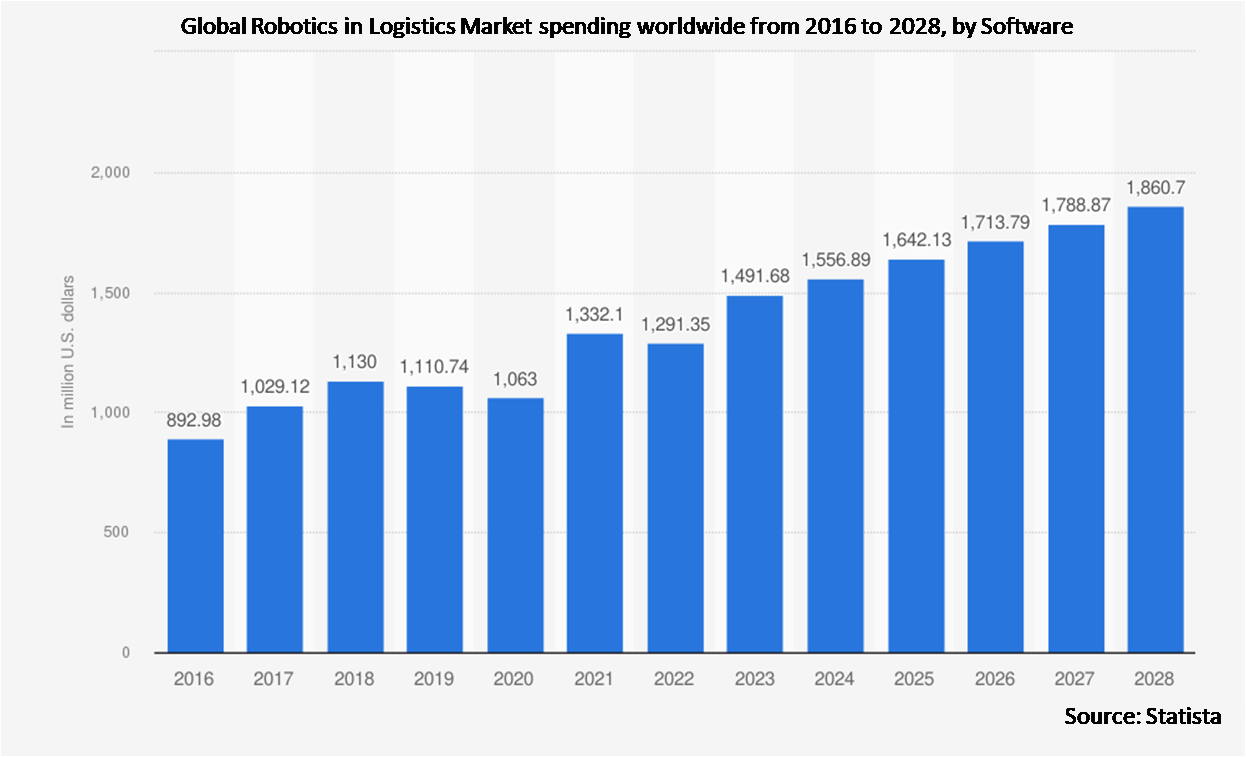
According to Stratistics MRC, the Global Robotics in Logistics Market is accounted for $12.24 billion in 2025 and is expected to reach $40.66 billion by 2032 growing at a CAGR of 18.7% during the forecast period. Logistics robotics is revolutionizing the handling, storage, and transportation of goods, increasing supply chain speed, accuracy, and efficiency. Warehouses and distribution centers are increasingly using robots, including autonomous mobile robots (AMRs), robotic arms, automated guided vehicles (AGVs), and drone systems, to automate tasks like inventory management, picking, packing, and sorting. To meet the demands of e-commerce and just-in-time delivery models, these technologies are particularly important because they prevent human error, reduce labor costs, and enable 24/7 operations. Moreover, logistics robotics is anticipated to grow more intelligent and adaptive as artificial intelligence and machine learning continue to progress, further streamlining supply chain operations and facilitating scalable, real-time responsiveness.
According to the International Federation of Robotics (IFR), their World Robotics 2023 report confirms that 4,281,585 industrial robots were operational in factories globally by the end of 2023—a 10% increase from the previous year. This marks the third consecutive year with over half a million new installations, reinforcing the global momentum toward automation in manufacturing and logistics.
Market Dynamics:
Driver:
Quick development of online shopping
The rapid growth of e-commerce has changed how consumers behave, leading to a greater need for delivery options that are accurate, quick, and flexible. Because of this, logistics companies are under tremendous pressure to handle a large number of small, customized orders quickly. It is no longer possible to meet the demands of same-day or next-day delivery using traditional manual processes. Robotics has emerged as a major facilitator of this change, enabling businesses to more quickly and accurately automate repetitive processes like order picking, sorting, and packaging. Additionally, robotic systems allow e-commerce players to scale their operations effectively and guarantee consistent throughput even during periods of high shopping demand.
Restraint:
Expensive initial investment costs
The high initial cost of buying, setting up, and integrating robotic systems is one of the biggest obstacles to the adoption of robotics in logistics. These expenses cover the cost of the robots themselves, including automated guided vehicles (AGVs), robotic arms, and autonomous mobile robots (AMRs), as well as related software, infrastructure upgrades, and employee training. These costs can be unaffordable for small and medium-sized logistics companies, particularly if there are no assured immediate returns on investment. Furthermore, the overall cost may also increase if facilities are upgraded to accommodate automation, such as by adding sensors, charging stations, and reinforced flooring.
Opportunity:
Expansion of robotics-as-a-service (RaaS) framework
The use of robotic solutions by logistics companies is changing as a result of the rise of the Robotics-as-a-Service (RaaS) model. Businesses no longer need to make significant upfront capital investments because RaaS enables them to rent or lease robots on a subscription basis. For small and medium-sized businesses (SMEs), this model dramatically reduces the entry barrier, allowing them to adopt cutting-edge robotics technology with little risk. Additionally, RaaS offers ongoing value without requiring a long-term commitment by including support services like analytics, maintenance, and upgrades.
Threat:
Supply chain interruptions and shortages of components
The supply chain for robotics depends on specialized sensors, electrical components, semiconductors, and mechanical parts, many of which are sourced from around the world. Significant disruptions in this supply chain can result from pandemics, natural disasters, trade restrictions, and geopolitical tensions, which can delay product deliveries and drive up prices. The global shortage of semiconductors, for instance, which started in 2020, had an impact on robot production schedules and caused many logistics companies to postpone their deployment dates. Moreover, these interruptions hinder the ability of users and vendors to plan capacity and schedules, which ultimately slows the adoption of robotic technologies in logistics networks.
Covid-19 Impact:
Due to labour shortages, social distancing regulations, and the growing demand for contactless delivery and e-commerce, the COVID-19 pandemic had a major impact on the logistics industry's adoption of robotics. Automation became strategically necessary to maintain operational continuity in warehouses and distribution centres due to limitations on human movement and health concerns. Furthermore, the pandemic brought attention to the weaknesses of conventional logistics models and spurred long-term investments in robotic technologies as a way to create supply chains that are more robust, scalable, and prepared for the future.
The automated guided vehicles (AGVs) segment is expected to be the largest during the forecast period
The automated guided vehicles (AGVs) segment is expected to account for the largest market share during the forecast period, motivated by their extensive use in manufacturing facilities and warehouses for the safe and effective transportation of goods. AGVs are perfect for structured environments with repetitive workflows because they use fixed paths that are guided by wires, magnets, or lasers. They are a popular option for automating material handling tasks because of their capacity to decrease manual labor, increase accuracy, and reduce workplace accidents. To increase throughput and operational efficiency and maintain their dominance in the current logistics automation landscape, industries like retail, e-commerce, and automotive make significant investments in AGVs.
The packing & co-packing segment is expected to have the highest CAGR during the forecast period
Over the forecast period, the packing & co-packing segment is predicted to witness the highest growth rate, driven by the expanding demand for speed, accuracy, and personalization in packaging procedures in sectors like food and beverage, pharmaceuticals, and e-commerce. By automating processes like boxing, sealing, labeling, and assembling promotional packages, robotics in packing and co-packing operations drastically lower labor costs and human error. Businesses are implementing robotic systems to guarantee consistency and scalability as consumer demand shifts toward customized and high-volume packaging solutions. Moreover, the versatility of automation is increased by developments in flexible gripper technologies and machine vision, which further accelerate this trend.
Region with largest share:
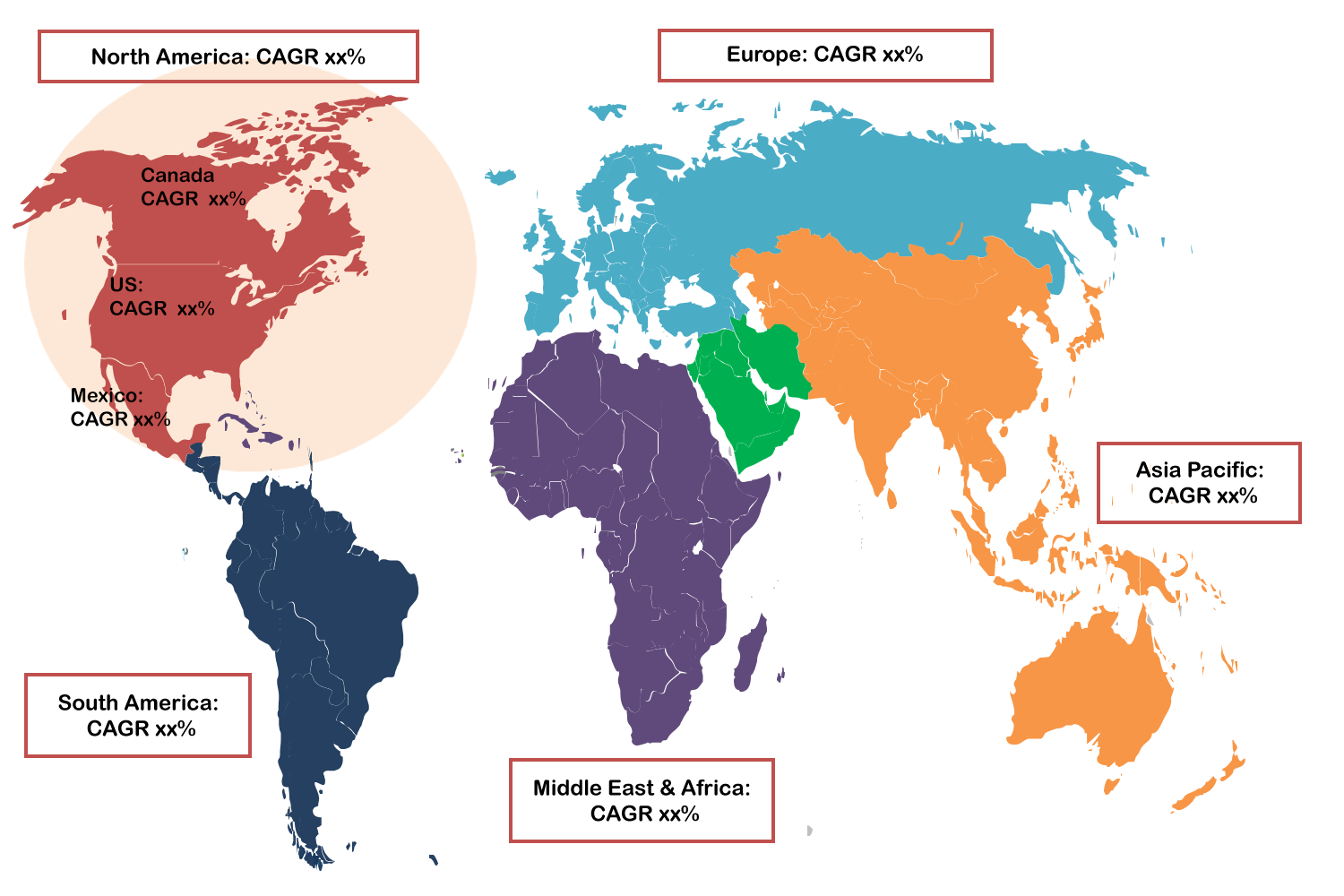
During the forecast period, the Asia-Pacific region is expected to hold the largest market share, mainly due to the boom in e-commerce, fast industrialization, and large investments in automation technologies in nations like South Korea, Japan, and China. China leads the region in the use of logistics robots in smart warehouses, owing to government programs that support Industry 4.0 and the Made in China 2025 strategy. Major regional players like Rakuten, JD.com, and Alibaba have also made significant investments in robotic logistics in an effort to speed up deliveries and optimize supply chains. Additionally, the region's robust manufacturing sector and mounting labor cost pressures contribute to the demand for automation.
Region with highest CAGR:
Over the forecast period, the North America region is anticipated to exhibit the highest CAGR, propelled by the swift development of technology, the dominance of top robotics producers, and the growing need for automation among third-party logistics (3PL) and e-commerce companies? The growing use of robotic arms, AI-integrated systems, and autonomous mobile robots (AMRs) in warehousing and distribution operations is driving notable growth, especially in the United States. Furthermore, robotics investments are being driven by factors like high labor costs, a lack of workers, and the increased focus on contactless logistics following COVID-19. Favorable government policies and robust R&D assistance also contribute to the region's market expansion.
Key players in the market
Some of the key players in Robotics in Logistics Market include KUKA AG, Honeywell International Inc, Kawasaki Heavy Industries, Ltd., Beumer Group, ABB Robotics, Swisslog Holding AG, Krones AG, Toshiba Corporation, Kion Group Ag, Toyota Industries Corporation, Fanuc Corporation, Omron Corporation, Yaskawa Electric Corporation, Amazon Robotics and Vecna Robotics Inc.
Key Developments:
In April 2025, Beumer Group South America has been awarded two contracts by Gerdau SA to supply stockyard machines to the Gerdau Açominas Ouro Branco steel plant. The double win will see BEUMER Group South America supply a new FAM bridge type bucket wheel reclaimer, one stacker and one reclaimer boom type for use in the stockyards of Gerdau’s steel plant. The project scope, aimed at enhancing the steel plant’s operational efficiency, also includes engineering, purchasing, fabrication, transport to site and site services.
In December 2024, Honeywell announced the signing of a strategic agreement with Bombardier, a global leader in aviation and manufacturer of world-class business jets, to provide advanced technology for current and future Bombardier aircraft in avionics, propulsion and satellite communications technologies. The collaboration will advance new technology to enable a host of high-value upgrades for the installed Bombardier operator base, as well as lay innovative foundations for future aircraft.
In September 2024, Kawasaki Heavy Industries, Ltd. and CB&I, a wholly owned unrestricted subsidiary of McDermott, announced their signing of a strategic agreement for promoting a commercial-use liquefied hydrogen (LH2) supply chain and realizing a zero-carbon-emission society. The signing ceremony took place at Gastech Exhibition & Conference in Houston.
Components Covered:
• Hardware
• Software
• Services
Robot Types Covered:
• Autonomous Mobile Robots (AMRs)
• Automated Guided Vehicles (AGVs)
• Robotic Arms
• Drones (Unmanned Aerial Vehicles)
• Other Robot Types
Functions Covered:
• Pick & Place
• Loading & Unloading
• Packing & Co-packing
• Palletizing & Depalletizing
• Sorting
• Transportation
• Shipment & Delivery
• Warehouse Execution Tasks
Payload Capacities Covered:
• Low-capacity Robots (under 100 kg)
• Medium-capacity Robots (100-500 kg)
• High-capacity Robots (above 500 kg)
Power Sources Covered:
• Battery-powered
• Hydrogen Fuel Cell
• Other Power Sources
End Users Covered:
• E-commerce & Retail
• Healthcare
• Warehousing & Distribution Centers
• Manufacturing
• Airports & Ports
• Cold Storage Facilities
• Other End Users
Regions Covered:
• North America
o US
o Canada
o Mexico
• Europe
o Germany
o UK
o Italy
o France
o Spain
o Rest of Europe
• Asia Pacific
o Japan
o China
o India
o Australia
o New Zealand
o South Korea
o Rest of Asia Pacific
• South America
o Argentina
o Brazil
o Chile
o Rest of South America
• Middle East & Africa
o Saudi Arabia
o UAE
o Qatar
o South Africa
o Rest of Middle East & Africa
What our report offers:
- Market share assessments for the regional and country-level segments
- Strategic recommendations for the new entrants
- Covers Market data for the years 2024, 2025, 2026, 2028, and 2032
- Market Trends (Drivers, Constraints, Opportunities, Threats, Challenges, Investment Opportunities, and recommendations)
- Strategic recommendations in key business segments based on the market estimations
- Competitive landscaping mapping the key common trends
- Company profiling with detailed strategies, financials, and recent developments
- Supply chain trends mapping the latest technological advancements
Free Customization Offerings:
All the customers of this report will be entitled to receive one of the following free customization options:
• Company Profiling
o Comprehensive profiling of additional market players (up to 3)
o SWOT Analysis of key players (up to 3)
• Regional Segmentation
o Market estimations, Forecasts and CAGR of any prominent country as per the client's interest (Note: Depends on feasibility check)
• Competitive Benchmarking
o Benchmarking of key players based on product portfolio, geographical presence, and strategic alliances
Table of Contents
1 Executive Summary
2 Preface
2.1 Abstract
2.2 Stake Holders
2.3 Research Scope
2.4 Research Methodology
2.4.1 Data Mining
2.4.2 Data Analysis
2.4.3 Data Validation
2.4.4 Research Approach
2.5 Research Sources
2.5.1 Primary Research Sources
2.5.2 Secondary Research Sources
2.5.3 Assumptions
3 Market Trend Analysis
3.1 Introduction
3.2 Drivers
3.3 Restraints
3.4 Opportunities
3.5 Threats
3.6 End User Analysis
3.7 Emerging Markets
3.8 Impact of Covid-19
4 Porters Five Force Analysis
4.1 Bargaining power of suppliers
4.2 Bargaining power of buyers
4.3 Threat of substitutes
4.4 Threat of new entrants
4.5 Competitive rivalry
5 Global Robotics in Logistics Market, By Component
5.1 Introduction
5.2 Hardware
5.3 Software
5.4 Services
6 Global Robotics in Logistics Market, By Robot Type
6.1 Introduction
6.2 Autonomous Mobile Robots (AMRs)
6.3 Automated Guided Vehicles (AGVs)
6.4 Robotic Arms
6.5 Drones (Unmanned Aerial Vehicles)
6.6 Other Robot Types
7 Global Robotics in Logistics Market, By Function
7.1 Introduction
7.2 Pick & Place
7.3 Loading & Unloading
7.4 Packing & Co-packing
7.5 Palletizing & Depalletizing
7.6 Sorting
7.7 Transportation
7.8 Shipment & Delivery
7.9 Warehouse Execution Tasks
8 Global Robotics in Logistics Market, By Payload Capacity
8.1 Introduction
8.2 Low-capacity Robots (under 100 kg)
8.3 Medium-capacity Robots (100-500 kg)
8.4 High-capacity Robots (above 500 kg)
9 Global Robotics in Logistics Market, By Power Source
9.1 Introduction
9.2 Battery-powered
9.3 Hydrogen Fuel Cell
9.4 Other Power Sources
10 Global Robotics in Logistics Market, By End User
10.1 Introduction
10.2 E-commerce & Retail
10.3 Healthcare
10.4 Warehousing & Distribution Centers
10.5 Manufacturing
10.6 Airports & Ports
10.7 Cold Storage Facilities
10.8 Other End Users
11 Global Robotics in Logistics Market, By Geography
11.1 Introduction
11.2 North America
11.2.1 US
11.2.2 Canada
11.2.3 Mexico
11.3 Europe
11.3.1 Germany
11.3.2 UK
11.3.3 Italy
11.3.4 France
11.3.5 Spain
11.3.6 Rest of Europe
11.4 Asia Pacific
11.4.1 Japan
11.4.2 China
11.4.3 India
11.4.4 Australia
11.4.5 New Zealand
11.4.6 South Korea
11.4.7 Rest of Asia Pacific
11.5 South America
11.5.1 Argentina
11.5.2 Brazil
11.5.3 Chile
11.5.4 Rest of South America
11.6 Middle East & Africa
11.6.1 Saudi Arabia
11.6.2 UAE
11.6.3 Qatar
11.6.4 South Africa
11.6.5 Rest of Middle East & Africa
12 Key Developments
12.1 Agreements, Partnerships, Collaborations and Joint Ventures
12.2 Acquisitions & Mergers
12.3 New Product Launch
12.4 Expansions
12.5 Other Key Strategies
13 Company Profiling
13.1 KUKA AG
13.2 Honeywell International Inc
13.3 Kawasaki Heavy Industries, Ltd.
13.4 Beumer Group
13.5 ABB Robotics
13.6 Swisslog Holding AG
13.7 Krones AG
13.8 Toshiba Corporation
13.9 Kion Group Ag
13.10 Toyota Industries Corporation
13.11 Fanuc Corporation
13.12 Omron Corporation
13.13 Yaskawa Electric Corporation
13.14 Amazon Robotics
13.15 Vecna Robotics Inc
List of Tables
1 Global Robotics in Logistics Market Outlook, By Region (2024-2032) ($MN)
2 Global Robotics in Logistics Market Outlook, By Component (2024-2032) ($MN)
3 Global Robotics in Logistics Market Outlook, By Hardware (2024-2032) ($MN)
4 Global Robotics in Logistics Market Outlook, By Software (2024-2032) ($MN)
5 Global Robotics in Logistics Market Outlook, By Services (2024-2032) ($MN)
6 Global Robotics in Logistics Market Outlook, By Robot Type (2024-2032) ($MN)
7 Global Robotics in Logistics Market Outlook, By Autonomous Mobile Robots (AMRs) (2024-2032) ($MN)
8 Global Robotics in Logistics Market Outlook, By Automated Guided Vehicles (AGVs) (2024-2032) ($MN)
9 Global Robotics in Logistics Market Outlook, By Robotic Arms (2024-2032) ($MN)
10 Global Robotics in Logistics Market Outlook, By Drones (Unmanned Aerial Vehicles) (2024-2032) ($MN)
11 Global Robotics in Logistics Market Outlook, By Other Robot Types (2024-2032) ($MN)
12 Global Robotics in Logistics Market Outlook, By Function (2024-2032) ($MN)
13 Global Robotics in Logistics Market Outlook, By Pick & Place (2024-2032) ($MN)
14 Global Robotics in Logistics Market Outlook, By Loading & Unloading (2024-2032) ($MN)
15 Global Robotics in Logistics Market Outlook, By Packing & Co-packing (2024-2032) ($MN)
16 Global Robotics in Logistics Market Outlook, By Palletizing & Depalletizing (2024-2032) ($MN)
17 Global Robotics in Logistics Market Outlook, By Sorting (2024-2032) ($MN)
18 Global Robotics in Logistics Market Outlook, By Transportation (2024-2032) ($MN)
19 Global Robotics in Logistics Market Outlook, By Shipment & Delivery (2024-2032) ($MN)
20 Global Robotics in Logistics Market Outlook, By Warehouse Execution Tasks (2024-2032) ($MN)
21 Global Robotics in Logistics Market Outlook, By Payload Capacity (2024-2032) ($MN)
22 Global Robotics in Logistics Market Outlook, By Low-capacity Robots (under 100 kg) (2024-2032) ($MN)
23 Global Robotics in Logistics Market Outlook, By Medium-capacity Robots (100-500 kg) (2024-2032) ($MN)
24 Global Robotics in Logistics Market Outlook, By High-capacity Robots (above 500 kg) (2024-2032) ($MN)
25 Global Robotics in Logistics Market Outlook, By Power Source (2024-2032) ($MN)
26 Global Robotics in Logistics Market Outlook, By Battery-powered (2024-2032) ($MN)
27 Global Robotics in Logistics Market Outlook, By Hydrogen Fuel Cell (2024-2032) ($MN)
28 Global Robotics in Logistics Market Outlook, By Other Power Sources (2024-2032) ($MN)
29 Global Robotics in Logistics Market Outlook, By End User (2024-2032) ($MN)
30 Global Robotics in Logistics Market Outlook, By E-commerce & Retail (2024-2032) ($MN)
31 Global Robotics in Logistics Market Outlook, By Healthcare (2024-2032) ($MN)
32 Global Robotics in Logistics Market Outlook, By Warehousing & Distribution Centers (2024-2032) ($MN)
33 Global Robotics in Logistics Market Outlook, By Manufacturing (2024-2032) ($MN)
34 Global Robotics in Logistics Market Outlook, By Airports & Ports (2024-2032) ($MN)
35 Global Robotics in Logistics Market Outlook, By Cold Storage Facilities (2024-2032) ($MN)
36 Global Robotics in Logistics Market Outlook, By Other End Users (2024-2032) ($MN)
Note: Tables for North America, Europe, APAC, South America, and Middle East & Africa Regions are also represented in the same manner as above.
List of Figures
RESEARCH METHODOLOGY

We at ‘Stratistics’ opt for an extensive research approach which involves data mining, data validation, and data analysis. The various research sources include in-house repository, secondary research, competitor’s sources, social media research, client internal data, and primary research.
Our team of analysts prefers the most reliable and authenticated data sources in order to perform the comprehensive literature search. With access to most of the authenticated data bases our team highly considers the best mix of information through various sources to obtain extensive and accurate analysis.
Each report takes an average time of a month and a team of 4 industry analysts. The time may vary depending on the scope and data availability of the desired market report. The various parameters used in the market assessment are standardized in order to enhance the data accuracy.
Data Mining
The data is collected from several authenticated, reliable, paid and unpaid sources and is filtered depending on the scope & objective of the research. Our reports repository acts as an added advantage in this procedure. Data gathering from the raw material suppliers, distributors and the manufacturers is performed on a regular basis, this helps in the comprehensive understanding of the products value chain. Apart from the above mentioned sources the data is also collected from the industry consultants to ensure the objective of the study is in the right direction.
Market trends such as technological advancements, regulatory affairs, market dynamics (Drivers, Restraints, Opportunities and Challenges) are obtained from scientific journals, market related national & international associations and organizations.
Data Analysis
From the data that is collected depending on the scope & objective of the research the data is subjected for the analysis. The critical steps that we follow for the data analysis include:
- Product Lifecycle Analysis
- Competitor analysis
- Risk analysis
- Porters Analysis
- PESTEL Analysis
- SWOT Analysis
The data engineering is performed by the core industry experts considering both the Marketing Mix Modeling and the Demand Forecasting. The marketing mix modeling makes use of multiple-regression techniques to predict the optimal mix of marketing variables. Regression factor is based on a number of variables and how they relate to an outcome such as sales or profits.
Data Validation
The data validation is performed by the exhaustive primary research from the expert interviews. This includes telephonic interviews, focus groups, face to face interviews, and questionnaires to validate our research from all aspects. The industry experts we approach come from the leading firms, involved in the supply chain ranging from the suppliers, distributors to the manufacturers and consumers so as to ensure an unbiased analysis.
We are in touch with more than 15,000 industry experts with the right mix of consultants, CEO's, presidents, vice presidents, managers, experts from both supply side and demand side, executives and so on.
The data validation involves the primary research from the industry experts belonging to:
- Leading Companies
- Suppliers & Distributors
- Manufacturers
- Consumers
- Industry/Strategic Consultants
Apart from the data validation the primary research also helps in performing the fill gap research, i.e. providing solutions for the unmet needs of the research which helps in enhancing the reports quality.
For more details about research methodology, kindly write to us at info@strategymrc.com
Frequently Asked Questions
In case of any queries regarding this report, you can contact the customer service by filing the “Inquiry Before Buy” form available on the right hand side. You may also contact us through email: info@strategymrc.com or phone: +1-301-202-5929
Yes, the samples are available for all the published reports. You can request them by filling the “Request Sample” option available in this page.
Yes, you can request a sample with your specific requirements. All the customized samples will be provided as per the requirement with the real data masked.
All our reports are available in Digital PDF format. In case if you require them in any other formats, such as PPT, Excel etc you can submit a request through “Inquiry Before Buy” form available on the right hand side. You may also contact us through email: info@strategymrc.com or phone: +1-301-202-5929
We offer a free 15% customization with every purchase. This requirement can be fulfilled for both pre and post sale. You may send your customization requirements through email at info@strategymrc.com or call us on +1-301-202-5929.
We have 3 different licensing options available in electronic format.
- Single User Licence: Allows one person, typically the buyer, to have access to the ordered product. The ordered product cannot be distributed to anyone else.
- 2-5 User Licence: Allows the ordered product to be shared among a maximum of 5 people within your organisation.
- Corporate License: Allows the product to be shared among all employees of your organisation regardless of their geographical location.
All our reports are typically be emailed to you as an attachment.
To order any available report you need to register on our website. The payment can be made either through CCAvenue or PayPal payments gateways which accept all international cards.
We extend our support to 6 months post sale. A post sale customization is also provided to cover your unmet needs in the report.
Request Customization
We offer complimentary customization of up to 15% with every purchase. To share your customization requirements, feel free to email us at info@strategymrc.com or call us on +1-301-202-5929. .
Please Note: Customization within the 15% threshold is entirely free of charge. If your request exceeds this limit, we will conduct a feasibility assessment. Following that, a detailed quote and timeline will be provided.
WHY CHOOSE US ?

Assured Quality
Best in class reports with high standard of research integrity

24X7 Research Support
Continuous support to ensure the best customer experience.

Free Customization
Adding more values to your product of interest.

Safe & Secure Access
Providing a secured environment for all online transactions.

Trusted by 600+ Brands
Serving the most reputed brands across the world.
