
Space In Orbit Refueling Market
Space In-Orbit Refueling Market Forecasts to 2032 - Global Analysis By Propellant Type (Chemical Propellants and Electric Propellants), Refueling Technology Type (Cryogenic Refueling and Non-Cryogenic Refueling), Capability, Platform, Application, End User and By Geography

|
Years Covered |
2024-2032 |
|
Estimated Year Value (2025) |
US $1532.66 MN |
|
Projected Year Value (2032) |
US $3930.32 MN |
|
CAGR (2025 - 2032) |
14.4% |
|
Regions Covered |
North America, Europe, Asia Pacific, South America, and Middle East & Africa |
|
Countries Covered |
US, Canada, Mexico, Germany, UK, Italy, France, Spain, Japan, China, India, Australia, New Zealand, South Korea, Rest of Asia Pacific, South America, Argentina, Brazil, Chile, Middle East & Africa, Saudi Arabia, UAE, Qatar, and South Africa |
|
Largest Market |
North America |
|
Highest Growing Market |
Asia Pacific |
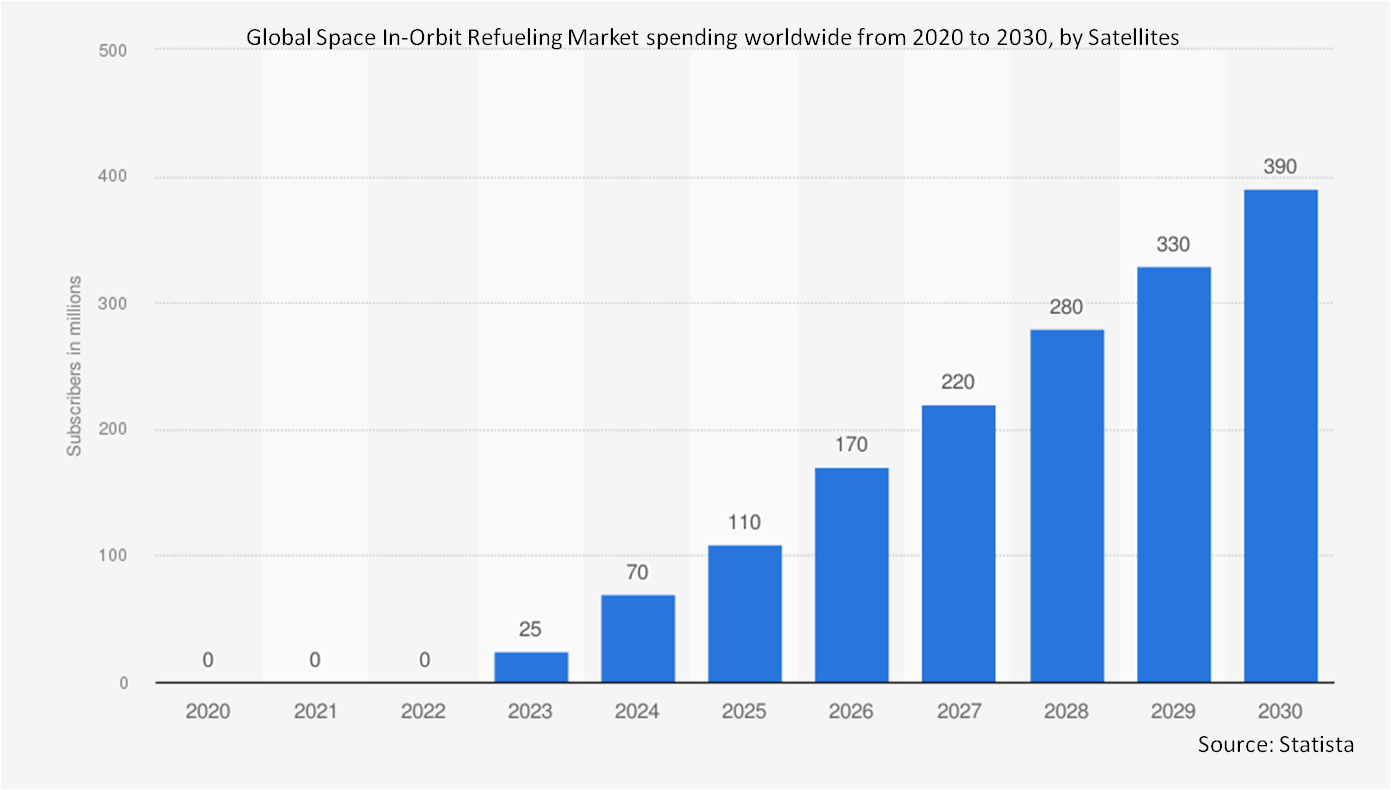
According to Stratistics MRC, the Global Space In-Orbit Refueling Market is accounted for $1532.66 million in 2025 and is expected to reach $3930.32 million by 2032 growing at a CAGR of 14.4% during the forecast period. Space in-orbit refueling is an emerging technology that enables spacecraft to be refueled while in space, significantly extending their operational lifespans and expanding mission capabilities. This method lowers the need for launching completely new systems and promotes more sustainable space operations by enabling satellites, space telescopes, and even crewed missions to refuel without going back to Earth
According to the European Space Agency (ESA), the ASSIST (Autonomous and SpacE Interface for Satellite Servicing and Transfer) project involves 6 partner organizations across 4 European countries, aiming to create a standardized docking mechanism that allows multiple refuelings during a satellite’s 15-year lifetime.
Market Dynamics:
Driver:
Growing interest in satellite life extension
A communication satellite's lifespan is usually between 10 and 15 years, depending mostly on the availability of fuel for maneuvering and station-keeping. Nonetheless, even after their fuel runs out, a large number of these satellites maintain fully operational subsystems, including payloads, solar arrays, and processors. Additionally, a game-changing solution is space in-orbit refueling, which delays decommissioning and replacement launches by allowing fuel replenishment while in orbit. With high-value satellites in GEO, where every extra year of operation can result in tens of millions of dollars in increased revenue generation, this is extremely beneficial.
Restraint:
High start-up costs for development and operations
Even though in-orbit space refueling has long-term advantages, it necessitates a large initial investment in mission execution, testing, and technology development. It often costs hundreds of millions of dollars to design spacecraft that can manage robotic servicing, fluid transfer, and precise docking in microgravity. This requires advanced engineering and stringent space qualification procedures. Furthermore, expenses are incurred when these servicing vehicles are launched into orbit, particularly for missions that are deep space or outside of low Earth orbit. The broad adoption of in-orbit refueling solutions is being slowed down by these capital requirements, which present a significant barrier to entry for many commercial operators, especially smaller players.
Opportunity:
Development of serviceable and modular satellite designs
A growing number of new satellites are being designed with servicing and refueling in mind as the space industry shifts toward standardization and modular architecture. This change makes way for the creation of industry-wide docking and refueling guidelines, like those found in ESA's SPACECRAFT program and NASA's Cooperative Servicing Aids (CSA). Moreover, modular parts that can be upgraded or maintained in orbit, such as plug-and-play power modules or replaceable propulsion units, are starting to be used by manufacturers. As regular maintenance, upgrades, and fuel top-ups become commonplace rather than extraordinary occurrences, this trend offers in-orbit refueling providers a huge chance to integrate into a broader on-orbit servicing ecosystem.
Threat:
High mission complexity and technical risk
Extremely precise docking, fluid transfer, leak detection, and thermal management are all necessary for in-orbit refueling because these tasks must be completed in the vacuum of space, where repairs are practically impossible. Any mechanical malfunctions or minor misalignments could put the entire mission in danger. Additionally, technologies need to take into consideration the fluid dynamics in zero gravity, which necessitates specially designed pumps and valves that are very different from those found in Earth-based systems. In-space validation is costly and time-consuming, and there is little ground testing available for these systems.
Covid-19 Impact:
Due to supply chain interruptions, postponed important missions, and delayed research and development efforts, the COVID-19 pandemic initially slowed down progress in the space in-orbit refuelling market. New technology testing and deployment were hampered by lockdowns and restrictions, and funds for some space projects were diverted to more pressing requirements. To guarantee satellite longevity and lower the frequency of new launches, the pandemic also highlighted the need for more resilient space infrastructure and longer-lasting satellite constellations. Furthermore, the market was positioned for growth in the post-pandemic era as a result of this change in focus, renewed investment, and strategic partnerships brought about by the growing demand for autonomous space operations.
The chemical propellants segment is expected to be the largest during the forecast period
The chemical propellants segment is expected to account for the largest market share during the forecast period. These propellants, which include hydrazine, liquid hydrogen, and hydrazine derivatives, are commonly used in spacecraft for a variety of orbital maneuvers, including attitude control, station-keeping, and orbital changes. Chemical propellants are still the best option for refueling missions in the near future due to their well-understood technology, high thrust capabilities, and reliable performance in a range of space environments, even with advances in electric propulsion. Moreover, the market is anticipated to remain dominated by this segment, particularly for low-Earth orbit and geostationary satellites.
The non-cryogenic refueling segment is expected to have the highest CAGR during the forecast period
Over the forecast period, the non-cryogenic refueling segment is predicted to witness the highest growth rate because they are easier to handle and store than cryogenic fuels, which need extremely cold temperatures to be stored, non-cryogenic propellants like hydrazine, green propellants, and electric propulsion systems are becoming more and more popular. These propellants are especially appealing for constellations and smaller satellites that need to have minimal infrastructure and longer mission lifespans. Additionally, the development of green propellant technologies, which provide safer handling and a lower environmental impact, is also fueling this expansion. Commercial space operators and low Earth orbit (LEO) satellites favor non-cryogenic refueling because it offers greater flexibility and cost-effectiveness.
Region with largest share:
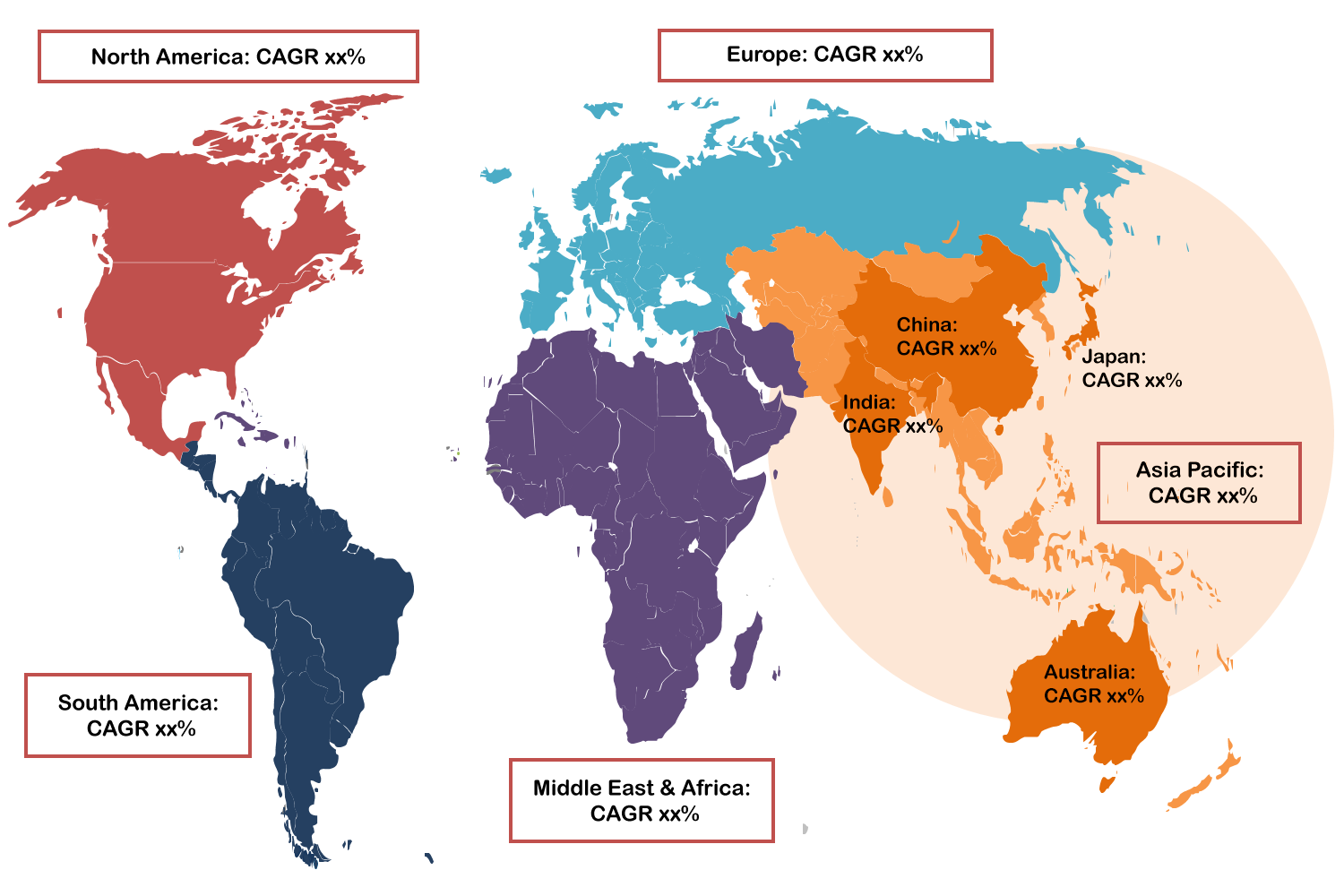
During the forecast period, the North America region is expected to hold the largest market share, driven by the strong presence of important private companies like SpaceX and Blue Origin, as well as important space agencies like NASA. With large investments in satellite maintenance and refueling technologies, the United States is leading the way in technological developments for space infrastructure, including in-orbit refueling. Additionally, the development and implementation of in-orbit refueling technologies are made possible by North America's sophisticated space policies, regulatory frameworks, and established commercial space ecosystem.
Region with highest CAGR:
Over the forecast period, the Asia Pacific region is anticipated to exhibit the highest CAGR. The swift expansion of space exploration and satellite launches in the region, fueled by nations such as China, India, and Japan, is creating a notable need for space infrastructure technologies, such as in-orbit refueling. Growth is primarily driven by China's ambitious space programs, such as its plans for orbital space stations and lunar exploration, as well as India's growing fleet of communication and remote sensing satellites. The private sector is also getting involved in space activities, and the region is witnessing significant investments in space innovation.
Key players in the market
Some of the key players in Space In-Orbit Refueling Market include Altius Space Machines, Inc, SpaceX, Lockheed Martin Corporation, Tethers Unlimited, Inc, Maxar Technologies Inc, Northrop Grumman Corporation, ClearSpace Inc, Astroscale Holdings Inc, Obruta Space Solutions Crop, D-Orbit SpA, Eta Space, Thales, Momentus Space Inc and LMO Space.
Key Developments:
In April 2025, SpaceX and United Launch Alliance are expected to each win a US Space Force rocket launch contract worth billions of dollars over the next several years to send some of the Pentagon's most sensitive satellites into space.
In December 2024, Maxar Intelligence and Satellogic, Inc. have announced a tasking, data licensing and distribution agreement (the “Agreement”) that enhances Maxar’s ability to deliver monitoring and change detection insights in near real-time for the U.S. government and the government’s partners around the world.
In September 2024, Lockheed Martin and Tata Advanced Systems Limited have entered into a teaming agreement to expand upon the companies' business relationship through the C-130J Super Hercules tactical airlifter. This announcement marks a significant step in enhancing India's defence and aerospace capabilities while also deepening India-U.S. strategic ties
Propellant Types Covered:
• Chemical Propellants
• Electric Propellants
Refueling Technology Types Covered:
• Cryogenic Refueling
• Non-Cryogenic Refueling
Capabilities Covered:
• Propellant Transfer
• In-Orbit Rendezvous
• In-Orbit Propellant Storage
Platforms Covered:
• Satellites
• Space Stations
• Space Exploration Probes
Applications Covered:
• Communication
• Satellite Servicing
• Deep Space Missions
• Other Applications
End Users Covered:
• Government Agencies
• Private Space Companies
Regions Covered:
• North America
o US
o Canada
o Mexico
• Europe
o Germany
o UK
o Italy
o France
o Spain
o Rest of Europe
• Asia Pacific
o Japan
o China
o India
o Australia
o New Zealand
o South Korea
o Rest of Asia Pacific
• South America
o Argentina
o Brazil
o Chile
o Rest of South America
• Middle East & Africa
o Saudi Arabia
o UAE
o Qatar
o South Africa
o Rest of Middle East & Africa
What our report offers:
- Market share assessments for the regional and country-level segments
- Strategic recommendations for the new entrants
- Covers Market data for the years 2024, 2025, 2026, 2028, and 2032
- Market Trends (Drivers, Constraints, Opportunities, Threats, Challenges, Investment Opportunities, and recommendations)
- Strategic recommendations in key business segments based on the market estimations
- Competitive landscaping mapping the key common trends
- Company profiling with detailed strategies, financials, and recent developments
- Supply chain trends mapping the latest technological advancements
Free Customization Offerings:
All the customers of this report will be entitled to receive one of the following free customization options:
• Company Profiling
o Comprehensive profiling of additional market players (up to 3)
o SWOT Analysis of key players (up to 3)
• Regional Segmentation
o Market estimations, Forecasts and CAGR of any prominent country as per the client's interest (Note: Depends on feasibility check)
• Competitive Benchmarking
o Benchmarking of key players based on product portfolio, geographical presence, and strategic alliances
Table of Contents
1 Executive Summary
2 Preface
2.1 Abstract
2.2 Stake Holders
2.3 Research Scope
2.4 Research Methodology
2.4.1 Data Mining
2.4.2 Data Analysis
2.4.3 Data Validation
2.4.4 Research Approach
2.5 Research Sources
2.5.1 Primary Research Sources
2.5.2 Secondary Research Sources
2.5.3 Assumptions
3 Market Trend Analysis
3.1 Introduction
3.2 Drivers
3.3 Restraints
3.4 Opportunities
3.5 Threats
3.6 Application Analysis
3.7 End User Analysis
3.8 Emerging Markets
3.9 Impact of Covid-19
4 Porters Five Force Analysis
4.1 Bargaining power of suppliers
4.2 Bargaining power of buyers
4.3 Threat of substitutes
4.4 Threat of new entrants
4.5 Competitive rivalry
5 Global Space In-Orbit Refueling Market, By Propellant Type
5.1 Introduction
5.2 Chemical Propellants
5.3 Electric Propellants
6 Global Space In-Orbit Refueling Market, By Refueling Technology Type
6.1 Introduction
6.2 Cryogenic Refueling
6.3 Non-Cryogenic Refueling
7 Global Space In-Orbit Refueling Market, By Capability
7.1 Introduction
7.2 Propellant Transfer
7.3 In-Orbit Rendezvous
7.4 In-Orbit Propellant Storage
8 Global Space In-Orbit Refueling Market, By Platform
8.1 Introduction
8.2 Satellites
8.3 Space Stations
8.4 Space Exploration Probes
9 Global Space In-Orbit Refueling Market, By Application
9.1 Introduction
9.2 Communication
9.3 Satellite Servicing
9.4 Deep Space Missions
9.5 Other Applications
10 Global Space In-Orbit Refueling Market, By End User
10.1 Introduction
10.2 Government Agencies
10.3 Private Space Companies
11 Global Space In-Orbit Refueling Market, By Geography
11.1 Introduction
11.2 North America
11.2.1 US
11.2.2 Canada
11.2.3 Mexico
11.3 Europe
11.3.1 Germany
11.3.2 UK
11.3.3 Italy
11.3.4 France
11.3.5 Spain
11.3.6 Rest of Europe
11.4 Asia Pacific
11.4.1 Japan
11.4.2 China
11.4.3 India
11.4.4 Australia
11.4.5 New Zealand
11.4.6 South Korea
11.4.7 Rest of Asia Pacific
11.5 South America
11.5.1 Argentina
11.5.2 Brazil
11.5.3 Chile
11.5.4 Rest of South America
11.6 Middle East & Africa
11.6.1 Saudi Arabia
11.6.2 UAE
11.6.3 Qatar
11.6.4 South Africa
11.6.5 Rest of Middle East & Africa
12 Key Developments
12.1 Agreements, Partnerships, Collaborations and Joint Ventures
12.2 Acquisitions & Mergers
12.3 New Product Launch
12.4 Expansions
12.5 Other Key Strategies
13 Company Profiling
13.1 Altius Space Machines, Inc
13.2 SpaceX
13.3 Lockheed Martin Corporation
13.4 Tethers Unlimited, Inc
13.5 Maxar Technologies Inc
13.6 Northrop Grumman Corporation
13.7 ClearSpace Inc
13.8 Astroscale Holdings Inc
13.9 Obruta Space Solutions Crop
13.10 D-Orbit SpA
13.11 Eta Space
13.12 Thales
13.13 Momentus Space Inc
13.14 LMO Space
List of Tables
1 Global Space In-Orbit Refueling Market Outlook, By Region (2024-2032) ($MN)
2 Global Space In-Orbit Refueling Market Outlook, By Propellant Type (2024-2032) ($MN)
3 Global Space In-Orbit Refueling Market Outlook, By Chemical Propellants (2024-2032) ($MN)
4 Global Space In-Orbit Refueling Market Outlook, By Electric Propellants (2024-2032) ($MN)
5 Global Space In-Orbit Refueling Market Outlook, By Refueling Technology Type (2024-2032) ($MN)
6 Global Space In-Orbit Refueling Market Outlook, By Cryogenic Refueling (2024-2032) ($MN)
7 Global Space In-Orbit Refueling Market Outlook, By Non-Cryogenic Refueling (2024-2032) ($MN)
8 Global Space In-Orbit Refueling Market Outlook, By Capability (2024-2032) ($MN)
9 Global Space In-Orbit Refueling Market Outlook, By Propellant Transfer (2024-2032) ($MN)
10 Global Space In-Orbit Refueling Market Outlook, By In-Orbit Rendezvous (2024-2032) ($MN)
11 Global Space In-Orbit Refueling Market Outlook, By In-Orbit Propellant Storage (2024-2032) ($MN)
12 Global Space In-Orbit Refueling Market Outlook, By Platform (2024-2032) ($MN)
13 Global Space In-Orbit Refueling Market Outlook, By Satellites (2024-2032) ($MN)
14 Global Space In-Orbit Refueling Market Outlook, By Space Stations (2024-2032) ($MN)
15 Global Space In-Orbit Refueling Market Outlook, By Space Exploration Probes (2024-2032) ($MN)
16 Global Space In-Orbit Refueling Market Outlook, By Application (2024-2032) ($MN)
17 Global Space In-Orbit Refueling Market Outlook, By Communication (2024-2032) ($MN)
18 Global Space In-Orbit Refueling Market Outlook, By Satellite Servicing (2024-2032) ($MN)
19 Global Space In-Orbit Refueling Market Outlook, By Deep Space Missions (2024-2032) ($MN)
20 Global Space In-Orbit Refueling Market Outlook, By Other Applications (2024-2032) ($MN)
21 Global Space In-Orbit Refueling Market Outlook, By End User (2024-2032) ($MN)
22 Global Space In-Orbit Refueling Market Outlook, By Government Agencies (2024-2032) ($MN)
23 Global Space In-Orbit Refueling Market Outlook, By Private Space Companies (2024-2032) ($MN)
24 North America Space In-Orbit Refueling Market Outlook, By Country (2024-2032) ($MN)
25 North America Space In-Orbit Refueling Market Outlook, By Propellant Type (2024-2032) ($MN)
26 North America Space In-Orbit Refueling Market Outlook, By Chemical Propellants (2024-2032) ($MN)
27 North America Space In-Orbit Refueling Market Outlook, By Electric Propellants (2024-2032) ($MN)
28 North America Space In-Orbit Refueling Market Outlook, By Refueling Technology Type (2024-2032) ($MN)
29 North America Space In-Orbit Refueling Market Outlook, By Cryogenic Refueling (2024-2032) ($MN)
30 North America Space In-Orbit Refueling Market Outlook, By Non-Cryogenic Refueling (2024-2032) ($MN)
31 North America Space In-Orbit Refueling Market Outlook, By Capability (2024-2032) ($MN)
32 North America Space In-Orbit Refueling Market Outlook, By Propellant Transfer (2024-2032) ($MN)
33 North America Space In-Orbit Refueling Market Outlook, By In-Orbit Rendezvous (2024-2032) ($MN)
34 North America Space In-Orbit Refueling Market Outlook, By In-Orbit Propellant Storage (2024-2032) ($MN)
35 North America Space In-Orbit Refueling Market Outlook, By Platform (2024-2032) ($MN)
36 North America Space In-Orbit Refueling Market Outlook, By Satellites (2024-2032) ($MN)
37 North America Space In-Orbit Refueling Market Outlook, By Space Stations (2024-2032) ($MN)
38 North America Space In-Orbit Refueling Market Outlook, By Space Exploration Probes (2024-2032) ($MN)
39 North America Space In-Orbit Refueling Market Outlook, By Application (2024-2032) ($MN)
40 North America Space In-Orbit Refueling Market Outlook, By Communication (2024-2032) ($MN)
41 North America Space In-Orbit Refueling Market Outlook, By Satellite Servicing (2024-2032) ($MN)
42 North America Space In-Orbit Refueling Market Outlook, By Deep Space Missions (2024-2032) ($MN)
43 North America Space In-Orbit Refueling Market Outlook, By Other Applications (2024-2032) ($MN)
44 North America Space In-Orbit Refueling Market Outlook, By End User (2024-2032) ($MN)
45 North America Space In-Orbit Refueling Market Outlook, By Government Agencies (2024-2032) ($MN)
46 North America Space In-Orbit Refueling Market Outlook, By Private Space Companies (2024-2032) ($MN)
47 Europe Space In-Orbit Refueling Market Outlook, By Country (2024-2032) ($MN)
48 Europe Space In-Orbit Refueling Market Outlook, By Propellant Type (2024-2032) ($MN)
49 Europe Space In-Orbit Refueling Market Outlook, By Chemical Propellants (2024-2032) ($MN)
50 Europe Space In-Orbit Refueling Market Outlook, By Electric Propellants (2024-2032) ($MN)
51 Europe Space In-Orbit Refueling Market Outlook, By Refueling Technology Type (2024-2032) ($MN)
52 Europe Space In-Orbit Refueling Market Outlook, By Cryogenic Refueling (2024-2032) ($MN)
53 Europe Space In-Orbit Refueling Market Outlook, By Non-Cryogenic Refueling (2024-2032) ($MN)
54 Europe Space In-Orbit Refueling Market Outlook, By Capability (2024-2032) ($MN)
55 Europe Space In-Orbit Refueling Market Outlook, By Propellant Transfer (2024-2032) ($MN)
56 Europe Space In-Orbit Refueling Market Outlook, By In-Orbit Rendezvous (2024-2032) ($MN)
57 Europe Space In-Orbit Refueling Market Outlook, By In-Orbit Propellant Storage (2024-2032) ($MN)
58 Europe Space In-Orbit Refueling Market Outlook, By Platform (2024-2032) ($MN)
59 Europe Space In-Orbit Refueling Market Outlook, By Satellites (2024-2032) ($MN)
60 Europe Space In-Orbit Refueling Market Outlook, By Space Stations (2024-2032) ($MN)
61 Europe Space In-Orbit Refueling Market Outlook, By Space Exploration Probes (2024-2032) ($MN)
62 Europe Space In-Orbit Refueling Market Outlook, By Application (2024-2032) ($MN)
63 Europe Space In-Orbit Refueling Market Outlook, By Communication (2024-2032) ($MN)
64 Europe Space In-Orbit Refueling Market Outlook, By Satellite Servicing (2024-2032) ($MN)
65 Europe Space In-Orbit Refueling Market Outlook, By Deep Space Missions (2024-2032) ($MN)
66 Europe Space In-Orbit Refueling Market Outlook, By Other Applications (2024-2032) ($MN)
67 Europe Space In-Orbit Refueling Market Outlook, By End User (2024-2032) ($MN)
68 Europe Space In-Orbit Refueling Market Outlook, By Government Agencies (2024-2032) ($MN)
69 Europe Space In-Orbit Refueling Market Outlook, By Private Space Companies (2024-2032) ($MN)
70 Asia Pacific Space In-Orbit Refueling Market Outlook, By Country (2024-2032) ($MN)
71 Asia Pacific Space In-Orbit Refueling Market Outlook, By Propellant Type (2024-2032) ($MN)
72 Asia Pacific Space In-Orbit Refueling Market Outlook, By Chemical Propellants (2024-2032) ($MN)
73 Asia Pacific Space In-Orbit Refueling Market Outlook, By Electric Propellants (2024-2032) ($MN)
74 Asia Pacific Space In-Orbit Refueling Market Outlook, By Refueling Technology Type (2024-2032) ($MN)
75 Asia Pacific Space In-Orbit Refueling Market Outlook, By Cryogenic Refueling (2024-2032) ($MN)
76 Asia Pacific Space In-Orbit Refueling Market Outlook, By Non-Cryogenic Refueling (2024-2032) ($MN)
77 Asia Pacific Space In-Orbit Refueling Market Outlook, By Capability (2024-2032) ($MN)
78 Asia Pacific Space In-Orbit Refueling Market Outlook, By Propellant Transfer (2024-2032) ($MN)
79 Asia Pacific Space In-Orbit Refueling Market Outlook, By In-Orbit Rendezvous (2024-2032) ($MN)
80 Asia Pacific Space In-Orbit Refueling Market Outlook, By In-Orbit Propellant Storage (2024-2032) ($MN)
81 Asia Pacific Space In-Orbit Refueling Market Outlook, By Platform (2024-2032) ($MN)
82 Asia Pacific Space In-Orbit Refueling Market Outlook, By Satellites (2024-2032) ($MN)
83 Asia Pacific Space In-Orbit Refueling Market Outlook, By Space Stations (2024-2032) ($MN)
84 Asia Pacific Space In-Orbit Refueling Market Outlook, By Space Exploration Probes (2024-2032) ($MN)
85 Asia Pacific Space In-Orbit Refueling Market Outlook, By Application (2024-2032) ($MN)
86 Asia Pacific Space In-Orbit Refueling Market Outlook, By Communication (2024-2032) ($MN)
87 Asia Pacific Space In-Orbit Refueling Market Outlook, By Satellite Servicing (2024-2032) ($MN)
88 Asia Pacific Space In-Orbit Refueling Market Outlook, By Deep Space Missions (2024-2032) ($MN)
89 Asia Pacific Space In-Orbit Refueling Market Outlook, By Other Applications (2024-2032) ($MN)
90 Asia Pacific Space In-Orbit Refueling Market Outlook, By End User (2024-2032) ($MN)
91 Asia Pacific Space In-Orbit Refueling Market Outlook, By Government Agencies (2024-2032) ($MN)
92 Asia Pacific Space In-Orbit Refueling Market Outlook, By Private Space Companies (2024-2032) ($MN)
93 South America Space In-Orbit Refueling Market Outlook, By Country (2024-2032) ($MN)
94 South America Space In-Orbit Refueling Market Outlook, By Propellant Type (2024-2032) ($MN)
95 South America Space In-Orbit Refueling Market Outlook, By Chemical Propellants (2024-2032) ($MN)
96 South America Space In-Orbit Refueling Market Outlook, By Electric Propellants (2024-2032) ($MN)
97 South America Space In-Orbit Refueling Market Outlook, By Refueling Technology Type (2024-2032) ($MN)
98 South America Space In-Orbit Refueling Market Outlook, By Cryogenic Refueling (2024-2032) ($MN)
99 South America Space In-Orbit Refueling Market Outlook, By Non-Cryogenic Refueling (2024-2032) ($MN)
100 South America Space In-Orbit Refueling Market Outlook, By Capability (2024-2032) ($MN)
101 South America Space In-Orbit Refueling Market Outlook, By Propellant Transfer (2024-2032) ($MN)
102 South America Space In-Orbit Refueling Market Outlook, By In-Orbit Rendezvous (2024-2032) ($MN)
103 South America Space In-Orbit Refueling Market Outlook, By In-Orbit Propellant Storage (2024-2032) ($MN)
104 South America Space In-Orbit Refueling Market Outlook, By Platform (2024-2032) ($MN)
105 South America Space In-Orbit Refueling Market Outlook, By Satellites (2024-2032) ($MN)
106 South America Space In-Orbit Refueling Market Outlook, By Space Stations (2024-2032) ($MN)
107 South America Space In-Orbit Refueling Market Outlook, By Space Exploration Probes (2024-2032) ($MN)
108 South America Space In-Orbit Refueling Market Outlook, By Application (2024-2032) ($MN)
109 South America Space In-Orbit Refueling Market Outlook, By Communication (2024-2032) ($MN)
110 South America Space In-Orbit Refueling Market Outlook, By Satellite Servicing (2024-2032) ($MN)
111 South America Space In-Orbit Refueling Market Outlook, By Deep Space Missions (2024-2032) ($MN)
112 South America Space In-Orbit Refueling Market Outlook, By Other Applications (2024-2032) ($MN)
113 South America Space In-Orbit Refueling Market Outlook, By End User (2024-2032) ($MN)
114 South America Space In-Orbit Refueling Market Outlook, By Government Agencies (2024-2032) ($MN)
115 South America Space In-Orbit Refueling Market Outlook, By Private Space Companies (2024-2032) ($MN)
116 Middle East & Africa Space In-Orbit Refueling Market Outlook, By Country (2024-2032) ($MN)
117 Middle East & Africa Space In-Orbit Refueling Market Outlook, By Propellant Type (2024-2032) ($MN)
118 Middle East & Africa Space In-Orbit Refueling Market Outlook, By Chemical Propellants (2024-2032) ($MN)
119 Middle East & Africa Space In-Orbit Refueling Market Outlook, By Electric Propellants (2024-2032) ($MN)
120 Middle East & Africa Space In-Orbit Refueling Market Outlook, By Refueling Technology Type (2024-2032) ($MN)
121 Middle East & Africa Space In-Orbit Refueling Market Outlook, By Cryogenic Refueling (2024-2032) ($MN)
122 Middle East & Africa Space In-Orbit Refueling Market Outlook, By Non-Cryogenic Refueling (2024-2032) ($MN)
123 Middle East & Africa Space In-Orbit Refueling Market Outlook, By Capability (2024-2032) ($MN)
124 Middle East & Africa Space In-Orbit Refueling Market Outlook, By Propellant Transfer (2024-2032) ($MN)
125 Middle East & Africa Space In-Orbit Refueling Market Outlook, By In-Orbit Rendezvous (2024-2032) ($MN)
126 Middle East & Africa Space In-Orbit Refueling Market Outlook, By In-Orbit Propellant Storage (2024-2032) ($MN)
127 Middle East & Africa Space In-Orbit Refueling Market Outlook, By Platform (2024-2032) ($MN)
128 Middle East & Africa Space In-Orbit Refueling Market Outlook, By Satellites (2024-2032) ($MN)
129 Middle East & Africa Space In-Orbit Refueling Market Outlook, By Space Stations (2024-2032) ($MN)
130 Middle East & Africa Space In-Orbit Refueling Market Outlook, By Space Exploration Probes (2024-2032) ($MN)
131 Middle East & Africa Space In-Orbit Refueling Market Outlook, By Application (2024-2032) ($MN)
132 Middle East & Africa Space In-Orbit Refueling Market Outlook, By Communication (2024-2032) ($MN)
133 Middle East & Africa Space In-Orbit Refueling Market Outlook, By Satellite Servicing (2024-2032) ($MN)
134 Middle East & Africa Space In-Orbit Refueling Market Outlook, By Deep Space Missions (2024-2032) ($MN)
135 Middle East & Africa Space In-Orbit Refueling Market Outlook, By Other Applications (2024-2032) ($MN)
136 Middle East & Africa Space In-Orbit Refueling Market Outlook, By End User (2024-2032) ($MN)
137 Middle East & Africa Space In-Orbit Refueling Market Outlook, By Government Agencies (2024-2032) ($MN)
138 Middle East & Africa Space In-Orbit Refueling Market Outlook, By Private Space Companies (2024-2032) ($MN)
List of Figures
RESEARCH METHODOLOGY

We at ‘Stratistics’ opt for an extensive research approach which involves data mining, data validation, and data analysis. The various research sources include in-house repository, secondary research, competitor’s sources, social media research, client internal data, and primary research.
Our team of analysts prefers the most reliable and authenticated data sources in order to perform the comprehensive literature search. With access to most of the authenticated data bases our team highly considers the best mix of information through various sources to obtain extensive and accurate analysis.
Each report takes an average time of a month and a team of 4 industry analysts. The time may vary depending on the scope and data availability of the desired market report. The various parameters used in the market assessment are standardized in order to enhance the data accuracy.
Data Mining
The data is collected from several authenticated, reliable, paid and unpaid sources and is filtered depending on the scope & objective of the research. Our reports repository acts as an added advantage in this procedure. Data gathering from the raw material suppliers, distributors and the manufacturers is performed on a regular basis, this helps in the comprehensive understanding of the products value chain. Apart from the above mentioned sources the data is also collected from the industry consultants to ensure the objective of the study is in the right direction.
Market trends such as technological advancements, regulatory affairs, market dynamics (Drivers, Restraints, Opportunities and Challenges) are obtained from scientific journals, market related national & international associations and organizations.
Data Analysis
From the data that is collected depending on the scope & objective of the research the data is subjected for the analysis. The critical steps that we follow for the data analysis include:
- Product Lifecycle Analysis
- Competitor analysis
- Risk analysis
- Porters Analysis
- PESTEL Analysis
- SWOT Analysis
The data engineering is performed by the core industry experts considering both the Marketing Mix Modeling and the Demand Forecasting. The marketing mix modeling makes use of multiple-regression techniques to predict the optimal mix of marketing variables. Regression factor is based on a number of variables and how they relate to an outcome such as sales or profits.
Data Validation
The data validation is performed by the exhaustive primary research from the expert interviews. This includes telephonic interviews, focus groups, face to face interviews, and questionnaires to validate our research from all aspects. The industry experts we approach come from the leading firms, involved in the supply chain ranging from the suppliers, distributors to the manufacturers and consumers so as to ensure an unbiased analysis.
We are in touch with more than 15,000 industry experts with the right mix of consultants, CEO's, presidents, vice presidents, managers, experts from both supply side and demand side, executives and so on.
The data validation involves the primary research from the industry experts belonging to:
- Leading Companies
- Suppliers & Distributors
- Manufacturers
- Consumers
- Industry/Strategic Consultants
Apart from the data validation the primary research also helps in performing the fill gap research, i.e. providing solutions for the unmet needs of the research which helps in enhancing the reports quality.
For more details about research methodology, kindly write to us at info@strategymrc.com
Frequently Asked Questions
In case of any queries regarding this report, you can contact the customer service by filing the “Inquiry Before Buy” form available on the right hand side. You may also contact us through email: info@strategymrc.com or phone: +1-301-202-5929
Yes, the samples are available for all the published reports. You can request them by filling the “Request Sample” option available in this page.
Yes, you can request a sample with your specific requirements. All the customized samples will be provided as per the requirement with the real data masked.
All our reports are available in Digital PDF format. In case if you require them in any other formats, such as PPT, Excel etc you can submit a request through “Inquiry Before Buy” form available on the right hand side. You may also contact us through email: info@strategymrc.com or phone: +1-301-202-5929
We offer a free 15% customization with every purchase. This requirement can be fulfilled for both pre and post sale. You may send your customization requirements through email at info@strategymrc.com or call us on +1-301-202-5929.
We have 3 different licensing options available in electronic format.
- Single User Licence: Allows one person, typically the buyer, to have access to the ordered product. The ordered product cannot be distributed to anyone else.
- 2-5 User Licence: Allows the ordered product to be shared among a maximum of 5 people within your organisation.
- Corporate License: Allows the product to be shared among all employees of your organisation regardless of their geographical location.
All our reports are typically be emailed to you as an attachment.
To order any available report you need to register on our website. The payment can be made either through CCAvenue or PayPal payments gateways which accept all international cards.
We extend our support to 6 months post sale. A post sale customization is also provided to cover your unmet needs in the report.
Request Customization
We offer complimentary customization of up to 15% with every purchase. To share your customization requirements, feel free to email us at info@strategymrc.com or call us on +1-301-202-5929. .
Please Note: Customization within the 15% threshold is entirely free of charge. If your request exceeds this limit, we will conduct a feasibility assessment. Following that, a detailed quote and timeline will be provided.
WHY CHOOSE US ?

Assured Quality
Best in class reports with high standard of research integrity

24X7 Research Support
Continuous support to ensure the best customer experience.

Free Customization
Adding more values to your product of interest.

Safe & Secure Access
Providing a secured environment for all online transactions.

Trusted by 600+ Brands
Serving the most reputed brands across the world.
