
Neuromorphic Computing Market
Neuromorphic Computing Market Forecasts to 2032 - Global Analysis By Component (Hardware and Software), Deployment (Edge Computing and Cloud Computing), Application, End User and By Geography

|
Years Covered |
2024-2032 |
|
Estimated Year Value (2025) |
US $8.29 BN |
|
Projected Year Value (2032) |
US $30.12 BN |
|
CAGR (2025 - 2032) |
20.23% |
|
Regions Covered |
North America, Europe, Asia Pacific, South America, and Middle East & Africa |
|
Countries Covered |
US, Canada, Mexico, Germany, UK, Italy, France, Spain, Japan, China, India, Australia, New Zealand, South Korea, Rest of Asia Pacific, South America, Argentina, Brazil, Chile, Middle East & Africa, Saudi Arabia, UAE, Qatar, and South Africa |
|
Largest Market |
North America |
|
Highest Growing Market |
Asia Pacific |
According to Stratistics MRC, the Global Neuromorphic Computing Market is accounted for $8.29 billion in 2025 and is expected to reach $30.12 billion by 2032 growing at a CAGR of 20.23% during the forecast period. Neuromorphic computing is a new technology that processes information more effectively than conventional computing systems by simulating the composition and operations of the human brain. The use of specialized hardware, such as memristors and spiking neural networks, in neuromorphic systems, which are inspired by neural networks and brain-like architectures, allows for faster computation with much lower power consumption. This method is perfect for applications in robotics, edge computing, and artificial intelligence since it excels at tasks requiring pattern recognition, sensory data processing, and adaptive learning. Moreover, neuromorphic computing is gaining traction as a revolutionary step toward next-generation intelligent systems to meet the growing demand for energy-efficient AI solutions.
According to a 2022 IBM?led roadmap published in Neuromorphic Computing and Engineering, neuromorphic systems offer significantly lower power consumption than traditional von?Neumann architectures—potentially enabling exascale-level computing at only 20–30?MW instead of hundreds of megawatts.
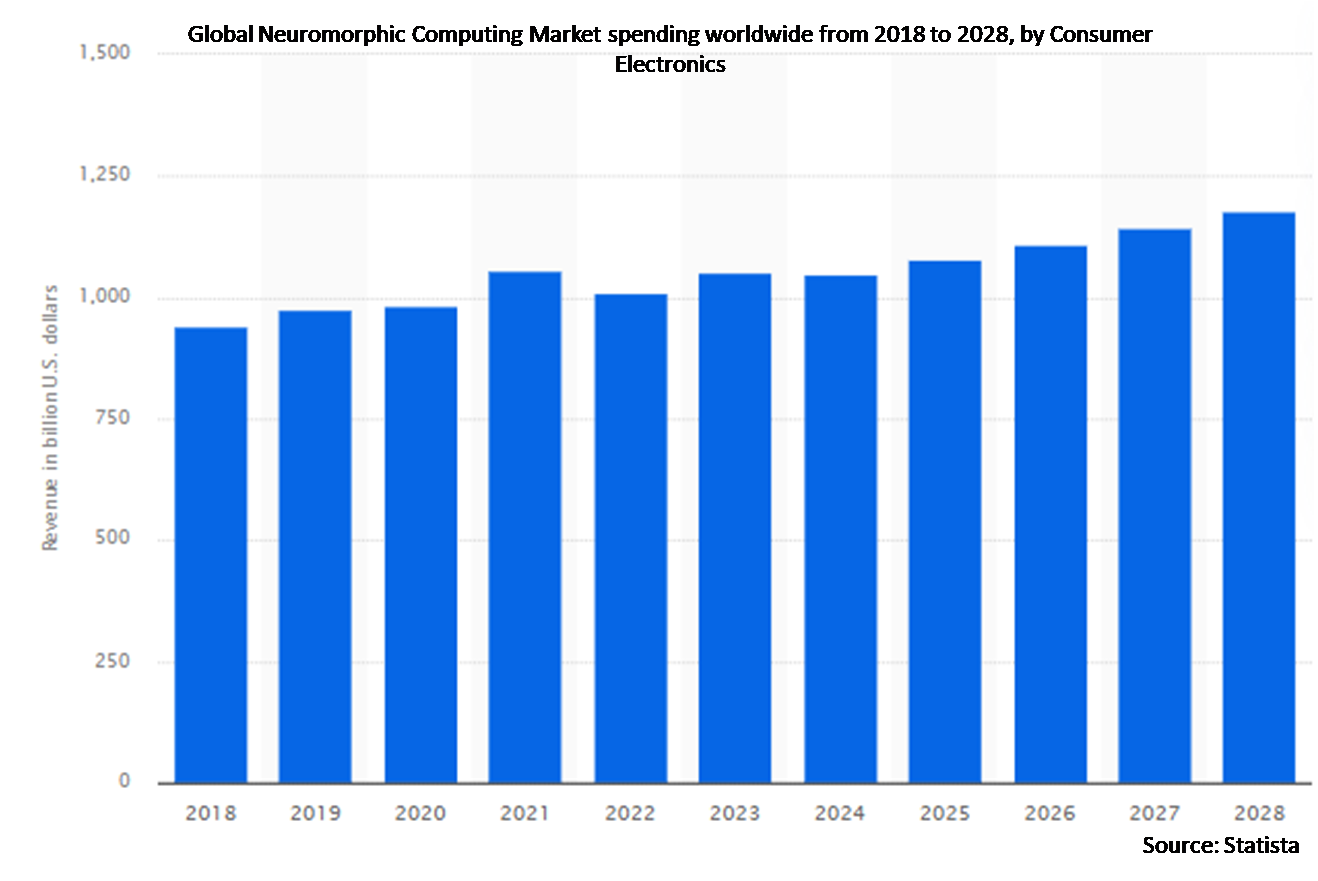
Market Dynamics:
Driver:
Growing need for AI hardware that uses less energy
Large data centers are frequently needed to run traditional AI models, particularly deep learning architectures, which demand enormous amounts of energy and processing power. Neuromorphic computing offers a paradigm shift, drawing inspiration from the brain's capacity to process information with little energy. Chips such as IBM's True North and Intel's Loihi are made to carry out intricate calculations with significantly less power usage. Additionally, this makes them perfect for battery-limited applications where efficiency is essential without compromising intelligence, like wearable’s, drones, and mobile robots.
Restraint:
Absence of standardized programming models and architecture
Neuromorphic computing does not have industry-wide standards for programming models, software interfaces, or hardware design, in contrast to traditional computing systems that adhere to well-known von Neumann or Harvard architectures. Custom learning algorithms, compilers, and toolchains are frequently needed for each chip. Compatibility problems brought on by this fragmentation make it challenging for developers and system integrators to create scalable and portable applications. Furthermore, adoption will continue to be restricted to research settings and specialized applications until a single ecosystem is established.
Opportunity:
Developments in neurotechnology and brain-machine interfaces (BMIs)
Due to its biological roots, neuromorphic computing is well suited for neuroscience applications, particularly neuroprosthetics and brain-machine interfaces. Because it can process bio-signals like EEG or EMG in real time, human-computer interaction can become more natural. The potential for mind-controlled wheelchairs, robotic limbs, and communication devices in assistive technologies for individuals with disabilities is particularly encouraging. As neurotechnology and biomedical engineering advance, neuromorphic platforms provide the perfect computational basis for decoding intricate brain signals with low power consumption and latency.
Threat:
Rivalry with well-known ai hardware technologies
There is fierce competition for neuromorphic computing from well-known AI accelerators such as GPUs, TPUs, FPGAs, and even custom ASICs. These platforms have established performance in AI tasks like deep learning and inference, as well as developed ecosystems and robust developer support. Companies like Google and NVIDIA are also constantly coming up with new and improved AI chips that use less power. Given that software compatibility and infrastructure investments are already in place for current platforms, the perceived advantages of neuromorphic systems could be overshadowed by the quick advancements in conventional AI hardware.
Covid-19 Impact:
The COVID-19 pandemic affected the neuromorphic computing market in a variety of ways. In the near term, delays in semiconductor production, diminished R&D budgets, and disruptions in global supply chains hindered hardware development and slowed the rate of commercial deployment. However, the pandemic also sped up digital transformation and brought attention to the need for intelligent, energy-efficient systems that can process data locally, particularly in edge AI applications, healthcare, and remote monitoring. Because of this change, there is now more interest in neuromorphic computing as a low-power, real-time processing solution. Because of this, even though early advancements were delayed, the post-pandemic environment has encouraged more research and investment in neuromorphic technologies.
The image processing segment is expected to be the largest during the forecast period
The image processing segment is expected to account for the largest market share during the forecast period. This dominance is explained by the neuromorphic architecture's capacity to closely resemble the human visual cortex by processing high-speed visual data efficiently through event-driven, parallel computation. Applications that require real-time image recognition and classification, like autonomous cars, surveillance systems, and medical imaging, greatly benefit from neuromorphic systems' low power consumption and lightning-fast reaction times. Since image processing offers greater efficiency, speed, and scalability than conventional techniques, it continues to dominate the market despite the quick growth of edge computing and smart vision systems.
The automotive segment is expected to have the highest CAGR during the forecast period
Over the forecast period, the automotive segment is predicted to witness the highest growth rate. The growing use of autonomous vehicles and advanced driver-assistance systems (ADAS), which demand real-time processing of large amounts of sensory data with extremely low latency and power consumption, is the main driver of this quick expansion. With their event-driven, brain-like architectures, neuromorphic chips are perfect for facilitating safe, energy-efficient decision-making in situations involving time-sensitive driving. Moreover, neuromorphic processors are anticipated to be crucial in forming the next generation of smart cars as the automotive industry gradually transitions to Level 5 autonomy and vehicle-to-everything (V2X) communication.
Region with largest share:
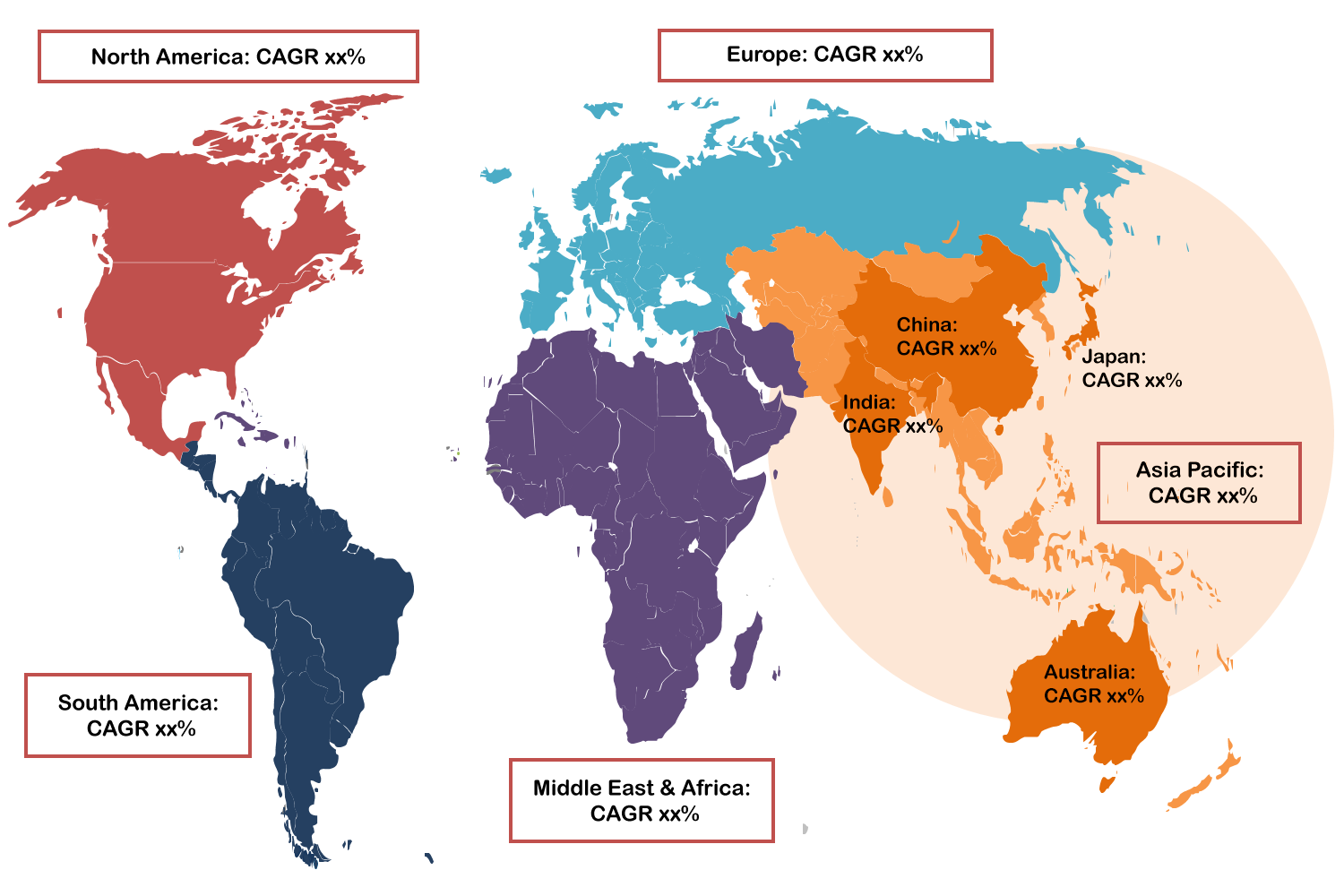
During the forecast period, the North America region is expected to hold the largest market share, driven by large investments in cutting-edge computing technologies and the robust presence of major players like BrainChip, IBM, and Intel. Strong funding for defense research, artificial intelligence, and academic projects centered on brain-inspired computing is advantageous to the area. Furthermore, the need for neuromorphic hardware is supported by North America's early adoption of AI in industries like consumer electronics, healthcare, automotive, and aerospace. Through government-supported initiatives and private sector innovation, the U.S. in particular leads in neuromorphic R&D, making the region a dominant force in both technological development and market revenue share.
Region with highest CAGR:
Over the forecast period, the Asia-Pacific region is anticipated to exhibit the highest CAGR. Rapid technological advancements, rising investments in robotics and artificial intelligence, and robust government support for semiconductor innovation in nations like China, Japan, South Korea, and India are the main drivers of this growth. Energy-efficient, real-time computing solutions are in high demand due to the region's growing electronics manufacturing base and the growing use of smart technologies in consumer electronics, industrial automation, and automotive. Additionally, Asia-Pacific's rise as a global center for the development of next-generation AI hardware is being accelerated by the expansion of both academic and commercial research in neuromorphic systems.
Key players in the market
Some of the key players in Neuromorphic Computing Market include Intel Corporation, HRL Laboratories, LLC, GrAI Matter Labs, IBM Corporation, Qualcomm Technologies, Inc., Micron Technology Inc, BrainChip Holdings Ltd., Hewlett Packard Enterprise (HPE), Samsung Electronics Co. Ltd, Knowm Inc., General Vision Inc., SK Hynix Inc., Vicarious FPC Inc., Nepes Corporation, Gyrfalcon Technology Inc. and SynSense AG.
Key Developments:
In May 2025, Qualcomm Technologies, Inc. and Xiaomi Corporation are celebrating 15 years of collaboration and have executed a multi-year agreement. The relationship between Qualcomm Technologies and Xiaomi has been pivotal in driving innovation across the technology industry and the companies are committed to delivering industry-leading products and solutions across various device categories globally.
In April 2025, HRL Laboratories, LLC has officially opened its new advanced research and manufacturing facility in Camarillo, California, marking a significant milestone in the company’s commitment to innovation in infrared (IR) hardware. The 60,000-square-foot facility, housing state-of-the-art labs, cleanrooms, high-bay and office space, dramatically enhances HRL’s fabrication and in-house testing capabilities.
In April 2025, Intel Corporation announced that it has entered into a definitive agreement to sell 51% of its Altera business to Silver Lake, a global leader in technology investing. The transaction, which values Altera at $8.75 billion, establishes Altera’s operational independence and makes it the largest pure-play FPGA semiconductor solutions company. Altera offers a proven and highly scalable architecture and tool chain and is focused on driving growth and FPGA innovation to meet the demands and opportunities of an AI-driven market.
Components Covered:
• Hardware
• Software
Deployments Covered:
• Edge Computing
• Cloud Computing
Applications Covered:
• Signal Processing
• Image Processing
• Data Processing
• Object Detection
• Other Applications
End Users Covered:
• Consumer Electronics
• Automotive
• Aerospace & Defense
• Healthcare
• IT & Telecom
• Industrial
• Other End Users
Regions Covered:
• North America
o US
o Canada
o Mexico
• Europe
o Germany
o UK
o Italy
o France
o Spain
o Rest of Europe
• Asia Pacific
o Japan
o China
o India
o Australia
o New Zealand
o South Korea
o Rest of Asia Pacific
• South America
o Argentina
o Brazil
o Chile
o Rest of South America
• Middle East & Africa
o Saudi Arabia
o UAE
o Qatar
o South Africa
o Rest of Middle East & Africa
What our report offers:
- Market share assessments for the regional and country-level segments
- Strategic recommendations for the new entrants
- Covers Market data for the years 2024, 2025, 2026, 2028, and 2032
- Market Trends (Drivers, Constraints, Opportunities, Threats, Challenges, Investment Opportunities, and recommendations)
- Strategic recommendations in key business segments based on the market estimations
- Competitive landscaping mapping the key common trends
- Company profiling with detailed strategies, financials, and recent developments
- Supply chain trends mapping the latest technological advancements
Free Customization Offerings:
All the customers of this report will be entitled to receive one of the following free customization options:
• Company Profiling
o Comprehensive profiling of additional market players (up to 3)
o SWOT Analysis of key players (up to 3)
• Regional Segmentation
o Market estimations, Forecasts and CAGR of any prominent country as per the client's interest (Note: Depends on feasibility check)
• Competitive Benchmarking
o Benchmarking of key players based on product portfolio, geographical presence, and strategic alliances
Table of Contents
1 Executive Summary
2 Preface
2.1 Abstract
2.2 Stake Holders
2.3 Research Scope
2.4 Research Methodology
2.4.1 Data Mining
2.4.2 Data Analysis
2.4.3 Data Validation
2.4.4 Research Approach
2.5 Research Sources
2.5.1 Primary Research Sources
2.5.2 Secondary Research Sources
2.5.3 Assumptions
3 Market Trend Analysis
3.1 Introduction
3.2 Drivers
3.3 Restraints
3.4 Opportunities
3.5 Threats
3.6 Application Analysis
3.7 End User Analysis
3.8 Emerging Markets
3.9 Impact of Covid-19
4 Porters Five Force Analysis
4.1 Bargaining power of suppliers
4.2 Bargaining power of buyers
4.3 Threat of substitutes
4.4 Threat of new entrants
4.5 Competitive rivalry
5 Global Neuromorphic Computing Market, By Component
5.1 Introduction
5.2 Hardware
5.3 Software
6 Global Neuromorphic Computing Market, By Deployment
6.1 Introduction
6.2 Edge Computing
6.3 Cloud Computing
7 Global Neuromorphic Computing Market, By Application
7.1 Introduction
7.2 Signal Processing
7.3 Image Processing
7.4 Data Processing
7.5 Object Detection
7.6 Other Applications
8 Global Neuromorphic Computing Market, By End User
8.1 Introduction
8.2 Consumer Electronics
8.3 Automotive
8.4 Aerospace & Defense
8.5 Healthcare
8.6 IT & Telecom
8.7 Industrial
8.8 Other End Users
9 Global Neuromorphic Computing Market, By Geography
9.1 Introduction
9.2 North America
9.2.1 US
9.2.2 Canada
9.2.3 Mexico
9.3 Europe
9.3.1 Germany
9.3.2 UK
9.3.3 Italy
9.3.4 France
9.3.5 Spain
9.3.6 Rest of Europe
9.4 Asia Pacific
9.4.1 Japan
9.4.2 China
9.4.3 India
9.4.4 Australia
9.4.5 New Zealand
9.4.6 South Korea
9.4.7 Rest of Asia Pacific
9.5 South America
9.5.1 Argentina
9.5.2 Brazil
9.5.3 Chile
9.5.4 Rest of South America
9.6 Middle East & Africa
9.6.1 Saudi Arabia
9.6.2 UAE
9.6.3 Qatar
9.6.4 South Africa
9.6.5 Rest of Middle East & Africa
10 Key Developments
10.1 Agreements, Partnerships, Collaborations and Joint Ventures
10.2 Acquisitions & Mergers
10.3 New Product Launch
10.4 Expansions
10.5 Other Key Strategies
11 Company Profiling
11.1 Intel Corporation
11.2 HRL Laboratories, LLC
11.3 GrAI Matter Labs
11.4 IBM Corporation
11.5 Qualcomm Technologies, Inc.
11.6 Micron Technology Inc
11.7 BrainChip Holdings Ltd.
11.8 Hewlett Packard Enterprise (HPE)
11.9 Samsung Electronics Co. Ltd
11.10 Knowm Inc.
11.11 General Vision Inc.
11.12 SK Hynix Inc.
11.13 Vicarious FPC Inc.
11.14 Nepes Corporation
11.15 Gyrfalcon Technology Inc.
11.16 SynSense AG
List of Tables
1 Global Neuromorphic Computing Market Outlook, By Region (2024-2032) ($MN)
2 Global Neuromorphic Computing Market Outlook, By Component (2024-2032) ($MN)
3 Global Neuromorphic Computing Market Outlook, By Hardware (2024-2032) ($MN)
4 Global Neuromorphic Computing Market Outlook, By Software (2024-2032) ($MN)
5 Global Neuromorphic Computing Market Outlook, By Deployment (2024-2032) ($MN)
6 Global Neuromorphic Computing Market Outlook, By Edge Computing (2024-2032) ($MN)
7 Global Neuromorphic Computing Market Outlook, By Cloud Computing (2024-2032) ($MN)
8 Global Neuromorphic Computing Market Outlook, By Application (2024-2032) ($MN)
9 Global Neuromorphic Computing Market Outlook, By Signal Processing (2024-2032) ($MN)
10 Global Neuromorphic Computing Market Outlook, By Image Processing (2024-2032) ($MN)
11 Global Neuromorphic Computing Market Outlook, By Data Processing (2024-2032) ($MN)
12 Global Neuromorphic Computing Market Outlook, By Object Detection (2024-2032) ($MN)
13 Global Neuromorphic Computing Market Outlook, By Other Applications (2024-2032) ($MN)
14 Global Neuromorphic Computing Market Outlook, By End User (2024-2032) ($MN)
15 Global Neuromorphic Computing Market Outlook, By Consumer Electronics (2024-2032) ($MN)
16 Global Neuromorphic Computing Market Outlook, By Automotive (2024-2032) ($MN)
17 Global Neuromorphic Computing Market Outlook, By Aerospace & Defense (2024-2032) ($MN)
18 Global Neuromorphic Computing Market Outlook, By Healthcare (2024-2032) ($MN)
19 Global Neuromorphic Computing Market Outlook, By IT & Telecom (2024-2032) ($MN)
20 Global Neuromorphic Computing Market Outlook, By Industrial (2024-2032) ($MN)
21 Global Neuromorphic Computing Market Outlook, By Other End Users (2024-2032) ($MN)
22 North America Neuromorphic Computing Market Outlook, By Country (2024-2032) ($MN)
23 North America Neuromorphic Computing Market Outlook, By Component (2024-2032) ($MN)
24 North America Neuromorphic Computing Market Outlook, By Hardware (2024-2032) ($MN)
25 North America Neuromorphic Computing Market Outlook, By Software (2024-2032) ($MN)
26 North America Neuromorphic Computing Market Outlook, By Deployment (2024-2032) ($MN)
27 North America Neuromorphic Computing Market Outlook, By Edge Computing (2024-2032) ($MN)
28 North America Neuromorphic Computing Market Outlook, By Cloud Computing (2024-2032) ($MN)
29 North America Neuromorphic Computing Market Outlook, By Application (2024-2032) ($MN)
30 North America Neuromorphic Computing Market Outlook, By Signal Processing (2024-2032) ($MN)
31 North America Neuromorphic Computing Market Outlook, By Image Processing (2024-2032) ($MN)
32 North America Neuromorphic Computing Market Outlook, By Data Processing (2024-2032) ($MN)
33 North America Neuromorphic Computing Market Outlook, By Object Detection (2024-2032) ($MN)
34 North America Neuromorphic Computing Market Outlook, By Other Applications (2024-2032) ($MN)
35 North America Neuromorphic Computing Market Outlook, By End User (2024-2032) ($MN)
36 North America Neuromorphic Computing Market Outlook, By Consumer Electronics (2024-2032) ($MN)
37 North America Neuromorphic Computing Market Outlook, By Automotive (2024-2032) ($MN)
38 North America Neuromorphic Computing Market Outlook, By Aerospace & Defense (2024-2032) ($MN)
39 North America Neuromorphic Computing Market Outlook, By Healthcare (2024-2032) ($MN)
40 North America Neuromorphic Computing Market Outlook, By IT & Telecom (2024-2032) ($MN)
41 North America Neuromorphic Computing Market Outlook, By Industrial (2024-2032) ($MN)
42 North America Neuromorphic Computing Market Outlook, By Other End Users (2024-2032) ($MN)
43 Europe Neuromorphic Computing Market Outlook, By Country (2024-2032) ($MN)
44 Europe Neuromorphic Computing Market Outlook, By Component (2024-2032) ($MN)
45 Europe Neuromorphic Computing Market Outlook, By Hardware (2024-2032) ($MN)
46 Europe Neuromorphic Computing Market Outlook, By Software (2024-2032) ($MN)
47 Europe Neuromorphic Computing Market Outlook, By Deployment (2024-2032) ($MN)
48 Europe Neuromorphic Computing Market Outlook, By Edge Computing (2024-2032) ($MN)
49 Europe Neuromorphic Computing Market Outlook, By Cloud Computing (2024-2032) ($MN)
50 Europe Neuromorphic Computing Market Outlook, By Application (2024-2032) ($MN)
51 Europe Neuromorphic Computing Market Outlook, By Signal Processing (2024-2032) ($MN)
52 Europe Neuromorphic Computing Market Outlook, By Image Processing (2024-2032) ($MN)
53 Europe Neuromorphic Computing Market Outlook, By Data Processing (2024-2032) ($MN)
54 Europe Neuromorphic Computing Market Outlook, By Object Detection (2024-2032) ($MN)
55 Europe Neuromorphic Computing Market Outlook, By Other Applications (2024-2032) ($MN)
56 Europe Neuromorphic Computing Market Outlook, By End User (2024-2032) ($MN)
57 Europe Neuromorphic Computing Market Outlook, By Consumer Electronics (2024-2032) ($MN)
58 Europe Neuromorphic Computing Market Outlook, By Automotive (2024-2032) ($MN)
59 Europe Neuromorphic Computing Market Outlook, By Aerospace & Defense (2024-2032) ($MN)
60 Europe Neuromorphic Computing Market Outlook, By Healthcare (2024-2032) ($MN)
61 Europe Neuromorphic Computing Market Outlook, By IT & Telecom (2024-2032) ($MN)
62 Europe Neuromorphic Computing Market Outlook, By Industrial (2024-2032) ($MN)
63 Europe Neuromorphic Computing Market Outlook, By Other End Users (2024-2032) ($MN)
64 Asia Pacific Neuromorphic Computing Market Outlook, By Country (2024-2032) ($MN)
65 Asia Pacific Neuromorphic Computing Market Outlook, By Component (2024-2032) ($MN)
66 Asia Pacific Neuromorphic Computing Market Outlook, By Hardware (2024-2032) ($MN)
67 Asia Pacific Neuromorphic Computing Market Outlook, By Software (2024-2032) ($MN)
68 Asia Pacific Neuromorphic Computing Market Outlook, By Deployment (2024-2032) ($MN)
69 Asia Pacific Neuromorphic Computing Market Outlook, By Edge Computing (2024-2032) ($MN)
70 Asia Pacific Neuromorphic Computing Market Outlook, By Cloud Computing (2024-2032) ($MN)
71 Asia Pacific Neuromorphic Computing Market Outlook, By Application (2024-2032) ($MN)
72 Asia Pacific Neuromorphic Computing Market Outlook, By Signal Processing (2024-2032) ($MN)
73 Asia Pacific Neuromorphic Computing Market Outlook, By Image Processing (2024-2032) ($MN)
74 Asia Pacific Neuromorphic Computing Market Outlook, By Data Processing (2024-2032) ($MN)
75 Asia Pacific Neuromorphic Computing Market Outlook, By Object Detection (2024-2032) ($MN)
76 Asia Pacific Neuromorphic Computing Market Outlook, By Other Applications (2024-2032) ($MN)
77 Asia Pacific Neuromorphic Computing Market Outlook, By End User (2024-2032) ($MN)
78 Asia Pacific Neuromorphic Computing Market Outlook, By Consumer Electronics (2024-2032) ($MN)
79 Asia Pacific Neuromorphic Computing Market Outlook, By Automotive (2024-2032) ($MN)
80 Asia Pacific Neuromorphic Computing Market Outlook, By Aerospace & Defense (2024-2032) ($MN)
81 Asia Pacific Neuromorphic Computing Market Outlook, By Healthcare (2024-2032) ($MN)
82 Asia Pacific Neuromorphic Computing Market Outlook, By IT & Telecom (2024-2032) ($MN)
83 Asia Pacific Neuromorphic Computing Market Outlook, By Industrial (2024-2032) ($MN)
84 Asia Pacific Neuromorphic Computing Market Outlook, By Other End Users (2024-2032) ($MN)
85 South America Neuromorphic Computing Market Outlook, By Country (2024-2032) ($MN)
86 South America Neuromorphic Computing Market Outlook, By Component (2024-2032) ($MN)
87 South America Neuromorphic Computing Market Outlook, By Hardware (2024-2032) ($MN)
88 South America Neuromorphic Computing Market Outlook, By Software (2024-2032) ($MN)
89 South America Neuromorphic Computing Market Outlook, By Deployment (2024-2032) ($MN)
90 South America Neuromorphic Computing Market Outlook, By Edge Computing (2024-2032) ($MN)
91 South America Neuromorphic Computing Market Outlook, By Cloud Computing (2024-2032) ($MN)
92 South America Neuromorphic Computing Market Outlook, By Application (2024-2032) ($MN)
93 South America Neuromorphic Computing Market Outlook, By Signal Processing (2024-2032) ($MN)
94 South America Neuromorphic Computing Market Outlook, By Image Processing (2024-2032) ($MN)
95 South America Neuromorphic Computing Market Outlook, By Data Processing (2024-2032) ($MN)
96 South America Neuromorphic Computing Market Outlook, By Object Detection (2024-2032) ($MN)
97 South America Neuromorphic Computing Market Outlook, By Other Applications (2024-2032) ($MN)
98 South America Neuromorphic Computing Market Outlook, By End User (2024-2032) ($MN)
99 South America Neuromorphic Computing Market Outlook, By Consumer Electronics (2024-2032) ($MN)
100 South America Neuromorphic Computing Market Outlook, By Automotive (2024-2032) ($MN)
101 South America Neuromorphic Computing Market Outlook, By Aerospace & Defense (2024-2032) ($MN)
102 South America Neuromorphic Computing Market Outlook, By Healthcare (2024-2032) ($MN)
103 South America Neuromorphic Computing Market Outlook, By IT & Telecom (2024-2032) ($MN)
104 South America Neuromorphic Computing Market Outlook, By Industrial (2024-2032) ($MN)
105 South America Neuromorphic Computing Market Outlook, By Other End Users (2024-2032) ($MN)
106 Middle East & Africa Neuromorphic Computing Market Outlook, By Country (2024-2032) ($MN)
107 Middle East & Africa Neuromorphic Computing Market Outlook, By Component (2024-2032) ($MN)
108 Middle East & Africa Neuromorphic Computing Market Outlook, By Hardware (2024-2032) ($MN)
109 Middle East & Africa Neuromorphic Computing Market Outlook, By Software (2024-2032) ($MN)
110 Middle East & Africa Neuromorphic Computing Market Outlook, By Deployment (2024-2032) ($MN)
111 Middle East & Africa Neuromorphic Computing Market Outlook, By Edge Computing (2024-2032) ($MN)
112 Middle East & Africa Neuromorphic Computing Market Outlook, By Cloud Computing (2024-2032) ($MN)
113 Middle East & Africa Neuromorphic Computing Market Outlook, By Application (2024-2032) ($MN)
114 Middle East & Africa Neuromorphic Computing Market Outlook, By Signal Processing (2024-2032) ($MN)
115 Middle East & Africa Neuromorphic Computing Market Outlook, By Image Processing (2024-2032) ($MN)
116 Middle East & Africa Neuromorphic Computing Market Outlook, By Data Processing (2024-2032) ($MN)
117 Middle East & Africa Neuromorphic Computing Market Outlook, By Object Detection (2024-2032) ($MN)
118 Middle East & Africa Neuromorphic Computing Market Outlook, By Other Applications (2024-2032) ($MN)
119 Middle East & Africa Neuromorphic Computing Market Outlook, By End User (2024-2032) ($MN)
120 Middle East & Africa Neuromorphic Computing Market Outlook, By Consumer Electronics (2024-2032) ($MN)
121 Middle East & Africa Neuromorphic Computing Market Outlook, By Automotive (2024-2032) ($MN)
122 Middle East & Africa Neuromorphic Computing Market Outlook, By Aerospace & Defense (2024-2032) ($MN)
123 Middle East & Africa Neuromorphic Computing Market Outlook, By Healthcare (2024-2032) ($MN)
124 Middle East & Africa Neuromorphic Computing Market Outlook, By IT & Telecom (2024-2032) ($MN)
125 Middle East & Africa Neuromorphic Computing Market Outlook, By Industrial (2024-2032) ($MN)
126 Middle East & Africa Neuromorphic Computing Market Outlook, By Other End Users (2024-2032) ($MN)
List of Figures
RESEARCH METHODOLOGY

We at ‘Stratistics’ opt for an extensive research approach which involves data mining, data validation, and data analysis. The various research sources include in-house repository, secondary research, competitor’s sources, social media research, client internal data, and primary research.
Our team of analysts prefers the most reliable and authenticated data sources in order to perform the comprehensive literature search. With access to most of the authenticated data bases our team highly considers the best mix of information through various sources to obtain extensive and accurate analysis.
Each report takes an average time of a month and a team of 4 industry analysts. The time may vary depending on the scope and data availability of the desired market report. The various parameters used in the market assessment are standardized in order to enhance the data accuracy.
Data Mining
The data is collected from several authenticated, reliable, paid and unpaid sources and is filtered depending on the scope & objective of the research. Our reports repository acts as an added advantage in this procedure. Data gathering from the raw material suppliers, distributors and the manufacturers is performed on a regular basis, this helps in the comprehensive understanding of the products value chain. Apart from the above mentioned sources the data is also collected from the industry consultants to ensure the objective of the study is in the right direction.
Market trends such as technological advancements, regulatory affairs, market dynamics (Drivers, Restraints, Opportunities and Challenges) are obtained from scientific journals, market related national & international associations and organizations.
Data Analysis
From the data that is collected depending on the scope & objective of the research the data is subjected for the analysis. The critical steps that we follow for the data analysis include:
- Product Lifecycle Analysis
- Competitor analysis
- Risk analysis
- Porters Analysis
- PESTEL Analysis
- SWOT Analysis
The data engineering is performed by the core industry experts considering both the Marketing Mix Modeling and the Demand Forecasting. The marketing mix modeling makes use of multiple-regression techniques to predict the optimal mix of marketing variables. Regression factor is based on a number of variables and how they relate to an outcome such as sales or profits.
Data Validation
The data validation is performed by the exhaustive primary research from the expert interviews. This includes telephonic interviews, focus groups, face to face interviews, and questionnaires to validate our research from all aspects. The industry experts we approach come from the leading firms, involved in the supply chain ranging from the suppliers, distributors to the manufacturers and consumers so as to ensure an unbiased analysis.
We are in touch with more than 15,000 industry experts with the right mix of consultants, CEO's, presidents, vice presidents, managers, experts from both supply side and demand side, executives and so on.
The data validation involves the primary research from the industry experts belonging to:
- Leading Companies
- Suppliers & Distributors
- Manufacturers
- Consumers
- Industry/Strategic Consultants
Apart from the data validation the primary research also helps in performing the fill gap research, i.e. providing solutions for the unmet needs of the research which helps in enhancing the reports quality.
For more details about research methodology, kindly write to us at info@strategymrc.com
Frequently Asked Questions
In case of any queries regarding this report, you can contact the customer service by filing the “Inquiry Before Buy” form available on the right hand side. You may also contact us through email: info@strategymrc.com or phone: +1-301-202-5929
Yes, the samples are available for all the published reports. You can request them by filling the “Request Sample” option available in this page.
Yes, you can request a sample with your specific requirements. All the customized samples will be provided as per the requirement with the real data masked.
All our reports are available in Digital PDF format. In case if you require them in any other formats, such as PPT, Excel etc you can submit a request through “Inquiry Before Buy” form available on the right hand side. You may also contact us through email: info@strategymrc.com or phone: +1-301-202-5929
We offer a free 15% customization with every purchase. This requirement can be fulfilled for both pre and post sale. You may send your customization requirements through email at info@strategymrc.com or call us on +1-301-202-5929.
We have 3 different licensing options available in electronic format.
- Single User Licence: Allows one person, typically the buyer, to have access to the ordered product. The ordered product cannot be distributed to anyone else.
- 2-5 User Licence: Allows the ordered product to be shared among a maximum of 5 people within your organisation.
- Corporate License: Allows the product to be shared among all employees of your organisation regardless of their geographical location.
All our reports are typically be emailed to you as an attachment.
To order any available report you need to register on our website. The payment can be made either through CCAvenue or PayPal payments gateways which accept all international cards.
We extend our support to 6 months post sale. A post sale customization is also provided to cover your unmet needs in the report.
Request Customization
We offer complimentary customization of up to 15% with every purchase. To share your customization requirements, feel free to email us at info@strategymrc.com or call us on +1-301-202-5929. .
Please Note: Customization within the 15% threshold is entirely free of charge. If your request exceeds this limit, we will conduct a feasibility assessment. Following that, a detailed quote and timeline will be provided.
WHY CHOOSE US ?

Assured Quality
Best in class reports with high standard of research integrity

24X7 Research Support
Continuous support to ensure the best customer experience.

Free Customization
Adding more values to your product of interest.

Safe & Secure Access
Providing a secured environment for all online transactions.

Trusted by 600+ Brands
Serving the most reputed brands across the world.
