
Vehicles For Disabled Market
Vehicles for Disabled Market Forecasts to 2032 - Global Analysis By Vehicle Type (Passenger Cars, Mobility Scooters, Electric Wheelchair Accessible Vehicles, SUVs & Vans, Motorized/Powered Vehicles, Manual Vehicles and Other Vehicle Types), Driving Option, Engine Type, Technology, Sales Channel, End User and By Geography

|
Years Covered |
2022-2030 |
|
Estimated Year Value (2024) |
US $4.9 BN |
|
Projected Year Value (2030) |
US $11.6 BN |
|
CAGR (2024 - 2030) |
12.8% |
|
Regions Covered |
North America, Europe, Asia Pacific, South America, and Middle East & Africa |
|
Countries Covered |
US, Canada, Mexico, Germany, UK, Italy, France, Spain, Japan, China, India, Australia, New Zealand, South Korea, Rest of Asia Pacific, South America, Argentina, Brazil, Chile, Middle East & Africa, Saudi Arabia, UAE, Qatar, and South Africa |
|
Largest Market |
Asia Pacific |
|
Highest Growing Market |
North America |
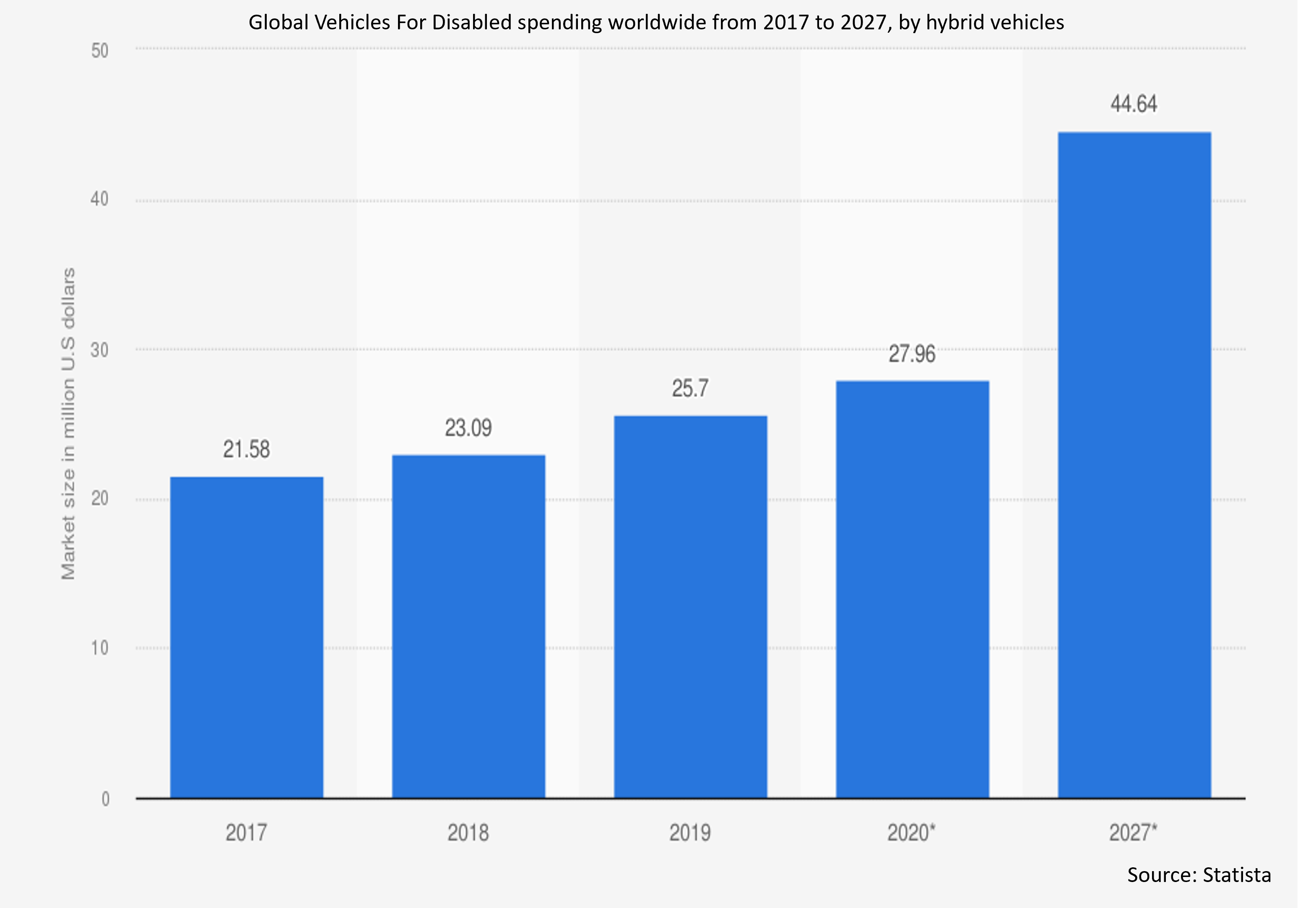
According to Stratistics MRC, the Global Vehicles for Disabled Market is accounted for $4.9 billion in 2025 and is expected to reach $11.6 billion by 2032 growing at a CAGR of 12.8% during the forecast period. Vehicles for people with physical limitations are specially made or adapted modes of transportation that allow them to travel either alone or with help. Wheelchair ramps or lifts, hand controls, swivel seats, and automated systems designed to accommodate a range of mobility requirements are all features found in these cars. They include accessible buses and taxis as well as private vehicles like cars and vans. By giving people with temporary or permanent mobility disabilities safe, practical, and accessible transportation, these cars improve mobility, autonomy, and social inclusion while also enhancing quality of life.
Market Dynamics:
Driver:
Rising geriatric and disabled population
The need for accessible transit options is rising as ageing causes mobility issues. Specialised cars are becoming more and more necessary for disabled people to be independent and convenient. This need is being met by governments and healthcare systems through mobility initiatives and subsidies. Manufacturers are encouraged to develop innovative, user-friendly, and adaptable car technologies by this demographic transition. In general, the market demand for specialised mobility solutions is increased by the growing number of elderly and disabled people.
Restraint:
High cost of customized vehicles
The cost of these cars is significantly increased by the specialised adaptations they frequently need, like wheelchair ramps, hand controls, and swivel seats. Many people with disabilities cannot pay these expenditures, particularly in low- and middle-income areas. The hardship is increased by a lack of insurance or financial support. Potential buyers might thereby put off or decide not to buy such cars at all. For a significant portion of the disabled population, this financial barrier limits accessibility and inhibits market penetration.
Opportunity:
Technological advancements and government support
The possibilities available to users have expanded thanks to innovations like voice-activated systems, adaptive cruise control, and wheelchair-accessible designs. More customisation has resulted from these advancements, meeting the various demands of people with disabilities. Market acceptance has also been fuelled by government support in the form of subsidies, tax breaks, and mobility assistance initiatives. Manufacturers have been encouraged to invest in R&D by regulatory frameworks that require inclusive transportation. The global market for cars for the disabled is expanding more quickly thanks to a combination of regulatory assistance and technological advancements.
Threat:
Limited infrastructure and low awareness in emerging economies
The usability of such cars is restricted by poorly built roads and a dearth of accessible public facilities. Furthermore, the development and use of specialised transportation solutions are constrained by the lack of financing and supportive regulations. The expansion of the market is further hampered by low public knowledge of mobility aids for the disabled. Many people are still ignorant of the advantages of the various car options that are available. Because of this, there is still little demand, which delays developments and investments in this industry.
Covid-19 Impact
The Covid-19 pandemic had a mixed impact on the Vehicles for Disabled market. Initially, global supply chain disruptions, manufacturing halts, and reduced consumer spending hindered market growth. Lockdowns and social distancing further delayed vehicle production and accessibility-related services. However, the crisis also heightened awareness about mobility needs for vulnerable populations, including the disabled. Governments and organizations gradually increased support and funding for accessible transportation solutions. As restrictions eased, demand rebounded, especially for personal-use modified vehicles, reflecting a shift toward independent and safer mobility options amid health concerns.
The mobility scooters segment is expected to be the largest during the forecast period
The mobility scooters segment is expected to account for the largest market share during the forecast period, due to enhanced independence and convenience to users with limited mobility. These scooters are increasingly preferred due to their user-friendly design, comfort, and affordability. Technological advancements such as improved battery life, compact designs, and smart controls have boosted their adoption. The growing elderly population and rising awareness of mobility aids further drive demand. Additionally, government support and reimbursement policies in many regions enhance market penetration for mobility scooters.
The disabled individual’s segment is expected to have the highest CAGR during the forecast period
Over the forecast period, the disabled individual’s segment is predicted to witness the highest growth rateby generating consistent demand for customized mobility solutions. As the global population of people with disabilities grows, the need for accessible and user-friendly vehicles continues to rise. Increased awareness, supportive government initiatives, and disability rights laws further accelerate adoption. Technological advancements in vehicle modification enhance comfort and usability for disabled users. This segment also influences manufacturers to innovate and expand their product offerings, boosting overall market growth.
Region with largest share:
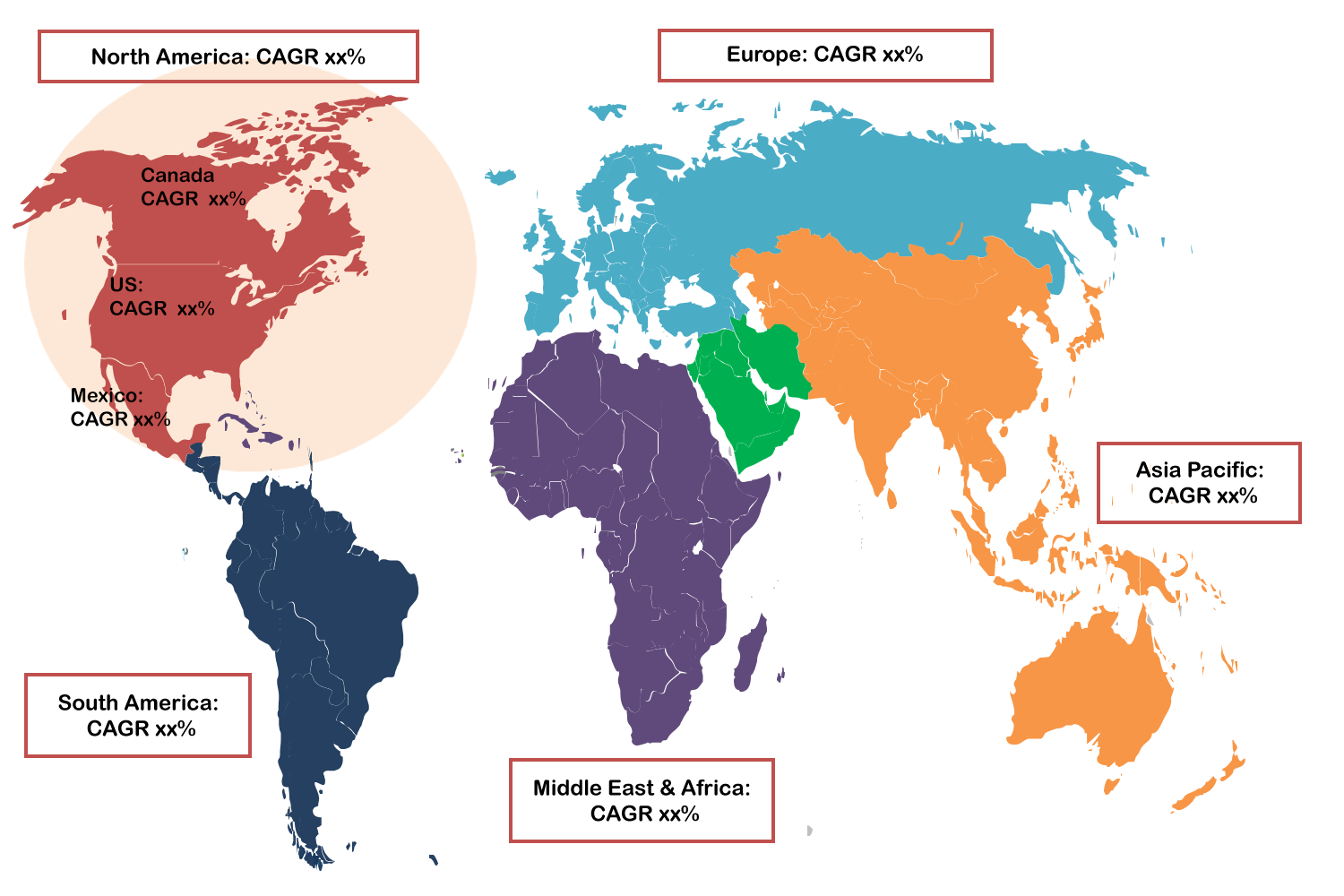
During the forecast period, the Asia Pacific region is expected to hold the largest market share due to expanding middle-class income groups, and supportive government initiatives in countries like Japan, China, and India. The market is being shaped by rapid urbanization, improving healthcare access, and increasing production of affordable mobility solutions. Technological advancements and increased local manufacturing are making adaptive vehicles more accessible. However, infrastructural limitations and limited insurance coverage in some developing nations continue to challenge widespread adoption, especially in rural areas.
Region with highest CAGR:
Over the forecast period, the North America region is anticipated to exhibit the highest CAGR, owing to rising awareness about mobility rights, and strong governmental support through funding and regulation. The U.S. dominates the region due to its mature automotive and assistive technology sectors. Increasing demand for retrofitted personal vehicles and growing geriatric populations further stimulate market expansion. Strategic collaborations among automakers and assistive device companies are enhancing product offerings. Moreover, a well-established insurance framework aids affordability, contributing to the growing adoption of adapted vehicles across the region.
Key players in the market
Some of the key players profiled in the Vehicles for Disabled Market include Toyota Motor Corporation, Volkswagen AG, Ford Motor Company, General Motors Company, Stellantis N.V., Honda Motor Co., Ltd., BraunAbility, Vantage Mobility International (VMI), Allied Mobility, Revability, AMF-Bruns GmbH & Co. KG, Freedom Motors USA, Automotive Innovations, Kersey Mobility, MobilityWorks, Nissan Motor Co., Ltd., Hyundai Motor Company and Rollx Vans.
Key Developments:
In January 2025, Toyota Kirloskar Motor launched TMSS, a fully owned subsidiary based in Bidadi (Bengaluru), targeting the certified pre?owned car market with transparent pricing, 203?point inspections, warranties, and roadside assistance.
In November 2024, Volkswagen Group and Rivian launched a 50:50 JV—Rivian and Volkswagen Group Technologies—backed by up to US?$5.8?billion to develop next-gen software/electrical architectures for electric vehicles.
Vehicle Types Covered:
• Passenger Cars
• Mobility Scooters
• Electric Wheelchair Accessible Vehicles
• SUVs & Vans
• Motorized/Powered Vehicles
• Manual Vehicles
• Other Vehicle Types
Driving Options Covered:
• Driving on Own
• Assisted Driving
• Manual Driving
• Automatic Driving
• Other Driving Options
Engine Types Covered:
• Internal Combustion Engine (ICE)
• Electric Vehicles (EV)
• Hybrid Vehicles
Technologies Covered:
• Adaptive Driving Controls
• Wheelchair Lifts & Ramps
• Steering Aids
• Pedal Extensions
• Remote-Controlled Driving Systems
• Other Technologies
Sale Channels Covered:
• Original Equipment Manufacturer
• Aftermarket
End Users Covered:
• Disabled Individuals
• Elderly Population
• Hospitals & Clinics
• Rehabilitation Centers
• NGOs & Government Bodies
• Other End Users
Regions Covered:
• North America
o US
o Canada
o Mexico
• Europe
o Germany
o UK
o Italy
o France
o Spain
o Rest of Europe
• Asia Pacific
o Japan
o China
o India
o Australia
o New Zealand
o South Korea
o Rest of Asia Pacific
• South America
o Argentina
o Brazil
o Chile
o Rest of South America
• Middle East & Africa
o Saudi Arabia
o UAE
o Qatar
o South Africa
o Rest of Middle East & Africa
What our report offers:
- Market share assessments for the regional and country-level segments
- Strategic recommendations for the new entrants
- Covers Market data for the years 2024, 2025, 2026, 2028, and 2032
- Market Trends (Drivers, Constraints, Opportunities, Threats, Challenges, Investment Opportunities, and recommendations)
- Strategic recommendations in key business segments based on the market estimations
- Competitive landscaping mapping the key common trends
- Company profiling with detailed strategies, financials, and recent developments
- Supply chain trends mapping the latest technological advancements
Free Customization Offerings:
All the customers of this report will be entitled to receive one of the following free customization options:
• Company Profiling
o Comprehensive profiling of additional market players (up to 3)
o SWOT Analysis of key players (up to 3)
• Regional Segmentation
o Market estimations, Forecasts and CAGR of any prominent country as per the client's interest (Note: Depends on feasibility check)
• Competitive Benchmarking
o Benchmarking of key players based on product portfolio, geographical presence, and strategic alliances
Table of Contents
1 Executive Summary
2 Preface
2.1 Abstract
2.2 Stake Holders
2.3 Research Scope
2.4 Research Methodology
2.4.1 Data Mining
2.4.2 Data Analysis
2.4.3 Data Validation
2.4.4 Research Approach
2.5 Research Sources
2.5.1 Primary Research Sources
2.5.2 Secondary Research Sources
2.5.3 Assumptions
3 Market Trend Analysis
3.1 Introduction
3.2 Drivers
3.3 Restraints
3.4 Opportunities
3.5 Threats
3.6 Technology Analysis
3.7 End User Analysis
3.8 Emerging Markets
3.9 Impact of Covid-19
4 Porters Five Force Analysis
4.1 Bargaining power of suppliers
4.2 Bargaining power of buyers
4.3 Threat of substitutes
4.4 Threat of new entrants
4.5 Competitive rivalry
5 Global Vehicles for Disabled Market, By Vehicle Type
5.1 Introduction
5.2 Passenger Cars
5.3 Mobility Scooters
5.4 Electric Wheelchair Accessible Vehicles
5.5 SUVs & Vans
5.6 Motorized/Powered Vehicles
5.7 Manual Vehicles
5.8 Other Vehicle Types
6 Global Vehicles for Disabled Market, By Driving Option
6.1 Introduction
6.2 Driving on Own
6.3 Assisted Driving
6.4 Manual Driving
6.5 Automatic Driving
6.6 Other Driving Options
7 Global Vehicles for Disabled Market, By Engine Type
7.1 Introduction
7.2 Internal Combustion Engine (ICE)
7.3 Electric Vehicles (EV)
7.4 Hybrid Vehicles
8 Global Vehicles for Disabled Market, By Technology
8.1 Introduction
8.2 Adaptive Driving Controls
8.3 Wheelchair Lifts & Ramps
8.4 Steering Aids
8.5 Pedal Extensions
8.6 Remote-Controlled Driving Systems
8.7 Other Technologies
9 Global Vehicles for Disabled Market, By Sales Channel
9.1 Introduction
9.2 Original Equipment Manufacturer
9.3 Aftermarket
10 Global Vehicles for Disabled Market, By End User
10.1 Introduction
10.2 Disabled Individuals
10.3 Elderly Population
10.4 Hospitals & Clinics
10.5 Rehabilitation Centers
10.6 NGOs & Government Bodies
10.7 Other End Users
11 Global Vehicles for Disabled Market, By Geography
11.1 Introduction
11.2 North America
11.2.1 US
11.2.2 Canada
11.2.3 Mexico
11.3 Europe
11.3.1 Germany
11.3.2 UK
11.3.3 Italy
11.3.4 France
11.3.5 Spain
11.3.6 Rest of Europe
11.4 Asia Pacific
11.4.1 Japan
11.4.2 China
11.4.3 India
11.4.4 Australia
11.4.5 New Zealand
11.4.6 South Korea
11.4.7 Rest of Asia Pacific
11.5 South America
11.5.1 Argentina
11.5.2 Brazil
11.5.3 Chile
11.5.4 Rest of South America
11.6 Middle East & Africa
11.6.1 Saudi Arabia
11.6.2 UAE
11.6.3 Qatar
11.6.4 South Africa
11.6.5 Rest of Middle East & Africa
12 Key Developments
12.1 Agreements, Partnerships, Collaborations and Joint Ventures
12.2 Acquisitions & Mergers
12.3 New Product Launch
12.4 Expansions
12.5 Other Key Strategies
13 Company Profiling
13.1 Toyota Motor Corporation
13.2 Volkswagen AG
13.3 Ford Motor Company
13.4 General Motors Company
13.5 Stellantis N.V.
13.6 Honda Motor Co., Ltd.
13.7 BraunAbility
13.8 Vantage Mobility International (VMI)
13.9 Allied Mobility
13.10 Revability
13.11 AMF-Bruns GmbH & Co. KG
13.12 Freedom Motors USA
13.13 Automotive Innovations
13.14 Kersey Mobility
13.15 MobilityWorks
13.16 Nissan Motor Co., Ltd.
13.17 Hyundai Motor Company
13.18 Rollx Vans
List of Tables
1 Global Vehicles for Disabled Market Outlook, By Region (2024-2032) ($MN)
2 Global Vehicles for Disabled Market Outlook, By Vehicle Type (2024-2032) ($MN)
3 Global Vehicles for Disabled Market Outlook, By Passenger Cars (2024-2032) ($MN)
4 Global Vehicles for Disabled Market Outlook, By Mobility Scooters (2024-2032) ($MN)
5 Global Vehicles for Disabled Market Outlook, By Electric Wheelchair Accessible Vehicles (2024-2032) ($MN)
6 Global Vehicles for Disabled Market Outlook, By SUVs & Vans (2024-2032) ($MN)
7 Global Vehicles for Disabled Market Outlook, By Motorized/Powered Vehicles (2024-2032) ($MN)
8 Global Vehicles for Disabled Market Outlook, By Manual Vehicles (2024-2032) ($MN)
9 Global Vehicles for Disabled Market Outlook, By Other Vehicle Types (2024-2032) ($MN)
10 Global Vehicles for Disabled Market Outlook, By Driving Option (2024-2032) ($MN)
11 Global Vehicles for Disabled Market Outlook, By Driving on Own (2024-2032) ($MN)
12 Global Vehicles for Disabled Market Outlook, By Assisted Driving (2024-2032) ($MN)
13 Global Vehicles for Disabled Market Outlook, By Manual Driving (2024-2032) ($MN)
14 Global Vehicles for Disabled Market Outlook, By Automatic Driving (2024-2032) ($MN)
15 Global Vehicles for Disabled Market Outlook, By Other Driving Options (2024-2032) ($MN)
16 Global Vehicles for Disabled Market Outlook, By Engine Type (2024-2032) ($MN)
17 Global Vehicles for Disabled Market Outlook, By Internal Combustion Engine (ICE) (2024-2032) ($MN)
18 Global Vehicles for Disabled Market Outlook, By Electric Vehicles (EV) (2024-2032) ($MN)
19 Global Vehicles for Disabled Market Outlook, By Hybrid Vehicles (2024-2032) ($MN)
20 Global Vehicles for Disabled Market Outlook, By Technology (2024-2032) ($MN)
21 Global Vehicles for Disabled Market Outlook, By Adaptive Driving Controls (2024-2032) ($MN)
22 Global Vehicles for Disabled Market Outlook, By Wheelchair Lifts & Ramps (2024-2032) ($MN)
23 Global Vehicles for Disabled Market Outlook, By Steering Aids (2024-2032) ($MN)
24 Global Vehicles for Disabled Market Outlook, By Pedal Extensions (2024-2032) ($MN)
25 Global Vehicles for Disabled Market Outlook, By Remote-Controlled Driving Systems (2024-2032) ($MN)
26 Global Vehicles for Disabled Market Outlook, By Other Technologies (2024-2032) ($MN)
27 Global Vehicles for Disabled Market Outlook, By Sales Channel (2024-2032) ($MN)
28 Global Vehicles for Disabled Market Outlook, By Original Equipment Manufacturer (2024-2032) ($MN)
29 Global Vehicles for Disabled Market Outlook, By Aftermarket (2024-2032) ($MN)
30 Global Vehicles for Disabled Market Outlook, By End User (2024-2032) ($MN)
31 Global Vehicles for Disabled Market Outlook, By Disabled Individuals (2024-2032) ($MN)
32 Global Vehicles for Disabled Market Outlook, By Elderly Population (2024-2032) ($MN)
33 Global Vehicles for Disabled Market Outlook, By Hospitals & Clinics (2024-2032) ($MN)
34 Global Vehicles for Disabled Market Outlook, By Rehabilitation Centers (2024-2032) ($MN)
35 Global Vehicles for Disabled Market Outlook, By NGOs & Government Bodies (2024-2032) ($MN)
36 Global Vehicles for Disabled Market Outlook, By Other End Users (2024-2032) ($MN)
Note: Tables for North America, Europe, APAC, South America, and Middle East & Africa Regions are also represented in the same manner as above.
List of Figures
RESEARCH METHODOLOGY

We at ‘Stratistics’ opt for an extensive research approach which involves data mining, data validation, and data analysis. The various research sources include in-house repository, secondary research, competitor’s sources, social media research, client internal data, and primary research.
Our team of analysts prefers the most reliable and authenticated data sources in order to perform the comprehensive literature search. With access to most of the authenticated data bases our team highly considers the best mix of information through various sources to obtain extensive and accurate analysis.
Each report takes an average time of a month and a team of 4 industry analysts. The time may vary depending on the scope and data availability of the desired market report. The various parameters used in the market assessment are standardized in order to enhance the data accuracy.
Data Mining
The data is collected from several authenticated, reliable, paid and unpaid sources and is filtered depending on the scope & objective of the research. Our reports repository acts as an added advantage in this procedure. Data gathering from the raw material suppliers, distributors and the manufacturers is performed on a regular basis, this helps in the comprehensive understanding of the products value chain. Apart from the above mentioned sources the data is also collected from the industry consultants to ensure the objective of the study is in the right direction.
Market trends such as technological advancements, regulatory affairs, market dynamics (Drivers, Restraints, Opportunities and Challenges) are obtained from scientific journals, market related national & international associations and organizations.
Data Analysis
From the data that is collected depending on the scope & objective of the research the data is subjected for the analysis. The critical steps that we follow for the data analysis include:
- Product Lifecycle Analysis
- Competitor analysis
- Risk analysis
- Porters Analysis
- PESTEL Analysis
- SWOT Analysis
The data engineering is performed by the core industry experts considering both the Marketing Mix Modeling and the Demand Forecasting. The marketing mix modeling makes use of multiple-regression techniques to predict the optimal mix of marketing variables. Regression factor is based on a number of variables and how they relate to an outcome such as sales or profits.
Data Validation
The data validation is performed by the exhaustive primary research from the expert interviews. This includes telephonic interviews, focus groups, face to face interviews, and questionnaires to validate our research from all aspects. The industry experts we approach come from the leading firms, involved in the supply chain ranging from the suppliers, distributors to the manufacturers and consumers so as to ensure an unbiased analysis.
We are in touch with more than 15,000 industry experts with the right mix of consultants, CEO's, presidents, vice presidents, managers, experts from both supply side and demand side, executives and so on.
The data validation involves the primary research from the industry experts belonging to:
- Leading Companies
- Suppliers & Distributors
- Manufacturers
- Consumers
- Industry/Strategic Consultants
Apart from the data validation the primary research also helps in performing the fill gap research, i.e. providing solutions for the unmet needs of the research which helps in enhancing the reports quality.
For more details about research methodology, kindly write to us at info@strategymrc.com
Frequently Asked Questions
In case of any queries regarding this report, you can contact the customer service by filing the “Inquiry Before Buy” form available on the right hand side. You may also contact us through email: info@strategymrc.com or phone: +1-301-202-5929
Yes, the samples are available for all the published reports. You can request them by filling the “Request Sample” option available in this page.
Yes, you can request a sample with your specific requirements. All the customized samples will be provided as per the requirement with the real data masked.
All our reports are available in Digital PDF format. In case if you require them in any other formats, such as PPT, Excel etc you can submit a request through “Inquiry Before Buy” form available on the right hand side. You may also contact us through email: info@strategymrc.com or phone: +1-301-202-5929
We offer a free 15% customization with every purchase. This requirement can be fulfilled for both pre and post sale. You may send your customization requirements through email at info@strategymrc.com or call us on +1-301-202-5929.
We have 3 different licensing options available in electronic format.
- Single User Licence: Allows one person, typically the buyer, to have access to the ordered product. The ordered product cannot be distributed to anyone else.
- 2-5 User Licence: Allows the ordered product to be shared among a maximum of 5 people within your organisation.
- Corporate License: Allows the product to be shared among all employees of your organisation regardless of their geographical location.
All our reports are typically be emailed to you as an attachment.
To order any available report you need to register on our website. The payment can be made either through CCAvenue or PayPal payments gateways which accept all international cards.
We extend our support to 6 months post sale. A post sale customization is also provided to cover your unmet needs in the report.
Request Customization
We offer complimentary customization of up to 15% with every purchase. To share your customization requirements, feel free to email us at info@strategymrc.com or call us on +1-301-202-5929. .
Please Note: Customization within the 15% threshold is entirely free of charge. If your request exceeds this limit, we will conduct a feasibility assessment. Following that, a detailed quote and timeline will be provided.
WHY CHOOSE US ?

Assured Quality
Best in class reports with high standard of research integrity

24X7 Research Support
Continuous support to ensure the best customer experience.

Free Customization
Adding more values to your product of interest.

Safe & Secure Access
Providing a secured environment for all online transactions.

Trusted by 600+ Brands
Serving the most reputed brands across the world.
