
Ai In Cybersecurity Threat Intelligence Market
AI in Cybersecurity - Threat Intelligence Market Forecasts to 2032 - Global Analysis By Component (Solutions, Services), Security Type (Network Security, Endpoint Security, Application Security, Cloud Security, Web Security and Other Security Types), Deployment Mode, Technology, Application, End User and By Geography

|
Years Covered |
2024-2032 |
|
Estimated Year Value (2025) |
US $20.46 BN |
|
Projected Year Value (2032) |
US $92.22 BN |
|
CAGR (2025-2032) |
24% |
|
Regions Covered |
North America, Europe, Asia Pacific, South America, and Middle East & Africa |
|
Countries Covered |
US, Canada, Mexico, Germany, UK, Italy, France, Spain, Japan, China, India, Australia, New Zealand, South Korea, Rest of Asia Pacific, South America, Argentina, Brazil, Chile, Middle East & Africa, Saudi Arabia, UAE, Qatar, and South Africa |
|
Largest Market |
Asia Pacific |
|
Highest Growing Market |
North America |
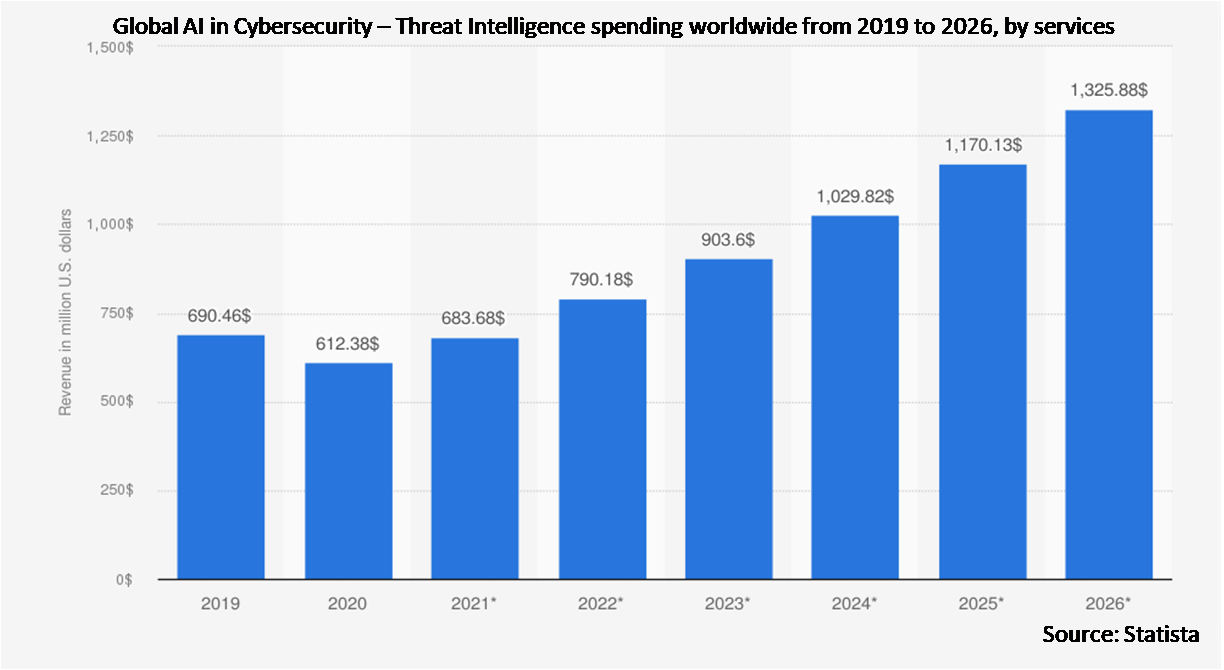
According to Stratistics MRC, the Global AI in Cybersecurity – Threat Intelligence Market is accounted for $20.46 billion in 2025 and is expected to reach $92.22 billion by 2032 growing at a CAGR of 24% during the forecast period. Artificial Intelligence in Cybersecurity: Threat Intelligence is the use of AI to detect, evaluate, and neutralise online threats instantly. To identify irregularities, anticipate attacks, and automate reactions, it makes use of machine learning, natural language processing, and data analytics. AI improves situational awareness and decision-making by digesting massive volumes of threat data from various sources. By spotting trends in ransomware, phishing, and malware activity, it makes proactive defence tactics possible. This clever automation strengthens an organization's entire cybersecurity posture by greatly increasing threat detection speed, accuracy, and response time.
Market Dynamics:
Driver:
Rising sophistication of cyber-attacks
Advanced threats like as AI-driven malware and zero-day exploits necessitate quicker and more intelligent detection methods. Real-time detection of intricate attack patterns is frequently a challenge for traditional security solutions. By automating data processing and quickly identifying abnormalities, AI improves threat intelligence. It enables proactive defence by foreseeing and removing threats before damage is done. The industry is growing as a result of organisations depending more and more on AI-powered solutions to stay ahead of hackers.
Restraint:
Data privacy & regulatory risk
Access to the vast datasets required to train AI models is restricted by stringent data privacy regulations such as the CCPA and GDPR. When gathering or disseminating threat intelligence internationally, organisations frequently encounter compliance issues. These legal restrictions may hinder the uptake of AI and reduce its capacity to detect threats in real time. Investment in cutting-edge AI-driven cybersecurity tools is also deterred by regulatory uncertainty. Additionally, businesses are reluctant to fully utilise AI capabilities due to a concern of non-compliance penalties.
Opportunity:
Automation and predictive analytics
Real-time monitoring and quick analysis of massive amounts of data are made possible via automation and predictive analytics. Automated technologies simplify everyday security chores and minimise human mistake. By spotting trends and abnormalities before they become more serious, predictive analytics foresees possible hazards. Instead of only responding to breaches, this proactive strategy assists organisations in preventing them. Consequently, by lowering operating expenses and enhancing security results, these technologies propel market expansion.
Threat:
Rapid attacker evolution
Rapid attacker evolution refers to the real-time adaptability of AI models. Machine learning algorithms are less successful against novel, invisible dangers since they frequently rely on prior data. The use of AI by cybercriminals is growing, leading to increasingly complex and elusive attacks. This increases the complexity and operational expenses by necessitating frequent model upgrades and retraining. As a result, security firms have ongoing challenges in maintaining effective threat detection.
Covid-19 Impact
The COVID-19 pandemic significantly accelerated the adoption of AI in the cybersecurity – threat intelligence market. As remote work became the norm, organizations faced a surge in cyber threats and data breaches, prompting an urgent need for intelligent, automated security solutions. AI-powered threat detection systems helped companies quickly identify and respond to new and evolving cyber risks. Additionally, limited human intervention during lockdowns emphasized the value of machine learning in monitoring vast digital environments. Overall, the crisis reshaped cybersecurity strategies, positioning AI as a crucial component of defense mechanisms.
The network security segment is expected to be the largest during the forecast period
The network security segment is expected to account for the largest market share during the forecast period by enabling real-time threat detection across complex IT infrastructures. AI-powered tools analyze vast volumes of network traffic to identify anomalies and malicious patterns swiftly. This proactive approach helps organizations prevent breaches before they occur. The growing sophistication of cyberattacks has intensified the demand for AI-driven network defense solutions. As enterprises expand their digital presence, securing networks through intelligent automation becomes essential, boosting market growth.
The anomaly detection segment is expected to have the highest CAGR during the forecast period
Over the forecast period, the anomaly detection segment is predicted to witness the highest growth rate by enabling early identification of suspicious patterns. It helps in detecting zero-day attacks and insider threats that traditional methods often miss. Real-time analysis of network traffic enhances proactive threat mitigation. AI-driven anomaly detection reduces false positives, improving incident response efficiency. Its continuous learning capability strengthens adaptive security frameworks across enterprises.
Region with largest share:
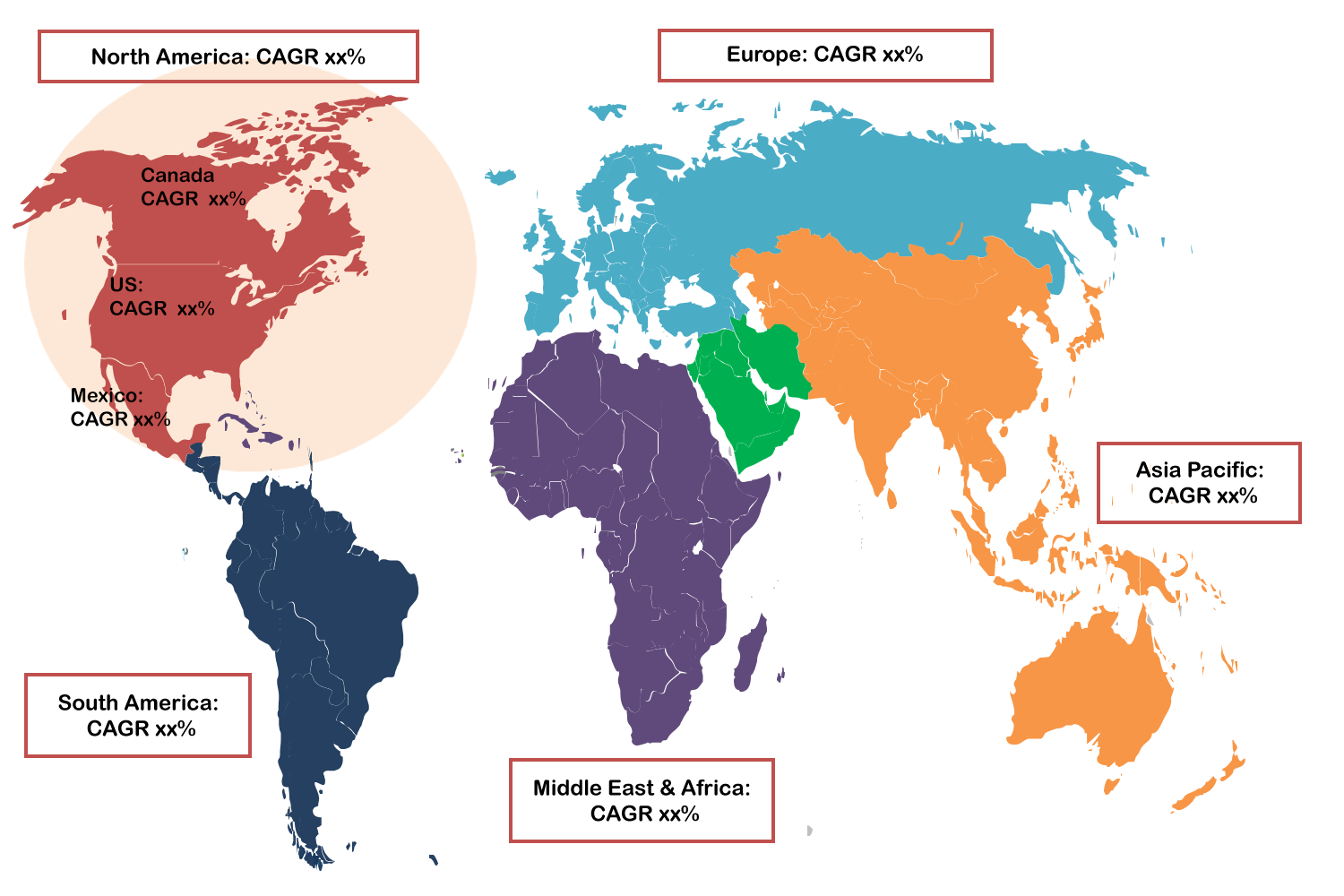
During the forecast period, the Asia Pacific region is expected to hold the largest market share due to the increasing digitization across sectors and rising cyberattacks on critical infrastructure. Countries like China, India, Japan, and South Korea are investing heavily in AI-based cybersecurity tools to protect financial services, government networks, and e-commerce platforms. This demand is further fuelled by rising cloud use and smartphone prevalence. Regional governments are also implementing stricter data protection laws, encouraging enterprises to deploy predictive threat detection and automated response systems, thereby fostering innovation in cybersecurity defense strategies.
Region with highest CAGR:
Over the forecast period, the North America region is anticipated to exhibit the highest CAGR, owing to advanced IT infrastructure and the presence of major tech companies. The U.S. leads in developing and deploying AI algorithms that identify, predict, and neutralize cyber threats in real-time. High cybercrime rates targeting banking, healthcare, and defense sectors push demand for AI-powered threat intelligence platforms. Additionally, rising investments in R&D and strategic partnerships among cybersecurity firms enhance threat detection capabilities. Strong regulatory frameworks like CISA and HIPAA further drive adoption of AI to secure digital ecosystems efficiently.
Key players in the market
Some of the key players profiled in the AI in Cybersecurity – Threat Intelligence Market include Palo Alto Networks, CrowdStrike, Fortinet, Darktrace, SentinelOne, Vectra AI, Wiz, Orca Security, Netskope, Check Point, Trellix, Tanium, Trend Micro, Splunk, Deep Instinct, Cybereason, SparkCognition and Armis.
Key Developments:
In April 2025, CrowdStrike entered a strategic partnership with Wipro to integrate its Falcon Next?Gen SIEM and threat intelligence into Wipro's cybersecurity services. This alliance aims to enhance global enterprise Security Operations Centers (SOCs) using AI-powered analytics and automation, streamlining threat detection, response workflows, and reducing operational complexity.
In March 2025, Palo Alto Networks signed a multiyear agreement with the NHL to be its Official Cybersecurity Partner. They'll deploy AI-powered next-gen firewalls, cloud and browser security to protect league operations and fan experiences across arenas ? boosting IoT threat blocking and reducing MTTR.
In October 2024, Fortinet and CrowdStrike integrated Falcon’s AI-native endpoint detection with FortiGate firewalls, creating a unified AI-powered threat intelligence platform that enhances attack surface visibility, automates threat response, and streamlines detection-to-remediation across hybrid and cloud network environments.
Components Covered:
• Solutions
• Services
Security Types Covered:
• Network Security
• Endpoint Security
• Application Security
• Cloud Security
• Web Security
• Other Security Types
Deployment Modes Covered:
• Cloud-based
• On-premises
Technologies Covered:
• Machine Learning (ML)
• Natural Language Processing (NLP)
• Context-Aware Computing
• Advanced Analytics
• Other Technologies
Applications Covered:
• Threat Intelligence
• Anomaly Detection
• Intrusion Detection and Prevention
• Identity and Access Management
• Risk and Compliance Management
• Other Applications
End Users Covered:
• Government and Defense
• IT and Telecom
• Healthcare
• Manufacturing
• Retail
• Energy and Utilities
• Education
• Transportation and Logistics
• Other End Users
Regions Covered:
• North America
o US
o Canada
o Mexico
• Europe
o Germany
o UK
o Italy
o France
o Spain
o Rest of Europe
• Asia Pacific
o Japan
o China
o India
o Australia
o New Zealand
o South Korea
o Rest of Asia Pacific
• South America
o Argentina
o Brazil
o Chile
o Rest of South America
• Middle East & Africa
o Saudi Arabia
o UAE
o Qatar
o South Africa
o Rest of Middle East & Africa
What our report offers:
- Market share assessments for the regional and country-level segments
- Strategic recommendations for the new entrants
- Covers Market data for the years 2024, 2025, 2026, 2028, and 2032
- Market Trends (Drivers, Constraints, Opportunities, Threats, Challenges, Investment Opportunities, and recommendations)
- Strategic recommendations in key business segments based on the market estimations
- Competitive landscaping mapping the key common trends
- Company profiling with detailed strategies, financials, and recent developments
- Supply chain trends mapping the latest technological advancements
Free Customization Offerings:
All the customers of this report will be entitled to receive one of the following free customization options:
• Company Profiling
o Comprehensive profiling of additional market players (up to 3)
o SWOT Analysis of key players (up to 3)
• Regional Segmentation
o Market estimations, Forecasts and CAGR of any prominent country as per the client's interest (Note: Depends on feasibility check)
• Competitive Benchmarking
o Benchmarking of key players based on product portfolio, geographical presence, and strategic alliances
Table of Contents
1 Executive Summary
2 Preface
2.1 Abstract
2.2 Stake Holders
2.3 Research Scope
2.4 Research Methodology
2.4.1 Data Mining
2.4.2 Data Analysis
2.4.3 Data Validation
2.4.4 Research Approach
2.5 Research Sources
2.5.1 Primary Research Sources
2.5.2 Secondary Research Sources
2.5.3 Assumptions
3 Market Trend Analysis
3.1 Introduction
3.2 Drivers
3.3 Restraints
3.4 Opportunities
3.5 Threats
3.6 Technology Analysis
3.7 Application Analysis
3.8 End User Analysis
3.9 Emerging Markets
3.10 Impact of Covid-19
4 Porters Five Force Analysis
4.1 Bargaining power of suppliers
4.2 Bargaining power of buyers
4.3 Threat of substitutes
4.4 Threat of new entrants
4.5 Competitive rivalry
5 Global AI in Cybersecurity – Threat Intelligence Market, By Component
5.1 Introduction
5.2 Solutions
5.3 Services
6 Global AI in Cybersecurity – Threat Intelligence Market, By Security Type
6.1 Introduction
6.2 Network Security
6.3 Endpoint Security
6.4 Application Security
6.5 Cloud Security
6.6 Web Security
6.7 Other Security Types
7 Global AI in Cybersecurity – Threat Intelligence Market, By Deployment Mode
7.1 Introduction
7.2 Cloud-based
7.3 On-premises
8 Global AI in Cybersecurity – Threat Intelligence Market, By Technology
8.1 Introduction
8.2 Machine Learning (ML)
8.3 Natural Language Processing (NLP)
8.4 Context-Aware Computing
8.5 Advanced Analytics
8.6 Other Technologies
9 Global AI in Cybersecurity – Threat Intelligence Market, By Application
9.1 Introduction
9.2 Threat Intelligence
9.3 Anomaly Detection
9.4 Intrusion Detection and Prevention
9.5 Identity and Access Management
9.6 Risk and Compliance Management
9.7 Other Applications
10 Global AI in Cybersecurity – Threat Intelligence Market, By End User
10.1 Introduction
10.2 Government and Defense
10.3 IT and Telecom
10.4 Healthcare
10.5 Manufacturing
10.6 Retail
10.7 Energy and Utilities
10.8 Education
10.9 Transportation and Logistics
10.10 Other End Users
11 Global AI in Cybersecurity – Threat Intelligence Market, By Geography
11.1 Introduction
11.2 North America
11.2.1 US
11.2.2 Canada
11.2.3 Mexico
11.3 Europe
11.3.1 Germany
11.3.2 UK
11.3.3 Italy
11.3.4 France
11.3.5 Spain
11.3.6 Rest of Europe
11.4 Asia Pacific
11.4.1 Japan
11.4.2 China
11.4.3 India
11.4.4 Australia
11.4.5 New Zealand
11.4.6 South Korea
11.4.7 Rest of Asia Pacific
11.5 South America
11.5.1 Argentina
11.5.2 Brazil
11.5.3 Chile
11.5.4 Rest of South America
11.6 Middle East & Africa
11.6.1 Saudi Arabia
11.6.2 UAE
11.6.3 Qatar
11.6.4 South Africa
11.6.5 Rest of Middle East & Africa
12 Key Developments
12.1 Agreements, Partnerships, Collaborations and Joint Ventures
12.2 Acquisitions & Mergers
12.3 New Product Launch
12.4 Expansions
12.5 Other Key Strategies
13 Company Profiling
13.1 Palo Alto Networks
13.2 CrowdStrike
13.3 Fortinet
13.4 Darktrace
13.5 SentinelOne
13.6 Vectra AI
13.7 Wiz
13.8 Orca Security
13.9 Netskope
13.10 Check Point
13.11 Trellix
13.12 Tanium
13.13 Trend Micro
13.14 Splunk
13.15 Deep Instinct
13.16 Cybereason
13.17 SparkCognition
13.18 Armis
List of Tables
1 Global AI in Cybersecurity – Threat Intelligence Market Outlook, By Region (2024-2032) ($MN)
2 Global AI in Cybersecurity – Threat Intelligence Market Outlook, By Component (2024-2032) ($MN)
3 Global AI in Cybersecurity – Threat Intelligence Market Outlook, By Solutions (2024-2032) ($MN)
4 Global AI in Cybersecurity – Threat Intelligence Market Outlook, By Services (2024-2032) ($MN)
5 Global AI in Cybersecurity – Threat Intelligence Market Outlook, By Security Type (2024-2032) ($MN)
6 Global AI in Cybersecurity – Threat Intelligence Market Outlook, By Network Security (2024-2032) ($MN)
7 Global AI in Cybersecurity – Threat Intelligence Market Outlook, By Endpoint Security (2024-2032) ($MN)
8 Global AI in Cybersecurity – Threat Intelligence Market Outlook, By Application Security (2024-2032) ($MN)
9 Global AI in Cybersecurity – Threat Intelligence Market Outlook, By Cloud Security (2024-2032) ($MN)
10 Global AI in Cybersecurity – Threat Intelligence Market Outlook, By Web Security (2024-2032) ($MN)
11 Global AI in Cybersecurity – Threat Intelligence Market Outlook, By Other Security Types (2024-2032) ($MN)
12 Global AI in Cybersecurity – Threat Intelligence Market Outlook, By Deployment Mode (2024-2032) ($MN)
13 Global AI in Cybersecurity – Threat Intelligence Market Outlook, By Cloud-based (2024-2032) ($MN)
14 Global AI in Cybersecurity – Threat Intelligence Market Outlook, By On-premises (2024-2032) ($MN)
15 Global AI in Cybersecurity – Threat Intelligence Market Outlook, By Technology (2024-2032) ($MN)
16 Global AI in Cybersecurity – Threat Intelligence Market Outlook, By Machine Learning (ML) (2024-2032) ($MN)
17 Global AI in Cybersecurity – Threat Intelligence Market Outlook, By Natural Language Processing (NLP) (2024-2032) ($MN)
18 Global AI in Cybersecurity – Threat Intelligence Market Outlook, By Context-Aware Computing (2024-2032) ($MN)
19 Global AI in Cybersecurity – Threat Intelligence Market Outlook, By Advanced Analytics (2024-2032) ($MN)
20 Global AI in Cybersecurity – Threat Intelligence Market Outlook, By Other Technologies (2024-2032) ($MN)
21 Global AI in Cybersecurity – Threat Intelligence Market Outlook, By Application (2024-2032) ($MN)
22 Global AI in Cybersecurity – Threat Intelligence Market Outlook, By Threat Intelligence (2024-2032) ($MN)
23 Global AI in Cybersecurity – Threat Intelligence Market Outlook, By Anomaly Detection (2024-2032) ($MN)
24 Global AI in Cybersecurity – Threat Intelligence Market Outlook, By Intrusion Detection and Prevention (2024-2032) ($MN)
25 Global AI in Cybersecurity – Threat Intelligence Market Outlook, By Identity and Access Management (2024-2032) ($MN)
26 Global AI in Cybersecurity – Threat Intelligence Market Outlook, By Risk and Compliance Management (2024-2032) ($MN)
27 Global AI in Cybersecurity – Threat Intelligence Market Outlook, By Other Applications (2024-2032) ($MN)
28 Global AI in Cybersecurity – Threat Intelligence Market Outlook, By End User (2024-2032) ($MN)
29 Global AI in Cybersecurity – Threat Intelligence Market Outlook, By Government and Defense (2024-2032) ($MN)
30 Global AI in Cybersecurity – Threat Intelligence Market Outlook, By IT and Telecom (2024-2032) ($MN)
31 Global AI in Cybersecurity – Threat Intelligence Market Outlook, By Healthcare (2024-2032) ($MN)
32 Global AI in Cybersecurity – Threat Intelligence Market Outlook, By Manufacturing (2024-2032) ($MN)
33 Global AI in Cybersecurity – Threat Intelligence Market Outlook, By Retail (2024-2032) ($MN)
34 Global AI in Cybersecurity – Threat Intelligence Market Outlook, By Energy and Utilities (2024-2032) ($MN)
35 Global AI in Cybersecurity – Threat Intelligence Market Outlook, By Education (2024-2032) ($MN)
36 Global AI in Cybersecurity – Threat Intelligence Market Outlook, By Transportation and Logistics (2024-2032) ($MN)
37 Global AI in Cybersecurity – Threat Intelligence Market Outlook, By Other End Users (2024-2032) ($MN)
Note: Tables for North America, Europe, APAC, South America, and Middle East & Africa Regions are also represented in the same manner as above.
List of Figures
RESEARCH METHODOLOGY

We at ‘Stratistics’ opt for an extensive research approach which involves data mining, data validation, and data analysis. The various research sources include in-house repository, secondary research, competitor’s sources, social media research, client internal data, and primary research.
Our team of analysts prefers the most reliable and authenticated data sources in order to perform the comprehensive literature search. With access to most of the authenticated data bases our team highly considers the best mix of information through various sources to obtain extensive and accurate analysis.
Each report takes an average time of a month and a team of 4 industry analysts. The time may vary depending on the scope and data availability of the desired market report. The various parameters used in the market assessment are standardized in order to enhance the data accuracy.
Data Mining
The data is collected from several authenticated, reliable, paid and unpaid sources and is filtered depending on the scope & objective of the research. Our reports repository acts as an added advantage in this procedure. Data gathering from the raw material suppliers, distributors and the manufacturers is performed on a regular basis, this helps in the comprehensive understanding of the products value chain. Apart from the above mentioned sources the data is also collected from the industry consultants to ensure the objective of the study is in the right direction.
Market trends such as technological advancements, regulatory affairs, market dynamics (Drivers, Restraints, Opportunities and Challenges) are obtained from scientific journals, market related national & international associations and organizations.
Data Analysis
From the data that is collected depending on the scope & objective of the research the data is subjected for the analysis. The critical steps that we follow for the data analysis include:
- Product Lifecycle Analysis
- Competitor analysis
- Risk analysis
- Porters Analysis
- PESTEL Analysis
- SWOT Analysis
The data engineering is performed by the core industry experts considering both the Marketing Mix Modeling and the Demand Forecasting. The marketing mix modeling makes use of multiple-regression techniques to predict the optimal mix of marketing variables. Regression factor is based on a number of variables and how they relate to an outcome such as sales or profits.
Data Validation
The data validation is performed by the exhaustive primary research from the expert interviews. This includes telephonic interviews, focus groups, face to face interviews, and questionnaires to validate our research from all aspects. The industry experts we approach come from the leading firms, involved in the supply chain ranging from the suppliers, distributors to the manufacturers and consumers so as to ensure an unbiased analysis.
We are in touch with more than 15,000 industry experts with the right mix of consultants, CEO's, presidents, vice presidents, managers, experts from both supply side and demand side, executives and so on.
The data validation involves the primary research from the industry experts belonging to:
- Leading Companies
- Suppliers & Distributors
- Manufacturers
- Consumers
- Industry/Strategic Consultants
Apart from the data validation the primary research also helps in performing the fill gap research, i.e. providing solutions for the unmet needs of the research which helps in enhancing the reports quality.
For more details about research methodology, kindly write to us at info@strategymrc.com
Frequently Asked Questions
In case of any queries regarding this report, you can contact the customer service by filing the “Inquiry Before Buy” form available on the right hand side. You may also contact us through email: info@strategymrc.com or phone: +1-301-202-5929
Yes, the samples are available for all the published reports. You can request them by filling the “Request Sample” option available in this page.
Yes, you can request a sample with your specific requirements. All the customized samples will be provided as per the requirement with the real data masked.
All our reports are available in Digital PDF format. In case if you require them in any other formats, such as PPT, Excel etc you can submit a request through “Inquiry Before Buy” form available on the right hand side. You may also contact us through email: info@strategymrc.com or phone: +1-301-202-5929
We offer a free 15% customization with every purchase. This requirement can be fulfilled for both pre and post sale. You may send your customization requirements through email at info@strategymrc.com or call us on +1-301-202-5929.
We have 3 different licensing options available in electronic format.
- Single User Licence: Allows one person, typically the buyer, to have access to the ordered product. The ordered product cannot be distributed to anyone else.
- 2-5 User Licence: Allows the ordered product to be shared among a maximum of 5 people within your organisation.
- Corporate License: Allows the product to be shared among all employees of your organisation regardless of their geographical location.
All our reports are typically be emailed to you as an attachment.
To order any available report you need to register on our website. The payment can be made either through CCAvenue or PayPal payments gateways which accept all international cards.
We extend our support to 6 months post sale. A post sale customization is also provided to cover your unmet needs in the report.
Request Customization
We offer complimentary customization of up to 15% with every purchase. To share your customization requirements, feel free to email us at info@strategymrc.com or call us on +1-301-202-5929. .
Please Note: Customization within the 15% threshold is entirely free of charge. If your request exceeds this limit, we will conduct a feasibility assessment. Following that, a detailed quote and timeline will be provided.
WHY CHOOSE US ?

Assured Quality
Best in class reports with high standard of research integrity

24X7 Research Support
Continuous support to ensure the best customer experience.

Free Customization
Adding more values to your product of interest.

Safe & Secure Access
Providing a secured environment for all online transactions.

Trusted by 600+ Brands
Serving the most reputed brands across the world.
